đŸ›ī¸ Licensed & Registered — Trade Licence 134585 (Ajman) 🕒 Open Daily 8:00 AM – 6:00 PM 📞 +971 50 988 6591
🚰 Not Filling With Water

Dishwasher Not Filling With Water in Dubai — We Follow the Supply Backwards

A machine that takes no water is far more often starved than broken. The isolating tap, the hose behind the cabinet and the silted mesh screen at the inlet union all come before anyone talks about a valve.

⚡ Same-Day Visits đŸ›Ąī¸ 90-Day Warranty 💲 Quote Before Any Work đŸ›ī¸ Licence No. 134585
â„šī¸

We are an independent repair company — not an authorized service center of any dishwasher brand. Brand names on this page identify only the machines we repair, and all trademarks remain the property of their owners.

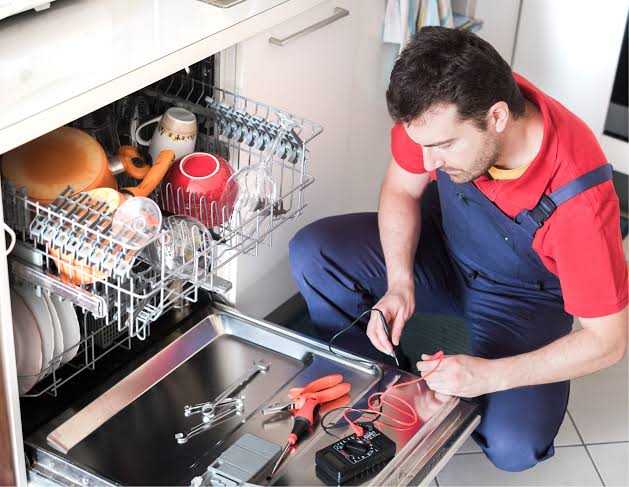
Technician probing the two terminals of a dishwasher inlet valve solenoid with a multimeter to read coil resistance
Start at the Tap, Not the Part

A Dishwasher That Will Not Fill Is Usually Starved, Not Faulty

A dishwasher not filling with water in Dubai ends at a closed tap more often than at a failed component. So before a meter comes out of the bag, we follow the water backwards from the machine to the wall. Every cheap answer lives somewhere along that short route, and each one is ruled in or out by looking rather than by buying.

It helps to know what the machine can and cannot sense. A dishwasher does not pull water in. It opens a valve and lets mains pressure do the pushing, then counts what turns up — by float height, by pressure switch, or on many recent models by a small turbine flow meter clicking off pulses. When the count fails to reach target inside the window the program allows, the cycle halts and a fill fault is displayed. The machine has no way of knowing whether the water was stopped at the tap, the hose, the screen or the valve. Separating those is the whole job.

The most frequent finding by a wide margin is the isolating tap beneath the sink. It sits behind the trap and a row of bottles, and it gets shut for reasons that had nothing to do with the dishwasher: a mixer cartridge changed, a drinking-water filter fitted, a night-time leak chased at the stopcock. Whoever closed it reopened it a quarter turn, or forgot it entirely, and the machine has been living on a trickle ever since.

Second comes the hose behind the cabinet. Freestanding machines get dragged out for a clean and shoved back hard, and the hose finishes up folded against the skirting or pinched under a rear foot. Integrated machines take the same damage during kitchen work, when the plinth goes back on and nobody looks behind it again.

Third, and this is the one that belongs to this city, is the fine mesh screen inside the inlet union — the gauze washer sitting where the hose threads onto the valve body. It is there to keep grit off the valve seat, and it does that faithfully until it is full. In Dubai, what fills it is tank sediment.

That deserves stating plainly, because the trade here usually says the opposite. The water is not hard. Almost all of it is desalinated and only lightly re-mineralised afterwards, so the screen is not choking on limescale. It is choking on loose material: fine sand, flakes of rust off an older riser, and silt lifted from the base of a storage tank.

One correction that follows from that, since customers ask it constantly: the mineral content of the supply does not change from one Dubai neighbourhood to another. What changes is the plumbing between the main and your kitchen. A villa with its own tank, a tower with a shared roof tank and a booster set, and an older building with steel risers all deliver visibly different amounts of loose matter to the same appliance. So we ask about the building rather than the district, and about when the tank was last serviced rather than about hardness.

Dubai Municipality requires residential water tanks to be cleaned at least twice a year. In a villa that duty sits with the owner; in a tower it runs through the building team on a maintenance schedule. When either one slips — and it does slip — the settled layer at the bottom gets stirred by the next pressure surge and travels down with the supply. Your dishwasher inlet screen is one of the finest filters in the property, so that is where the material comes to rest.

Ranked by Cost

Six Places the Water Stops, Cheapest First

Worked in this order every time, and the visit ends at whichever one explains the symptom.

🚰

The Tap Under the Sink

Closed during unrelated plumbing work and reopened a fraction, or never reopened. Free to check, and the answer more often than any part on this list.

đŸĒĸ

The Hose Behind the Cabinet

Folded flat against the wall, trapped under a rear foot, or bent to a radius tighter than the reinforcement allows. A crush that closes only under pressure looks perfectly normal at rest.

đŸ§ŋ

The Inlet Mesh Screen

The gauze washer at the union, packed with tank sediment rather than scale. Slows the fill long before it stops it, which is why it is misread as a dying valve.

📉

Building Supply Pressure

Dishwashers specify a minimum working pressure. A booster running to a schedule, or a pressure reducer drifting out of adjustment, produces a fault that comes and goes by the hour.

🛟

The Anti-Flood Float

Once water reaches the base tray the float latches and fill is locked out deliberately. The machine is protecting your kitchen, not failing. Find the leak or the foam first.

⚡

Valve Coil, Then Board

Coil resistance measured with the plug off, then confirmation the board actually energises it during fill. Only after both does anything get condemned.

Dishwasher supply union opened on the bench so the silted inlet mesh screen can be lifted out and inspected against the light
The Distinction Most Pages Miss

No Water At All and Slow Water Are Two Different Faults

Almost everything written about this symptom lumps the two together. They belong apart, because they point in opposite directions and the wrong assumption is what puts an unnecessary valve on the invoice.

No fill at all means silence right through the period when water should be arriving. Either the supply has been cut off entirely or the valve is never being opened. Candidates: a tap shut hard, a hose crushed closed, a coil reading open circuit, an anti-flood tray already latched, or a board that is not sending drive to the valve.

Slow fill sounds completely different. You can hear water — a thin hiss, or bursts that never build into a proper rush — and the machine either runs noticeably long or throws its fault several minutes in, sometimes halfway through the program. That is restriction, not absence. Candidates: a screen silted with sediment, a tap open only a crack, pressure sagging when the whole building showers at once, a safety hose partly closed, or grit sitting on the valve seat so it lifts only part way.

You can place your own machine in one group or the other without touching anything. Start the shortest program in a quiet kitchen and listen. Silence throughout is one fault. A trickle you can hear but that never turns into a surge is the other. Telling us which you have on the phone genuinely shortens the visit.

The two groups also age differently, and that history is worth telling us. Slow filling almost always creeps up: cycles that used to finish on time start overrunning, then one day the machine gives up partway. A total stop tends to arrive with no warning and usually just after something else happened in the kitchen — a plumber called out, an appliance swapped, a spill mopped from under the unit. Sudden onset points to an event. Gradual decline points to something quietly silting up.

One further pattern gets filed under fill problems and does not belong there: water arrives normally, then disappears, and the machine reports it never filled. That is siphoning down the waste, caused by a drain hose that lost its high loop or an outlet spigot sitting too low. The fill side is innocent, and we would say so.

Some of what gets reported is not a fault at all. Current machines are frugal — a full cycle may use only nine to twelve litres, delivered in several short fills rather than one long one, so there is far less noise than people expect. Many programs also pump out for the first half minute or so before admitting any water, and soil-sensing programs pause while they read the load. A quiet opening minute is normal behaviour, not a symptom.

What To Expect

How a Fill Fault Visit Actually Runs

Fixed order, cheapest first, and it stops at whatever explains what you described.

1. What you heard

Silence, a hiss, or water that came and went. Which of those you report decides which half of the fault tree we open first, along with any code on the display.

2. Tap and hose proved

Isolating tap opened fully and confirmed to flow, then the hose traced end to end for folds, crush marks and a bend radius tighter than the braiding tolerates.

3. Pressure and delivery

Flow measured at the supply into a timed container, so we know whether the machine is being fed properly or is fighting the building. Weak here means the fault is upstream of the appliance.

4. Inlet screen inspected

Tap closed, union broken under control, gauze washer lifted and held to the light. Sediment is obvious the moment it is out, and the screen is cleaned or renewed.

5. Float, coil and drive

Base tray checked for water and the float freed if it has latched, coil resistance read with the connector off, then confirmation the board energises the valve when the program calls for fill.

6. Quote, then work

Fault named, fix explained and price agreed before a component is fitted. If opening a tap or clearing a screen restored it, that is what the invoice says.

Straight Answers

When the Inlet Valve Really Is the Part

And the longer list of findings that mean the valve is being blamed for something upstream.

A genuine valve replacement

  • Coil reads open circuit across the terminals with the connector removed
  • Valve energised correctly by the board and still admitting nothing
  • Valve passing water continuously with the machine switched off, which is a seat that will not close
  • Body cracked or weeping at the solenoid, common where a union has been over-tightened
  • Flow through the valve still poor on a proven supply and a clean screen
  • Integral safety hose triggered and locked, where valve and hose are supplied as one assembly

An inlet valve is one of the less expensive parts in a dishwasher and on most models a contained job. What decides the recommendation is the condition of everything around it, and we set that out rather than leaving you to find out later.

Look upstream first

  • Fill got worse gradually over weeks — that pattern belongs to a silting screen
  • Fault appears at certain times of day only — building pressure, not the appliance
  • Machine has just been moved, or a kitchen fitter has been behind it
  • Water in the base tray with the float lifted, so fill is locked out by design
  • Recent plumbing anywhere in the property, however unrelated it seemed
  • Water arrives and drains straight out — a waste siphon, not a fill fault

Cabinet Decision 66/2023 sets a statutory minimum warranty of fifteen days on repair work in the UAE, together with a documented estimate, your consent before work starts and an itemised invoice afterwards. Ours runs to ninety days. If your dishwasher is still covered by its original manufacturer warranty, call the brand before you call us.

Related Pages

More Dishwasher Repair Help

Back to the main dishwasher page, or across to the fault that sits next to this one.

Showing a code rather than just a symptom? Start here. Decode Your Error Code →

đŸŊī¸

Main Service Page

The full dishwasher service — freestanding, built-in and fully integrated machines.

Dishwasher Repair & Service →

🔩

Inlet Valve Replacement

What happens when the supply is proved good and the valve itself is the failure.

Inlet Valve Replacement →

🔌

Dishwasher Not Starting

Nothing happens at all — door latch, power and program selection checked in order.

Not Starting →

đŸ’Ļ

Dishwasher Leaking Water

The leak that latched your anti-flood float and locked the fill out in the first place.

Leaking Water →

🔧

Bosch Dishwasher Repair

Fill-related codes read off the machine rather than guessed from a forum thread.

Bosch Repair →

📍

Palm Jumeirah

Villa and apartment tank arrangements differ, and that changes what reaches your inlet screen.

Palm Jumeirah →

FAQ

Dishwasher Not Filling — Your Questions

The machine is completely silent when it should be filling. What gets checked first?

The isolating tap under the sink, every time, because looking costs nothing and it is the most frequent finding of all. It usually hides behind the waste trap and the cleaning bottles, and it gets closed during work that had nothing to do with the dishwasher, then reopened a fraction of a turn or not at all. After that the supply hose is followed to the wall for a fold or a crush point under a rear foot. Only once water is proven to reach the machine do the screen, the float and the coil come into it.

What is the difference between a machine that will not fill and one that fills too slowly?

They are separate faults with separate causes, and treating them as one symptom is why valves get replaced needlessly. A machine taking no water at all has either lost its supply completely or is never being told to open: closed tap, flattened hose, latched anti-flood tray, open-circuit coil, or no drive arriving from the board. A machine that fills slowly and then times out has a restriction rather than an absence, and that is usually the silted mesh screen at the inlet union, a tap barely cracked open, or building pressure sagging at peak hours.

Why would the inlet screen block here if Dubai water is not hard?

Because what blocks it is sediment, not scale. The supply here is overwhelmingly desalinated and only modestly re-mineralised, so the hard water story repeated across the trade is marketing rather than measurement. What does travel down the risers is loose grit: fine sand, rust flake off older pipework, silt lifted from the floor of a storage tank. Municipal rules require residential tanks to be cleaned at least twice a year, and when that schedule slips the disturbed layer reaches the finest filter in the home, which is the gauze washer at your dishwasher inlet.

Can I take the hose off and clean the inlet screen myself?

We would rather you did not, and we never ask customers to. Undoing that union means opening a joint sitting at mains pressure, the gauze tears easily once it is dry and packed solid, and a safety hose with an integral shut-off can latch closed for good if it is disturbed. A weeping union hidden behind a fitted kitchen is a far worse outcome than a slow fill. What is completely fine for you to do is confirm the tap is fully open and look for an obvious kink behind the machine.

There is a fill error on the display but water is sitting in the base. Why?

That is usually the anti-flood system doing exactly what it was built to do. Most machines carry a shallow tray beneath the tub with a float riding in it. If water ever reaches that tray the float lifts, the fill valve is locked out, and no further water is admitted until the tray is dried and the source is found. Hand washing-up liquid poured in by mistake makes enough foam to trip the same protection. The fault worth chasing is the leak or the foaming, not the valve behind it.

How long does this take, and what warranty do I get?

Most fill faults are diagnosed and settled inside a single visit, since the checks run in a fixed order and stop at the first thing that explains the symptom. Ninety days on parts and labour covers whatever we fit. For context, Cabinet Decision 66/2023 sets a fifteen-day statutory minimum on repair work in the UAE and obliges the repairer to give a documented estimate, take your consent before starting, and issue an itemised invoice. Ask any repairer for all three. If the machine is still inside its manufacturer warranty, call the brand first.

No Water Going In? Let Us Follow the Supply.

Tap, hose, inlet screen and pressure proved before a valve is quoted, and the fault named before anything is fitted. Price agreed with you first.

Book a Fill Fault Diagnosis

Tell Us What You Hear in the First Two Minutes

Total silence, a thin hiss that never builds, water that arrives then drains straight out, or an error thrown ten minutes in. Each version points somewhere different.

📞 Phone

+971 50 988 6591
Daily, 8:00 AM – 6:00 PM

đŸ’Ŧ WhatsApp

+971 50 988 6591
Send a photo of the tap under your sink and any error on the display

âœ‰ī¸ Email

info@fixmyacdubai.ae

Request a Fill Fault Diagnosis

Opens WhatsApp with your request pre-filled — nothing is stored on this site.

Your details go directly to our team on WhatsApp. See our Privacy Policy.

Call Now+971 50 988 6591 WhatsAppInstant chat reply