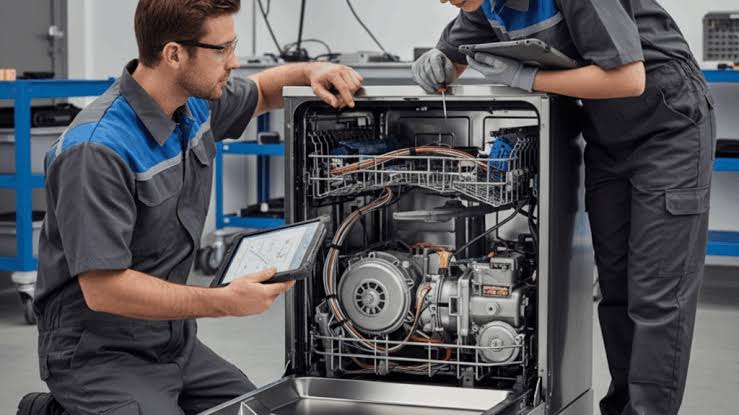
A code tells you which part of the machine raised its hand. It does not tell you which component failed, and reading it as a verdict is how the wrong part ends up fitted and paid for. Below are the codes we could check against each manufacturer UAE site, and an equally plain list of the brands where we could not.
We are an independent repair company β not an authorized service center of any dishwasher brand. Brand names on this page identify only the machines we repair, and all trademarks remain the property of their owners.

Dishwasher error codes in Dubai reach you in whichever way your machine was built to speak. A model with a digit display shows something like E15 or 4C outright. A model with nothing but programme lights blinks one of them in a repeating pattern, and that pattern is the code. Plenty of integrated machines carry the display on the top edge of the door, so you see nothing until you open it. Newer connected models push the same fault to a phone app, occasionally in friendlier wording than the panel itself uses.
Behind every one of those formats sits the same mechanism. The control board runs your programme against a short list of expectations: water in by a certain moment, level reached, temperature climbing at a certain rate, sump emptied inside a set window. Each expectation has a sensor attached to it. When a reading fails to arrive, or arrives outside its window, the board halts the programme and latches the code that belongs to that expectation.
The consequence matters more than the code does. What gets stored is the name of the subsystem that reported, not the name of the part that broke. Take a drainage code. All the machine knows is that the water level did not fall in time. The filter could be packed with grease, the pump impeller could be jammed on a fruit sticker, the drain hose could be crushed behind a plinth, the pump winding could be open, the level sensor could be lying, or the output driving the pump could have stopped switching. That is six suspects wearing one number, and only one of them costs anything to fix.
This is where money goes missing. Somebody reads the code, matches it to a part in their head, orders the part, fits it, and the code comes back on the second cycle because the actual fault was never touched. The customer has now paid for a component the machine did not need and still owns the original problem. We see this most often with drain pumps, heating elements and control boards, which happen to be the three most expensive things a code can be made to point at.
It is also worth saying plainly that several codes are not faults at all. LG stores CL for a control lock somebody switched on and PF for a power failure the building had. Samsung stores bC2 when a button has been held down for more than thirty seconds, which is usually a stuck key or a child leaning on the panel. None of those needs a technician, a part, or a payment. A code table that does not tell you which entries are harmless is doing half a job.
One last note on why this page exists in the shape it does. As far as we can find, no repair company serving this market publishes a dishwasher code table at all; the pages that surface for these searches tend to be booking forms with the word error in the heading. So we built one, and we built it under a rule: publish only what we could read on the manufacturer''s own UAE site, keep the manufacturer''s meaning intact, and name the brands where we came up empty rather than filling the space with something plausible.

They cost nothing to follow and they prevent the two mistakes that make code-led repairs go wrong: reading the wrong chart, and reading the right chart too literally.
Find the rating plate inside the door frame first. Several brands qualify their codes by model generation, so the number alone is not enough to look anything up.
Fill, drain, heat, leak, control. That is the resolution a code offers. Which component inside that subsystem failed is a separate question answered with a meter.
LE means the cleaning motor on an LG and a leak on a Samsung. Same two letters, two completely different repairs and two completely different bills.
Power off at the socket for a few minutes and run the cycle again. A code that never returns was a one-off. A code that returns is describing something real.
Write down whether it appeared at fill, during the wash, at the heat stage or at drain. That timing narrows the search faster than the code itself does.
Plenty of real faults never raise a code, because nothing the machine monitors went out of range. Silence means work backwards from the symptom instead.

Bosch and Siemens sit under the same parent group, use a similar E-prefixed numbering style, and are sold side by side across Dubai. That combination makes it feel safe to read one chart against the other machine. It is not, and the gap is easy to demonstrate: E22 has a published meaning on the Bosch UAE site and does not appear on the Siemens UAE site at all. Read a Bosch chart against a Siemens machine and you can end up cleaning filters that were never implicated, or worse, ordering a part for a fault the machine never reported.
Two things about that list deserve emphasis. E24 and E25 both point at the drain path, and between them they cover most of what people arrive worrying about: they usually resolve at the filter and sump rather than at a new pump, so clean before you buy. And E09 does not exist on the Bosch UAE site. If you have found an E09 meaning attributed to Bosch, it came from somewhere other than Bosch, and we are not going to repeat it here. More on how we work these machines on our Bosch dishwasher repair page.
And then the part we think is the most useful sentence on this page. Siemens maintains UAE support pages for E09 and E11 that state no meaning whatsoever. They advise only that the fault is not something to repair yourself. We are reproducing that exactly as we found it, because the alternative is to invent a definition or lift one from the Bosch chart, and the E22 example above shows precisely how far apart the two code sets can be. If your machine shows E09 or E11, the meaning has to be read out of the appliance in its own service mode rather than looked up. Our Siemens dishwasher repair page covers how that is done.
Where the E15 water protection code is concerned, on both brands, treat it as a report of water where water should not be. It is the Aquastop-style float in the base tray registering a spill, and the machine responds by cancelling the programme and running the drain pump. The tray is doing its job; something upstream has leaked into it. That is a job for a leak trace, not for a reset button pressed repeatedly until the code goes away.
Each manufacturer publishes differently. Miele qualifies by model generation, LG warns that its own codes vary by model, and Samsung uses two suffix letters for the same fault. All three caveats are reproduced here because leaving them off is what makes a table dangerous.
Now the caveat, which is the whole reason this block is separate. Miele qualifies its codes by model generation, and it does so seriously enough to publish separate articles for the same number. F11 has one article covering the G1xxx to G6xxx ranges and another covering G7xxx machines and the 2019-onward Discovery models. The advice is not identical between them. Any Miele code you look up therefore has to carry a model-range qualifier with it, or you are reading guidance written for a machine you do not own. Take the model from the plate inside the door before you take the code from anywhere. Our Miele dishwasher repair page has more on the ranges we work on.
F24 is worth a separate word. Miele states outright that it is a technical fault rather than an owner task, and we agree without qualification. A heating relay is a mains-switching contact on the control assembly, and there is nothing about it that belongs in a home diagnosis. If your machine reports it, the useful next step is a measurement of the heating circuit end to end, which is the same ground covered on our dishwasher not heating page.
LG attaches its own caveat to this list, and it belongs here: codes differ by model, so the table above is a starting point rather than a guarantee for every machine LG sells. CL and PF are the two entries that regularly bring out a technician for nothing. CL is a child lock somebody enabled. PF is the building, not the dishwasher. The F31, F35 and F37 group all relate to drying hardware and tend to arrive as complaints about wet dishes rather than as breakdowns. More on the range at LG dishwasher repair.
The paired spellings are ours to explain, not Samsung documentation: newer panels render these faults with a C and older ones with an E, and you should treat the two versions of each entry as the same code rather than hunting for a difference between them. Note bC2 as another non-fault, usually a key stuck under a swollen membrane or something resting on the panel. CA is the one entry on the list that genuinely points at electronics, since it describes two boards that have stopped talking to each other, which is territory covered on our control board repair page. See also Samsung dishwasher repair.
Samsung publishes suggested causes alongside several of these codes, and a number of them describe frozen hoses and freezing supply lines. That guidance is templated globally for markets where a dishwasher can sit behind an exterior wall below zero. In Dubai it is noise, and printing it would send an owner outside to thaw a hose that has never been cold in its life.
So here is the local version instead. A 4C almost always resolves at the tap, the inlet hose, the mesh filter in the hose connector, or the inlet valve, and the same four suspects sit behind the not filling with water symptom. A 5C is a drain path problem in the same order every time: filter, sump, hose, then pump, which is exactly the sequence on our not draining page.
One further point that argues against ever mixing charts. LE is a leak on a Samsung and the cleaning motor on an LG. PE is a dividing valve on a Samsung and the water level sensor on an LG. Two brands, two letters, four different repairs. Establish the brand and the model before the code means anything at all.
An error code page is only worth reading if it is honest about its edges. These are ours.
We could not find UAE-market code documentation we were prepared to publish for Whirlpool, Ariston, Indesit, Beko, Electrolux, AEG or Teka. That is a statement about what we could verify, not a judgement on the machines, several of which are perfectly good appliances that we repair every week.
Charts for all seven are easy to find elsewhere. That is the problem. They are copied between sites, harvested from forum threads, applied to whole product families that never shared a control platform, and left in place for a decade after the models changed. Fitting a part on the strength of one of those is a coin toss with your money on it, and we would rather hand you nothing than hand you something that looks authoritative and is not.
What we do instead is work these machines from the symptom, which is what a technician does regardless of brand once the meter comes out. If your Beko has stopped emptying, the sequence through filter, sump, hose and pump is the same sequence a code would have sent us on anyway. If your AEG halts partway through, the useful page is stops mid-cycle. If the door will not lock on a Teka, start at door not locking. The code was only ever a shortcut, and the long route still arrives.
Not every fault produces one. A code exists only where the manufacturer put a sensor and defined a window, so anything outside that set fails silently. Dishes coming out gritty, a machine that is noisy, a smell from the sump, glasses going cloudy: none of those trips anything, because every reading the board takes is still inside range.
Older and budget machines add a second kind of silence. With no display to show a number, they signal through blinking programme lights, and the pattern only means something if you have the sequence for that exact model. Some machines hold their faults in a service menu that never appears during normal use. And a machine that is completely dead has no way to tell you anything, which is its own diagnostic clue rather than an absence of one.
Work backwards from behaviour in that case. Nothing at all when you press start points at supply and the door circuit, covered on not starting. Water sitting in the base points at the drain path. Cold dishes at the end of a full cycle point at the heater or its sensor. Cloudy glassware is worth separating carefully, because permanent etching from over-dosed detergent in soft water is a different thing from a rinsing problem, and one of them cannot be reversed. That distinction is set out on cloudy glasses.
A closing word on hardness settings, since they come up constantly with fill and heating codes. Set the water hardness on your machine from its manual together with a test strip. We publish no hardness figure for Dubai because we could not verify one, and a setting entered from a number somebody guessed at will over-dose salt for years. The salt and softener unit page covers what that setting actually controls.
Back to the main dishwasher page, across to the two brands with the largest published code sets, or straight to the symptom your code was pointing at.
Our full dishwasher service across freestanding, built-in and integrated machines in Dubai.
Eight published UAE codes, and the filter-first sequence that resolves most of them.
Four codes with a stated meaning, two with none, and why we say so rather than guess.
The behaviour behind most latched codes, worked through by the stage it halts at.
Where drainage codes almost always end: filter, sump and hose long before a pump.
What a communication or relay code really implicates, and everything cleared first.
No, and this is the single most expensive misunderstanding in appliance repair. A code names the subsystem that reported a problem, not the component that caused it. A drainage code says only that the machine did not see the water level fall within the window the programme allowed. That could be a blocked filter, a bone or a bottle cap in the pump, a crushed drain hose, a failed pump, a level sensor reading wrongly, or a control output that never energised. Six candidates, one code. Treating the number as a verdict is how a pump gets fitted to a machine whose only fault was a dirty filter.
Because five is how many we could verify. Every code on this page was read off that manufacturer's own UAE support site, checked against the model ranges the site lists, and published with its meaning intact. For Whirlpool, Ariston, Indesit, Beko, Electrolux, AEG and Teka we found no UAE-market documentation we were willing to stand behind. Charts for those brands circulate freely on forums and scraped repair sites, and they are frequently generic across whole product families, frequently out of date, and occasionally invented. We would rather point you at a page describing what your machine is actually doing.
It is soft, and both things can be true. Bosch publishes E12 as a build-up of limescale in the heating system and asks you to descale, so do that first: it is the manufacturer's own instruction and descaler costs very little. What is worth knowing locally is that Dubai tap water is soft rather than hard, since almost all of it is desalinated and then only modestly re-mineralised, so scale accumulates far more slowly here than the local marketing suggests. If E12 returns soon after a proper descale, stop buying descaler and have the heating circuit and its temperature sensor measured.
Some of it, safely. Switching the machine off at the socket for a few minutes clears a latched code on most brands, and if the cause was a one-off it will not come back. Cleaning the filters, checking the drain hose is not crushed behind the plinth and confirming the tap is fully open are all reasonable owner tasks. What you must not do is open the control housing, work on mains wiring, or break into a pressurised water connection. If the same code returns on the next cycle, the machine is reporting something real and it needs measuring.
Because Siemens does not give one. The brand maintains UAE support pages for both E09 and E11, and neither page states what the code means. Both simply advise that the fault is not one to repair yourself. We have chosen to reproduce that gap exactly rather than borrow a meaning from a Bosch chart or a forum post, because the two brands share a parent company without sharing an identical code set. If your machine shows either code, the honest position is that the meaning has to be read off the appliance itself.
Ninety days on parts and labour, whichever code brought us out. For context, Cabinet Decision 66/2023 Article 26 sets fifteen days as the statutory minimum for repair work in the UAE and requires a documented estimate, your consent before work begins, and an itemised invoice afterwards. Expect all three from anybody you use. One point we would rather make early than late: if the machine is still inside its original manufacturer warranty, call the brand before you call us. A code that turns out to be a covered fault should not cost you anything at all.
The same three characters mean different things on different brands, and on some brands they mean different things on different generations of the same machine. Model plus code gets you a straight answer instead of a guess.
Whether it appeared during fill, mid-wash or at drain. Whether the machine cleared it and carried on. Whether it returns on every programme or only one. Those three details usually halve the diagnosis before anyone arrives.
+971 50 988 6591
Daily, 8:00 AM β 6:00 PM
+971 50 988 6591
Photograph the display and the rating plate inside the door frame, then send us both