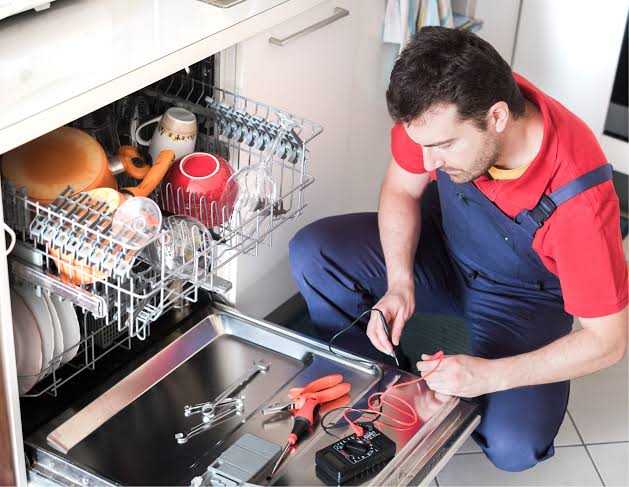
Nearly every not-heating call is judged from greasy plates or wet glasses rather than from a temperature reading. We establish first whether heat is genuinely missing, then climb the ladder in order of cost, with the control module last.
We are an independent repair company â not an authorized service center of any dishwasher brand. Brand names appear here only to identify the machines we work on, and every trademark stays with the company that owns it.

A dishwasher not heating in Dubai is nearly always reported with the verdict already attached. Plates came out greasy, glasses came out soaked, the tub felt cool when the door swung open â therefore the heater has gone. Each of those observations is real. Not one of them is a temperature reading, and the gap between the two is where most of the money in this repair gets lost.
Heat earns its place in a wash cycle three separate ways, and losing any one of them produces something the eye reads as cold-washed. Fat has to be warm enough to release from the crockery and stay suspended in the water instead of settling back down later in the programme. Detergent chemistry operates inside a band, and the enzymes are the fussy part â too cool and they work slowly, too hot and they are destroyed outright. Then the load itself has to finish warm enough that the heat stored in china and glass drives off the last film of water. Greasy plates point at the first mechanism. Wet plates point at the third. They are not the same complaint and they do not lead to the same part.
There is a check anyone can run without tools. Empty the machine completely, select a normal or intensive programme rather than eco, and stand a mug upright in the middle of the upper basket. When the cycle ends, open the door with reasonable care â steam leaves the tub for a few seconds â and drop a kitchen thermometer into that mug. Water carried through a heated main wash and a heated final rinse does not come out lukewarm. A tub warm to the back of the hand along the inner steel, and an inner door running with condensation, tell you the same thing more roughly.
The appliance keeps its own record as well. Almost every brand stores fault codes and will hand them over through a service or test mode entered at the panel, and on many models the sensor circuit is named directly rather than left to be inferred. Some will display the tub temperature live in that mode, which reduces the whole argument to a single number. Getting those readings off the machine costs nothing and happens before any tool comes out of the bag.
Being right in the first ten minutes is worth a great deal here. The heater and the control module are, alongside the circulation pump, the most expensive things inside a dishwasher. The sensor that tells the board what temperature the tub has reached happens to be among the cheapest. A machine that has stopped heating and a machine that believes it has already finished heating look identical from the kitchen, and only the second one is an inexpensive repair. Fitting a heater to what was really a sensor fault is a thoroughly well-worn way to spend a large sum and change nothing whatsoever.
Descriptions given over the phone still narrow things usefully, provided they describe rather than conclude. Nothing warm at any stage, with the cycle also finishing early, is one picture. Dishes clean but soaking wet is a completely different one. Acceptable results on the lower basket and poor ones above is a spray coverage or loading question rather than a temperature question. A programme that overruns its stated time by a wide margin is frequently a machine heating perfectly well but never being told it has arrived, which is the sensor again, wearing a different mask.
It is also fair to say early that a good share of these visits end with no part fitted. Programme choice accounts for a large number of them, missing rinse aid for many of the rest, and in this city there is a seasonal effect on the water arriving at the machine that hides genuine heater failures for months on end. Those three sit ahead of the electrical ladder for good reason, and they are dealt with first below.

Every one of these produces a load that feels cold-washed, and none of them is repaired by buying a heater.
Eco cleans by dwell time at a deliberately low temperature. It runs long, ends cool and leaves dishes damp. That is the design, not a failure.
Without it the water clings in sheets instead of running off. The load comes out wet and reads as cold-washed even after a properly heated cycle.
Through the hot months the supply can already sit near the target. The heater barely runs because there is nothing left for it to do.
Tubs and lids hold almost no heat, so they cannot dry themselves at the end. Steel and china beside them come out bone dry.
Egg, milk and cheese set hard if the prewash meets them warm. The residue that follows looks exactly like a wash that never got hot.
An overloaded basket or a blocked spray arm leaves soil behind wherever the water never reached. A geometry problem, not a temperature one.

One local factor changes this diagnosis more than anything else on the page, and it has nothing to do with what is dissolved in the water. It is the temperature the water arrives at.
Domestic supply here is stored above the building before it ever reaches a kitchen. Where those tanks sit exposed on a roof through the hot season, water leaving them has been reported at fifty to sixty degrees. Villa cold lines, run shallow or threaded through hot service voids, commonly deliver thirty-five to forty. Dishwashers are engineered around an inlet somewhere near forty-nine degrees at the absolute top of the permitted range. For a long stretch of the year, then, the machine is being handed water at or above the temperature it was designed to produce for itself.
The first consequence is a machine that barely heats. The element comes on for a token spell, or on some control strategies not at all, because the tub is already at target the moment filling stops. Owners who have learned the sound of the heater cutting in, or who watch the cycle countdown, decide the heating has failed. It has not. The appliance has been given the job already finished, and declining to add heat that is not needed is precisely correct behaviour.
The second consequence runs the other way, and it is the one worth knowing. A heater that has genuinely failed is invisible through a Dubai summer. Water entering near fifty degrees will carry a wash to a perfectly acceptable result on its own â plates come out clean, glasses come out reasonable, and nobody suspects a thing. The component dies in June and the household discovers it in December, when the tanks cool, the inlet falls back and the machine has to make up the whole difference itself for the first time in half a year. The complaint then arrives described as a sudden failure. Very often it is nothing of the kind. It is an old fault that the weather had been covering up.
That inversion is why the first question on a heating call is when the results changed rather than what the machine is doing today. A load that grew steadily worse as the season turned is a strong candidate for a heater or a sensor that has been dead for months. A machine that has behaved this way since the week it was installed points somewhere else entirely â a feed connected to the hot supply where a cold one was intended, a programme selector that was never moved off eco, or a machine that never heated properly from new and was accepted as normal.
Water arriving too hot does its own damage, and that damage is easy to mistake for a heating problem read backwards. The prewash is supposed to be cool. Egg, milk, cheese and the protein in most leftovers set hard the instant they meet hot water at the start of a cycle, and once set they stay on the plate for the remaining hour. The enzymes in the detergent fare worse still, denatured before they ever reach the soil they were included to break apart, so the tablet arrives chemically weaker than the label promises. The heating phase is truncated, which on many programmes also cuts short the soak the wash was quietly relying on. And light plastics in the upper basket can distort against water hotter than they were ever rated for. All of it presents as poor cleaning, which is usually the sentence immediately before somebody says the machine is not heating.
None of this is repaired inside the appliance. It belongs to the building â insulation on the tank and the riser, a tank sited out of direct sun, the cold branch routed away from hot pipework. In the meantime, drawing a few litres from the kitchen tap before starting a wash clears the hottest standing water out of the branch, and any machine plumbed to a hot feed in the belief that it saves energy should be returned to cold unless the manufacturer specifically allows otherwise. Dubai Municipality requires residential tanks to be cleaned at least twice a year, which is worth remembering if what arrives is not only hot but carrying sediment with it.
Free checks first, cheap parts next, expensive ones last, and each rung has to be cleared on a reading before the next one is climbed.
Which programme, whether rinse aid is present, when the results changed, and whether the machine is fed from cold or hot. This costs nothing and settles a fair number of calls outright.
Service mode entered at the panel, stored fault codes taken off the appliance rather than guessed from a forum, and live tub temperature read where the model will report it.
The thermistor is disconnected and read cold, then compared against the resistance figure published for that model. A sensor claiming the tub is already hot ends heating before it starts.
Pressure or flow switch, and the fill it depends on. No dishwasher will energise a heater it cannot prove is submerged, so this rung is checked before the heater is doubted.
Exposed element or flow-through heater in the pump housing, identified first, then resistance and insulation both measured with the appliance isolated at the socket.
Only when the sensor, the level permission and the heater have all read correctly does the board become the answer. The figure is agreed with you before anything is fitted.
And the findings that mean the heater should be left exactly where it is.
How the heat is delivered decides both the job and the price. Simpler and older machines carry an exposed element, a hooped tube lying in the base of the tub with its terminals reachable from underneath, and on those it can usually be changed on its own â that work is set out in full on our heating element replacement page. Most machines built in the last decade or so use a flow-through heater instead: a short heated passage integral to the circulation pump housing, through which the wash water travels. It is the better design and it clears the tub floor for the filter, but it is seldom sold as a standalone component, and on a good many models it arrives only as part of a pump assembly. That single distinction moves the estimate more than anything else, which is why it is established before a figure is quoted rather than after. It also explains why a heating complaint and a poor-wash complaint sometimes turn out to be the same repair.
One behaviour surprises people often enough to state plainly: a dishwasher that cannot confirm it is holding water will not switch its heater on at all. That is protection, not a defect. Energising a heater in a dry tub is how plastics melt and how a kitchen fire begins, so the control refuses until a pressure or flow switch says otherwise. It is also why a filling problem so regularly presents itself as a heating problem â the machine underfills, the switch never reaches its trip point, permission is withheld and the whole wash runs through cold. Where that is what we find, the repair sits on the fill side and the heater is never touched. The wider symptom is covered on the not filling with water page.
Cabinet Decision 66/2023 sets a statutory minimum warranty of fifteen days on repair work in the UAE, together with a documented estimate, your consent before work and an itemised invoice after. Ours runs to ninety days. If the machine is still inside its original manufacturer warranty, call the brand first.
Back to the main dishwasher page, or onward to the specific part the ladder pointed at.
Showing a code rather than just a symptom? Start here. Decode Your Error Code →
Our full dishwasher service across freestanding, built-in and integrated machines.
Exposed elements and flow-through heaters, how each is tested and what each one costs to change.
The cheap sensor that stops a healthy heater from ever being asked to run.
Wet plates from a cycle that heated correctly. Rinse aid, condenser drying and plastics explained.
Soil left behind when the temperature was never the problem in the first place.
Tower access and building permissions arranged ahead of the visit rather than at the lobby desk.
Run an empty normal or intensive programme with an upright mug standing in the middle of the upper basket, then put a kitchen thermometer into that mug as soon as the cycle ends. Water that has been through a heated wash and a heated rinse does not come out lukewarm. A tub that is warm along the inner steel, and an inner door running with condensation, say the same thing less precisely. Greasy plates and wet plates are two different complaints with two different causes, so the reading matters far more than the impression.
Because the incoming water had been doing the work for you. Water standing in exposed rooftop tanks through a Dubai summer has been reported leaving them at fifty to sixty degrees, and dishwashers are designed around an inlet somewhere near forty-nine at the very top of the range. A heater that died in June is therefore invisible until the tanks cool and the machine has to supply the whole difference itself. The failure feels sudden to the household, but the component usually stopped working months earlier. It is why we ask when the results changed, not only what the machine does now.
Usually nothing at all. Eco is built to reach a lower temperature and make up for it with time, so it runs long, draws less energy and cleans by dwell rather than by heat. Opened at the end it feels cooler than an intensive cycle, and the load is wetter, because there is less heat stored in the china to evaporate the last film of water. If a normal or intensive programme leaves the tub hot and eco does not, that is the design working. If every programme leaves it cold, that is worth measuring properly.
No. The heater sits fourth on the list rather than first. The temperature sensor gets measured before it, because a sensor reporting a tub that is already hot will stop heating before it begins and costs a small fraction of the price. We also confirm the machine is being permitted to heat, since it needs proof of water level first. Only then is the heater tested on its own terms, and that depends on whether the model carries an exposed element in the tub base or a flow-through heater built into the pump housing. Two very different jobs, two very different figures.
Because it cannot prove there is water covering the heater. A pressure or flow switch has to confirm the level before the control is allowed to energise anything hot, and if the machine underfills, if the switch sticks, or if its pressure chamber silts up, that permission never arrives and the wash runs through cold. This is protection rather than a fault. Heating a dry or half-filled tub is how plastics melt and how fires start, so the design simply refuses. Where that is the finding, the repair belongs on the fill side and the heater is left untouched.
Ninety days, covering the part and the labour together. For context, Cabinet Decision 66/2023 sets fifteen days as the statutory minimum on repair work in the UAE and also obliges the repairer to give a documented estimate, take your consent before starting and issue an itemised invoice afterwards. Ask for all three from anyone you use. One thing we would rather say at the beginning than the end: if the machine is still inside its original manufacturer warranty, call the brand before you call us. A heater or a pump assembly is an expensive thing to pay for twice over.
Cheap parts are measured first and expensive ones last. The fault, the fix and the figure are agreed with you before anything at all is fitted.
Greasy or simply wet. Every programme or only eco. Gradual or sudden. And whether the change arrived as the weather cooled. Each of those points at a different part of the machine.
+971 50 988 6591
Daily, 8:00 AM â 6:00 PM
+971 50 988 6591
Send the model number and the programme you normally run