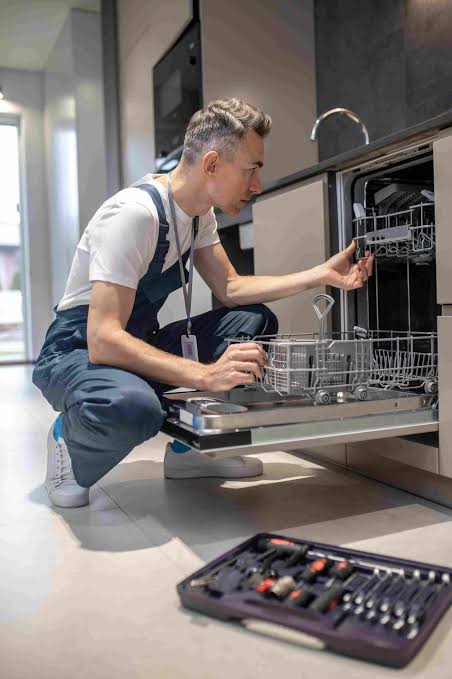
Most machines sold here dry by condensation, with no fan and no heater running in the drying phase. Plastics stay wet by design. We would rather say that on the phone than sell you a repair you do not need.
We are an independent repair company โ not an authorized service center of any dishwasher brand. Brand names on this page are used only to identify the machines we repair, and all trademarks remain the property of their owners.

A dishwasher not drying dishes in Dubai is the complaint we are called to most often that turns out not to be a fault at all. That belongs at the top of the page rather than at the end of an invoice.
Before anything gets diagnosed it helps to know which of two completely different drying systems your machine uses, because they behave differently, and only one of them has much that can fail.
Condenser drying is what almost every European-designed machine in this market uses. It has no fan and no heater running during the drying phase. The final rinse is heated, the load and the stainless steel tub come up to temperature together, and then the programme ends. The steel skin of the tub sits against the cooler air of your kitchen and falls a few degrees below the temperature of the dishes. Water evaporating off the crockery finds the coldest surface available, condenses on that tub wall, and runs down into the sump. Nothing is being powered. The whole process is driven by heat stored in the load and by a temperature difference measured in single figures.
Heated and fan-assisted drying is the other approach, common on North American designs and some Asian-built machines. An element runs through the drying phase, sometimes with a fan and a vent flap releasing the moisture. It dries plastics far better than condensation ever will, and consumes noticeably more energy โ which is why machines built for efficiency-rated markets moved away from it.
That one difference explains most of the calls. A condenser-drying machine cannot dry an item that holds no heat, and plastic holds almost none. Glass, ceramic and steel are dense enough to carry energy past the end of the cycle and evaporate their own surface water. A polypropylene tub is back at room temperature within seconds, so the droplets simply stay where they are. Manufacturers state this in their manuals, usually in a sentence nobody reads.
So the first question we ask is not what the machine is doing. It is what came out wet. Plastics alone, with the plates and glasses dry, means there is nothing to repair, and we say so on the phone rather than book a visit. Everything wet, plates included, means a short list of free corrections first โ and behind it, a small number of genuine faults.

Ranked by how often we actually find them. The first five cost nothing to correct. Only the last one is a repair.
The commonest cause by a wide margin. Without it water beads and clings instead of sheeting off. Free to check, free to fix, and it takes one load to prove.
No thermal mass, no residual heat, nothing to evaporate the droplets. Condenser machines leave plastics wet by design and always will.
Bowls spooned inside bowls, overlapping plates, cups with recessed bases holding a puddle. That is a loading result, not a drying result.
Humid air trapped in a cooling tub settles back onto the load. Cracking the door shortly after the cycle ends does more than any product.
Less heat in the final rinse means less energy stored in the load. Damper dishes are the trade you accepted for the energy saving.
A genuine fault, and identifiable: the load comes out cold. Measured on the element and the sensor before anything is condemned.

Where the plates and glasses are wet as well as the plastics, four things are worth correcting first. Between them they resolve the large majority of drying complaints, and none costs more than a bottle of rinse aid.
Rinse aid is the first and the biggest. It is not a cleaning product and it is not a water softener, and both confusions cause trouble here. It lowers the surface tension of the final rinse so the water sheets off in a film rather than standing in beads. A droplet on a glass has to be evaporated by stored heat. A film that already ran off does not. Remove the rinse aid and a condenser-drying machine loses most of its drying performance overnight.
Check the dose setting as well as the level. The dispenser has a numbered adjustment, factory-set to a middle value. If glasses come out beaded, raise it a step. If they streak or the machine foams, lower it a step. That single adjustment is the whole diagnosis on a surprising number of visits.
One local correction belongs here, because the advice circulating in this city sends people the wrong way. Rinse aid and dishwasher salt are different products doing different jobs. Dubai supply is overwhelmingly desalinated seawater, re-mineralised modestly, so it is soft rather than hard โ the hard-water claim repeated across local appliance content is unsourced, and we could not verify a hardness figure to a standard we were comfortable publishing. Read the hardness section of your own manual and test your tap with a strip. Softness reduces how much salt a machine needs. It does not reduce the need for rinse aid at all.
Nor should a damp load be answered with more detergent. Soft water plus an over-dosed detergent is what etches glassware in the UAE, and etching is permanent micro-pitting of the glass surface rather than a deposit that wipes off. An etched glass looks cloudy whether it is wet or bone dry, and it is often reported to us as a drying problem. It is not one, and no repair reverses it.
Loading decides a lot of what people blame on drying. A bowl nested inside another shields both from the rinse and holds water between them. Overlapping plates dry on the exposed face and stay wet where they touch. Cups with a recessed ring in the base carry a genuine puddle out of the machine, which is gravity rather than a fault. Leave gaps so air can move, and resist fitting one more pan in.
Then the timing. Condensation carries on after the programme ends, and the productive part happens while the load is still warm. Keep the door shut and the vapour has nowhere to go but back onto the dishes. Open it a hand width soon after the beep and the tub vents while the crockery still has heat to spare.
There is a Dubai variable worth naming. Condenser drying depends on the tub skin running cooler than the load, and in August, in a kitchen shut up all day, that difference narrows. The same machine with the same tablet delivers a damper result in summer than in February, with nothing wrong anywhere. Run it when the kitchen is cool.
Work through these in order first. If the load dries after step three, you have saved yourself a call-out and we would rather that than the alternative.
Plastics only, or plates and glasses too. If the plastics were the only casualties on a condenser-drying machine, the machine is behaving exactly as it was designed to and no part will change it.
Open the door the moment it finishes and touch a plate. Warm means the final rinse reached temperature and the heating circuit works. Cold is the one result that points at a real fault.
The capped opening beside the detergent cup. Empty is the most common answer on this whole page. Fill it, run one normal load, and judge the result before doing anything else.
The dispenser adjustment is set to a middle value at the factory. If glasses come out beaded, move it up a step. If they streak or the machine foams, move it back down.
Plastics on the upper basket, nothing nested, nothing overlapping, cups angled so the recessed base cannot hold a puddle. Then run the identical programme and compare honestly.
Crack it a hand width shortly after the beep. If eco is the only programme leaving things damp, that is a temperature trade-off rather than a breakdown, and the machine is fine.
Drying components do fail. They fail far less often than damp dishes are reported, and telling you which side you are on is the useful part of the visit.
Almost all of these announce themselves the same way: the load is cold when the programme ends, not merely wet.
Where the evidence lands here we tell you on the spot and leave without the work. Fitting a heater to a machine that heats correctly changes nothing.
If the machine is still inside its manufacturer warranty, call the brand first โ we will tell you the same on the phone. Our trade licence 134585 is issued in Ajman and Dubai is a service area we cover. Cabinet Decision 66/2023, Article 26 entitles you to a documented estimate and your consent before work begins, an itemised invoice afterwards, and a minimum fifteen-day warranty on the repair. Ours runs 90 days on parts and labour.
Back to the main service page, or straight to the fault that matches what your machine is actually doing.
Showing a code rather than just a symptom? Start here. Decode Your Error Code →
Our full dishwasher service โ built-in, freestanding, integrated and slimline machines across every brand.
What happens when the load really does come out cold, and the measurements taken before anything is condemned.
Etching versus limescale, why the two need opposite responses, and why one of them is permanent.
Spray arms, detergent dose and the summer inlet temperature problem, diagnosed in order of likelihood.
The published code table read properly, on the brand most associated with condenser drying.
Tower communities where hot summer kitchens make condensation drying work hardest.
Almost certainly not, and this is the single most common reason we are called to a drying complaint. Most machines sold in this market dry by condensation. There is no fan and no heater running in the drying phase. The final rinse heats the load, the tub wall then cools faster than the dishes, and moisture migrates across to that cooler steel and drains away. The process runs entirely on heat stored in the items themselves. Plastic stores almost none, cools within seconds, and therefore cannot dry itself. Wet plastic is designed behaviour rather than a failure.
The rinse aid reservoir, before anything else, because it is free to check and it is by far the most common fixable cause. Rinse aid lowers the surface tension of the water so it sheets off the load instead of standing in droplets. Without it, water clings, and a machine that dried perfectly last year will leave beaded glasses today simply because the bottle ran dry. Lift the cap next to the detergent cup and look. If it is empty, fill it, run one normal load, and judge the result before booking anyone.
Usually yes, and the label is not lying to you. All-in-one tablets do carry a rinse aid component, but the quantity is fixed by the tablet and released with the wash rather than metered separately into the final rinse. On short programmes, on heavy loads and on machines a few years old it is often not enough. Filling the dispenser as well costs very little and is the quickest test available. If a full reservoir and a raised dose transform the result, you have your answer and you have paid nobody.
It matters more than most people expect. Condenser drying continues after the programme finishes, and the useful part of it happens early, while the load is still warm. Leaving the door shut for hours traps humid air in a cooling tub, and that moisture settles back onto the load instead of draining away. Opening the door a hand width shortly after the cycle ends lets the vapour out while the dishes still hold enough heat to finish themselves. Machines with an auto-open door are doing precisely this for you.
No, and that pattern is a diagnosis in itself because it points away from a fault. Eco programmes save energy by washing and rinsing at a lower temperature over a longer period. Since condenser drying is powered purely by the heat stored in the load at the end of the cycle, a cooler final rinse leaves less energy available and the load comes out damper. A machine that dries properly on a hotter programme has a working heating circuit by definition. To improve eco, raise the rinse aid dose and open the door early.
When the load comes out cold. If the plates are cool to the touch the moment the cycle ends, the final rinse never reached temperature, and that points at a heating element or a temperature sensor reading wrong. On machines with a heat-dry fan, a seized fan or an open circuit to it is also real. We measure before condemning anything. If the machine is still inside its manufacturer warranty, call the brand first and we will say the same. Cabinet Decision 66 of 2023 requires a documented estimate, your consent and an itemised invoice, with fifteen days minimum warranty. Ours runs 90 days.
Rinse aid, loading and programme choice account for most damp loads and cost nothing to correct. Where the evidence genuinely points at a heater, a sensor or a dry fan, you get the fault, the fix and the price before any work starts.
Plastics only, or the plates and glasses too. Whether the plates feel warm the moment the cycle ends, which programme you run, and whether the rinse aid reservoir is full. Those four answers separate a design characteristic from a real fault.
+971 50 988 6591
Daily, 8:00 AM โ 6:00 PM
+971 50 988 6591
Send a photo of the open door with the load still inside