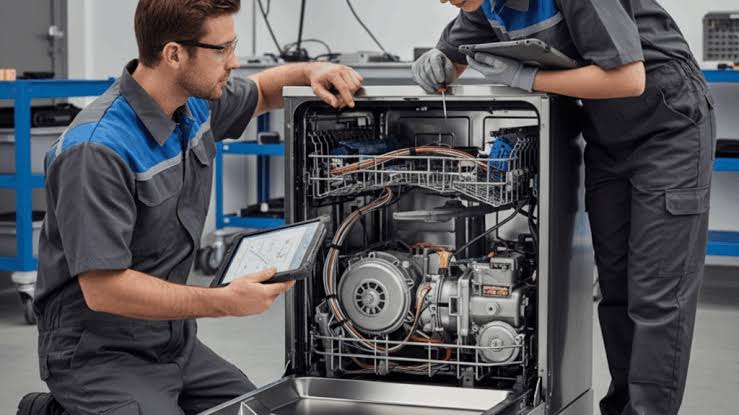
The Ariston badge covers more than one presentation in this market, and a specification sheet found online may belong to a model that never reached the UAE. So the first thing we ask you for is a photograph of the rating plate.
Unitech is an independent repair business and is not an authorized service centre for Ariston or for any other manufacturer. Brand names used here describe only the machines we are asked to work on, and every trademark stays with the company that owns it.

Ariston dishwasher repair in Dubai begins with a question that sounds trivial and is not: which machine is this, exactly? More than one presentation of the badge has reached this market, the fascia lettering has shifted across the years, and near-identical outward styling has covered noticeably different builds underneath.
That matters the moment anybody reaches for a fault chart. Search the model line printed across your door and you will find manuals, code tables and long forum threads, most of them written around machines sold in Europe or the United Kingdom. Some describe a specification that was never brought into the UAE at all. Others describe a run that shares the name and very little else. Reading a code from one of those against the appliance standing in your kitchen is precisely how a healthy component ends up in the bin.
So we place the machine first. The rating plate is the only statement about it that the machine itself makes. Everything else â the name on the fascia, the retailer listing, the delivery note, somebody at the developer remembering what went into the fit-out â is a description written by a third party, and descriptions drift.
On these dishwashers the plate normally sits on the outer edge of the door, down one side, concealed while the door is closed. Where it is not there, look along the tub rim that the door seals against on the same side. A minority carry the label on the back panel, which is unhelpful once the unit is trapped in a cabinet run, and in Dubai kitchens that is common enough to be worth planning for. Integrated machines behind a matching door make it worse again, because the plate is behind two layers rather than one.
The fields on that plate are not interchangeable. There is a model reference, which is close to the name you already know. There is a longer code, and that is the field the parts catalogue is actually keyed on. There is a serial number, which usually carries the build period inside it. Alongside those sit the electrical ratings, and on many plates a separate service reference that a workshop uses to pull the correct exploded diagram.
The longer code is the one that decides whether a part will fit. Two machines can wear the same name across the door, sit beside each other in the same showroom photograph, and take different pumps, different hinges and different boards. The marketing name groups appliances by how they were sold. The service code groups them by how they were built. Only the second is any use to a repairer holding a component in one hand.
That is why we ask for a photograph of the plate before we discuss a code and long before we quote a part. It takes half a minute, it costs nothing, and it removes the most common single reason a dishwasher visit goes badly.
If the plate has become unreadable â lifted by steam, scrubbed away by cleaning products, painted over during a fit-out â tell us rather than guessing at it. A machine can still be placed from a serial number and a set of photographs showing the tub, the basket rails and the pump housing. What we cannot work from is a name alone.

Grouped by what you can see and hear, because that is what you have. In every one of them the least expensive explanation is tested before anything is condemned.
Water goes in, the programme runs its full time, the plates come out with food still on them. Filter condition, spray arm jets and whether wash pressure ever builds are checked long before the wash motor is doubted.
A halt a few minutes in, sometimes with a light blinking, sometimes silent. More often a machine protecting itself against something it has sensed than a component that has actually failed.
Standing water when the cycle ends. Filter stack, sump well and the non-return flap are cleared and proved first, since the pump gets blamed far more often than it is genuinely at fault.
Dishes cool to the touch, plastics still streaming. The heater, the thermostat and the sensing that decides when to heat are three separate things, separated here by measurement rather than assumption.
A fill that takes far too long, or a cycle that gives up waiting. The mesh screen at the inlet collects building tank sediment for years before the valve itself has anything wrong with it.
The programme refuses to start, or the door sags open under its own weight. The latch, the striker alignment and the switch sitting behind it are three different repairs at three different prices.

Nearly every brand page you will land on carries a grid of error codes. We have deliberately left one off this page, and the reason is specific to this badge rather than general squeamishness about publishing technical detail.
To put a code table up honestly, we would have to be able to say which UAE-market machines each row applies to. We cannot say that, and neither can the pages that publish them. The Ariston name has arrived in this region through several routes and across several production periods, and the model mixes actually sold here have never lined up tidily with the ones documented in European service literature. A table lifted from that literature is accurate about appliances a large share of our customers do not own.
Verification against this market is the entire problem. A code list is worth something only if somebody has checked each entry against machines physically in service in the UAE. Copying rows out of a manual written for a model that was never imported is not verification. It is transcription with a local heading pasted on top, and it reads as authoritative precisely because nothing about it looks copied.
The consequence is not theoretical. A homeowner reads a code as a drain pump failure on a chart drawn up for a different run, buys a drain pump, has it fitted, and the machine still stands full of water because the real fault was a silted sump or a float switch held up by a slow leak under the base. The part is spent, the money is spent, and the fault has not been touched. We are called out to the aftermath of that often enough to have stopped contributing to it.
What we do instead is read the machine in front of us. Codes are recovered on site from the appliance itself, by whatever route that particular model exposes them, and then held against what the machine is physically doing: whether the pump is turning, whether the heater draws current, whether the fill valve opens when it is commanded to. A code narrows the search. A measurement closes it.
If you already have a code, please keep hold of it. It is useful and we want to hear it. We simply want the plate photograph alongside it, so the code is attached to a known machine before anyone spends money acting on it.
Sometimes the honest answer is that the code describes a condition rather than a failure. A machine reporting that it never reached temperature, on a summer morning when the supply arrived hot enough to have skipped most of the heating phase, does not need a part fitted. Telling you nothing is broken is part of the work, not a wasted visit.
None of this makes the brand awkward to repair. Mechanically these dishwashers are conventional, and what fails on them fails on most other machines too. It is the documentation around them that needs care, not the engineering inside them.
Identify, then observe, then measure. Nothing is ordered until the machine has been placed properly.
The label is photographed and written down before the toolbox is opened. Model reference, service code and serial number, so any parts search later that day is aimed at the right machine.
We run the programme and watch the failure occur rather than working from an account of it. Where in the cycle it happens tells us more than the fact that it happens.
Filter stack lifted out and rinsed, sump well cleared, both arms removed and their jets checked for blockage and free rotation. A meaningful share of visits are resolved and closed at this point.
Inlet mesh screen inspected for tank sediment, fill timed against what the model expects, then the discharge path followed all the way to the waste connection and back again.
Heater, pump and switch circuits measured with a meter, machine isolated and connectors off. Any code recovered from the appliance is checked against those readings, never the reverse.
Fault, remedy and price put to you before a single part is fitted. If the visit ended at the filter and the spray arms, that is what the invoice says.
The second list is longer than most people expect, and we would rather you saw it before we come out.
Most of those are modest parts on a conventional machine. What decides whether the repair is sensible is the state of everything around them, so we tell you what else looks close to failing rather than fitting one component and leaving you to find out later.
One local correction, because it drives a great deal of poor advice: mains water in Dubai is overwhelmingly desalinated and arrives soft, with only modest re-mineralisation afterwards, so the hard-water story repeated across appliance marketing here does not hold. Set the machine from its manual and a test strip, not from that assumption, since a softener wound up high on soft water alongside a heavy detergent dose is what etches glass permanently. What genuinely varies from building to building is sediment rather than hardness, and Dubai Municipality sets a floor of two residential tank cleans per year for exactly that reason.
Under Cabinet Decision 66/2023, fifteen days is the shortest repair warranty permitted in the UAE, together with a written estimate, your agreement recorded before anyone starts, and an itemised invoice handed over at the end. Our own cover runs to ninety days. Where the appliance remains under its original manufacturer warranty, approach the brand ahead of us.
Back to the main dishwasher page, or straight to the symptom that brought you to this one.
Not sure the code you are seeing is on our list? Compare it across every brand we decode. All Brand Error Codes →
Everything we do on dishwashers â freestanding, built-in and fully integrated machines.
Nothing happens when you press start. Door latch, supply and interlock checked in order.
Long fills and fill faults, starting at the inlet mesh screen rather than the valve.
Blocked jets, a loaded filter and a wash pump moving less than it should.
The wider group page, for machines badged Whirlpool in the same kitchens.
Villa kitchens, private tanks and built-in machines that have to come out to be worked on.
Open the door fully and run your eye down the outer edge of the door itself, usually along one side, where the label sits hidden while the machine is shut. If it is not there, check the rim of the tub that the door seals against on the same side. A few machines carry it on the rear panel, which is no help once the unit is built into a run of cabinets. Photograph the whole label square on and close enough that every line reads, rather than the single line you think matters.
Because a code on its own does not tell us which machine produced it. The code lists circulating online are almost always transcribed from European or UK service literature, and the model they describe may never have been imported here. The same blinking light can mean one thing on one production run and something different on the next. Send the plate photograph in the same message as the code and it becomes genuinely useful immediately. Without it, an interpretation is a guess wearing the clothes of a diagnosis, and guesses get sound parts replaced.
Yes. The badge has reached this region as plain Ariston and as Hotpoint-Ariston, and the fascia lettering by itself settles neither the vintage of the machine nor which parts fit it. One further source of confusion is worth naming: the Ariston name also appears on water heaters sold here, which are an entirely different product and have nothing to do with your dishwasher. If your search turned up heater manuals and heater fault codes, that is why. Send us the plate and we will place the actual machine.
Look at what the machine may be sensing before assuming something has broken. A filter packed tight enough to starve the wash pump, a spray arm fouled by a fallen utensil so pressure never builds, or an anti-flood float lifted by a small pool under the base will each halt a cycle on a machine that is otherwise healthy. Drainage that has gone slow rather than stopping altogether produces the same pause. We clear and prove those in order, and only then move to heating, sensing and the control board.
For current and reasonably recent models, usually yes, through the normal regional supply routes, and we tell you what we can source before you commit to anything. For older machines it depends entirely on the component. Pumps, hoses, heaters and seals are widely available. Fascia panels, control boards and basket hardware for a discontinued run can be slow to arrive or simply gone. This is the second reason we want the plate photograph early, because the parts catalogue is keyed on the codes printed there and not on the name across the door.
Ninety days, covering both the component and the labour that put it in. For context, Cabinet Decision 66/2023 sets fifteen days as the statutory floor for repair work in the UAE and also obliges the repairer to provide a documented estimate, obtain your agreement before starting and hand over an itemised invoice at the end. Ask for all three, from us or from anyone else. And where the dishwasher remains covered by its original manufacturer warranty, take the fault to the brand rather than to us. We will say so on the call.
A legible photograph of the rating plate plus a short description of the symptom is enough for us to say what is likely, what it involves and what is worth checking before anyone visits.
A fault code narrows things down only once we know which machine produced it. Tell us what the machine does, how far into the cycle it does it, and what you can hear while it happens.
+971 50 988 6591
Daily, 8:00 AM â 6:00 PM
+971 50 988 6591
Send a photo of the rating plate on the door edge