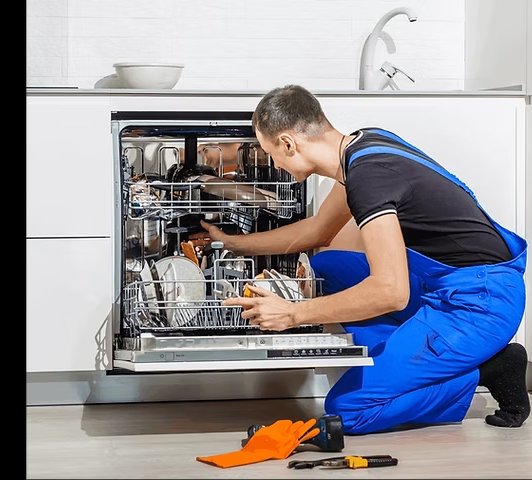
Standing water in the tub is usually debris, not a dead pump. We work down a ranked list starting with the cheapest cause, clear what is blocking it, and only then talk about parts.
We are an independent repair company โ not an authorized service center of any dishwasher brand. Brand names on this page are used only to identify the machines we repair, and all trademarks remain the property of their owners.

A dishwasher not draining in Dubai is one of the few faults where the cheapest explanation is also by far the most likely โ and where the expensive conclusion still gets reached first almost every time.
The cycle ends, the tub still holds several centimetres of grey water, and the natural assumption is that the drain pump has died. On most of the machines we attend it has not. The pump is running exactly as it should and moving almost nothing, because the path in front of it is packed with debris that took months to accumulate quietly.
So we work down a ranked list instead of reaching for a part. Filter and sump first, because that is where the debris collects. Then the drain hose. Then the waste connection it discharges into. Only when all of those are clear does the pump itself come into question, and by that stage it usually does not need to.
Two local conditions load a Dubai sump faster than any manual anticipates. The first is summer inlet temperature. Water arriving from an uninsulated rooftop tank can reach the machine far hotter than the roughly 49C inlet a dishwasher is designed around, and villa cold lines commonly sit at 35 to 40C through the season. The heating phase is effectively over before it begins, and enzyme detergents can be denatured before they have acted on protein soils. What should have been broken down and washed away instead arrives at the filter as solids.
The second is detergent dose. Dubai tap water is desalinated and soft, not hard, so the heavy dosing that saturates local advice is more than a load needs. Surplus detergent means suds, and a pump churning foam shifts very little water โ which reads as a drain failure and is nothing of the kind.
None of that calls for a new pump. It calls for the machine to be opened, cleared and tested.

Ranked by how often we actually find them. The last one on this list is the one most people assume first.
Glass chips, olive pits, seeds, rice and jar labels loading the mesh. The most common cause by a wide margin, and the one you can inspect yourself.
Crushed behind the machine when it was pushed back, or run flat with no rise. Without a high loop the water cannot be lifted out reliably.
Congealed grease in the spigot or trap โ or the moulded knockout blank never removed at installation, an outright install defect.
A glass fragment, a fruit stone or a softened adhesive label wrapped around the impeller. The pump hums and stalls, and gets condemned for it.
The small flap that stops waste water returning. Stuck closed and nothing leaves; stuck open and what left comes straight back in.
Open winding, seized rotor or a failed drive output. Real, but genuinely uncommon โ and only concluded once the five above are ruled out.

Once the filter and sump are clear and the tub still holds water, the next suspects sit outside the appliance altogether. They are cheap to resolve when you find them and expensive to misdiagnose when you do not.
The drain hose has to rise before it falls. Manufacturers ask for a high loop that takes the hose up close to the underside of the worktop before it drops to the waste connection, or a proper air gap in its place. Without that rise the machine struggles to lift water out, and dirty water can siphon back into the tub between cycles. The other hose fault is purely mechanical: when a machine is pushed back into its housing after a service or a kitchen clean, the hose gets crushed against the wall or trapped behind a levelling foot. The symptom then appears suddenly, for no reason the household can see, which is exactly what makes it so easy to blame on the pump.
The waste connection is where installation defects live. A sink waste spigot or a waste disposal inlet comes with a moulded blank sealing it, and it has to be knocked out before the hose goes on. Miss that step and the machine has never drained properly and never will until the blank is removed. If yours has held water since the week it was fitted, this is the first thing worth ruling out. Where the spigot is open, it can still narrow over the years with congealed grease, and so can the trap immediately behind it.
In towers there is one more layer. Your kitchen branch joins a shared waste stack, and a restriction in that stack surfaces in individual apartments as slow sink drainage, gurgling when the dishwasher pumps out, and water refusing to leave the tub. If your sink gurgles in sympathy, or neighbours above and below notice the same thing in the same week, the fault is in the building rather than in the appliance. We will say so on the spot, and it goes to facilities management rather than onto your invoice.
Clear first, quote second. The order matters, because it decides whether you pay for a part at all.
Pump audible but nothing moves, silent, or draining slowly. Whether the sink gurgles alongside it, and whether the machine has ever drained properly since installation.
The tub is baled out so the base can be seen, then the coarse filter and fine mesh come out for inspection. This is where the fault ends on many visits.
With the supply isolated, the sump is cleared and the impeller checked for glass, stones and wrapped labels. The non-return flap is checked for free movement.
The full hose run traced for kinks and crushing, the high loop confirmed, and the waste spigot checked for grease and for a knockout blank left in place.
Run on a full cycle and watched to completion, so you see the water leave rather than take our word for it. A slow drain is not a fixed drain.
Fault, fix and cost agreed before anything is ordered or fitted. Parts and labour carry a 90-day warranty, and if the same fault returns inside it, so do we.
Drain pumps do fail. They fail far less often than they are replaced, and the difference is worth money to you.
If the machine is still inside its manufacturer warranty, call the brand first โ we will tell you the same on the phone. Cabinet Decision 66/2023 entitles you to a documented estimate and your consent before work, an itemised invoice afterwards, and a minimum fifteen-day warranty on the repair. Ours runs to 90 days.
Back to the main service page, or straight to the part of the diagnosis that matches your machine.
Showing a code rather than just a symptom? Start here. Decode Your Error Code →
Our full dishwasher service โ built-in, freestanding and slimline machines across the emirates.
What a real pump replacement involves, on the machines where clearing the blockage was not enough.
The other pump entirely โ the one that drives the spray arms rather than emptying the tub.
Blocked spray arms, detergent dose and the summer inlet temperature problem, diagnosed in order.
Brand-specific drain faults, filter design and the fault indications these machines give you.
Same-day cover across the tower communities where shared waste stacks matter most.
Usually not, and that is the single most useful thing on this page. The overwhelming majority of machines that reach us described as pump failures are blocked machines with a perfectly healthy pump. Debris collects in the filter and in the sump beneath it, and once that mesh is loaded the pump can run at full speed while moving almost nothing. To anyone listening at the door it sounds exactly like a working pump achieving nothing, because that is what it is. The filter is the first thing we lift out, and on a great many visits it is also the last.
Yes, and we would rather you did. Switch the machine off at the wall socket, slide out the lower basket, and unscrew the coarse filter assembly in the base of the tub. Look for glass fragments, olive pits, seeds, rice, shreds of foil and the paper labels that float off jars during a cycle. Clear what you find, rinse the mesh under a tap, and refit it squarely, because a filter that is not seated properly lets debris bypass straight into the pump. Do not open the trap or any pipework under the sink, and do not remove electrical covers.
That is a strong signal the restriction sits downstream of your machine rather than inside it. The drain hose normally discharges into the sink waste, so a loaded trap, a narrowed branch pipe or a restricted shared stack shows up as gurgling, slow sink drainage and a dishwasher that will not empty. In an apartment tower it is worth asking around: if neighbours on the same stack notice slow drainage in the same week, that is a building drainage issue for facilities management, and no part fitted to your machine will change it.
Where a dishwasher hose connects to a sink waste spigot or to a waste disposal unit, that spigot is supplied with a moulded blank sealing it shut. Whoever installs the machine is meant to knock the blank out before connecting the hose. When it gets missed, the machine has nowhere to discharge and has never drained properly since the day it was fitted. It is an installation defect rather than a component failure, it is far more common than it ought to be, and we check for it early on any machine that has never worked correctly.
It can, and it is worth knowing because most local advice pushes people the wrong way. Dubai tap water is desalinated and soft rather than hard, so the heavy dosing widely recommended here is more than a normal load needs. Surplus detergent produces suds, and a pump churning foam moves very little water, which presents convincingly as a drain failure. Over-dosing in soft water also etches glassware, which is permanent damage and quite different from limescale that wipes off. Set the dose and the hardness level using your manual and a test strip.
No. We clear and test before anything is quoted, because a cleared blockage frequently ends the visit with no part fitted at all. Where a component genuinely has failed you get the fault, the fix and the price before work begins, which is also what UAE consumer protection law expects: Cabinet Decision 66/2023 requires a documented estimate and your consent before work, an itemised invoice afterwards, and a minimum fifteen-day warranty on the repair. Our warranty on parts and labour runs to 90 days.
Most drain faults are debris rather than a failed pump. We clear and test before any part is quoted, and the price is agreed with you before work starts.
Whether the pump runs and nothing moves, whether it is silent, whether the water leaves slowly, and whether the kitchen sink gurgles at the same time. Each one points somewhere different.
+971 50 988 6591
Daily, 8:00 AM โ 6:00 PM
+971 50 988 6591
Send a photo of the sump with the filter lifted out