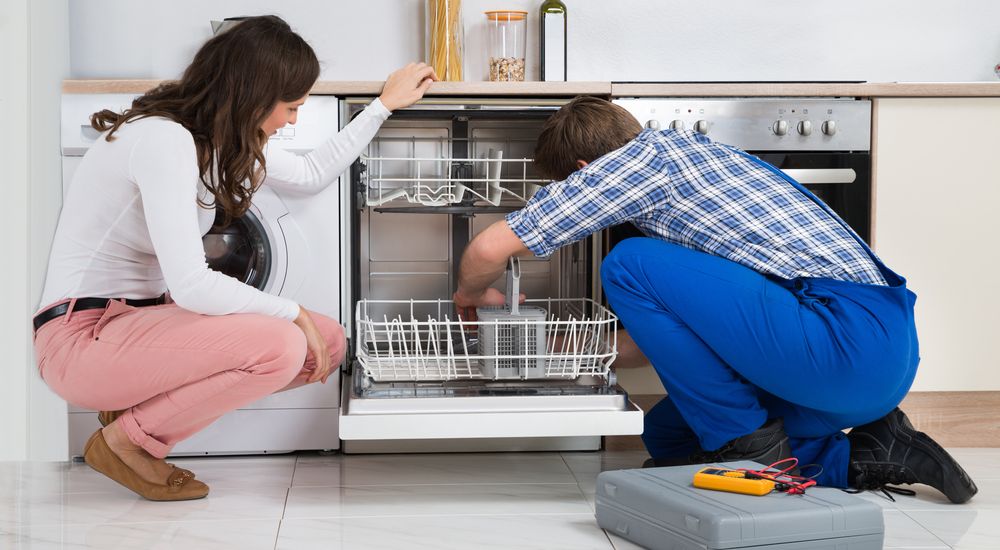
JLT towers release the service lift in booked windows and most clusters want an access form first. We arrange both before the visit, then deal with the galley kitchen the machine is wedged into.
We are an independent repair company โ not an authorized service center of any dishwasher brand, and not appointed by or affiliated with any building management or facilities company in Jumeirah Lakes Towers. Brand names appear here only to identify the machines we repair, and all trademarks remain the property of their owners.

Dishwasher repair in JLT is rarely delayed by the fault. It is delayed by the lift.
Jumeirah Lakes Towers is organised as lettered clusters, each a small group of towers sharing a podium, a basement and one facilities management team. Almost every tower reserves its service lift for contractors, deliveries and residents moving in or out, releases it in booked windows rather than on demand, and expects that window to be requested in advance. Arrive without one and you either wait for the next release or carry equipment up a residential lift that nobody wants you in.
So we book it first. When you give us the cluster letter, the tower name and the apartment number, we contact the FM office, ask what their access process is, submit whatever form they use, and take the earliest window that suits you rather than the earliest window that suits our schedule.
Parking follows the same logic. The clusters share podium and basement bays, visitor space is tight through the working day, and the loading bay is often the only practical place to bring in a replacement pump, a spare door or a machine that has to leave. Knowing which cluster you are in tells us where that bay is and whether it needs its own permission.
None of this is complicated. It is simply the part that turns a ninety-minute repair into a wasted afternoon when it is left until the engineer is already standing in the lobby.
The second JLT-specific factor is the kitchen itself, covered further down this page. A large share of these apartments were built with galley kitchens, where the dishwasher sits tight under a continuous worktop run with no slack around it. That changes how the machine comes out, and it changes what a realistic repair looks like on the day.
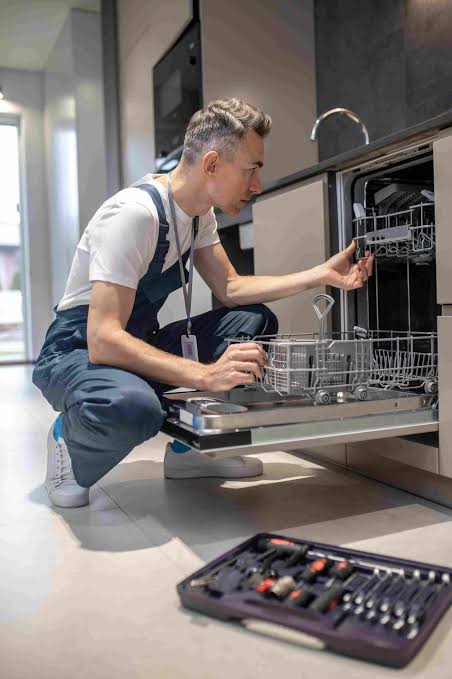
Three are access, three are the machine. In a cluster tower both need thinking about in advance.
Requested from your building, not assumed. Most towers release the lift in slots and will not open it for an unbooked contractor.
Each cluster runs its own paperwork. We submit it and chase it, so the permission exists before anyone travels.
Shared bays fill early. Knowing the cluster tells us where to unload a pump or a door without blocking a ramp.
A narrow aisle decides whether the machine can come out at all, or whether the repair is done from the front.
Fine silt on the inlet valve mesh screen is the usual reason a tower machine fills slowly and times out.
Rooftop storage runs hot in July. Water arriving too warm shortens the heating phase and bakes protein soil on.

The cluster towers were built to repeating apartment layouts, and in a large share of them the kitchen is a galley: two parallel runs with a narrow aisle between them, or a single run against one wall with the dishwasher integrated into it.
That format is efficient to live with and awkward to service. The machine is not a free-standing appliance parked in a gap. It is built into a continuous carcass, levelled up against the worktop, usually held by anti-tip fixings driven into the underside, and often wearing a decor panel that matches the cupboard doors and has to come off before anything else does.
Behind it there is very little depth. The inlet hose, the corrugated drain hose and the power cable all have to live somewhere, and in a shallow housing they end up folded rather than routed. Draw the machine forward without releasing them first and the drain hose is the thing that tears.
The aisle in front is the other constraint. In a true galley the opposite run can be less than a metre away, so a machine cannot simply be walked out and turned, and there may not be floor space for it to stand on while it is worked on. Where that is the case we say so before starting and agree what happens next. Sometimes the correct answer is to work entirely from the front. Sometimes it is to move the machine out to the living area on a protective sheet and bring it back afterwards.
Plenty of faults never need it out at all. Filter and sump cleaning, spray arm bearings and blocked jets, the door seal, the detergent dispenser, most heater and sensor testing, and a fair portion of drainage diagnosis are all reachable from the front. We check that route first, because it is quicker for you and because nothing in the kitchen gets disturbed.
When the machine genuinely has to come out โ a drain pump, a circulation pump, a leaking sump, an inlet valve โ it comes out deliberately: plinth off, fixings released, services fed forward by hand, worktop edge protected, and the floor covered before anything is dragged across it.
Access first, diagnosis second, and a price you have agreed before a tool comes out of the bag.
Those three details decide the lift route, the parking and which FM office we deal with. Add the brand and the fault code if the machine shows one.
We contact your building, submit whatever permit they use, and book the service lift slot. You are told the confirmed window rather than an optimistic one.
Filter, sump, spray arms, seal, dispenser, drain behaviour and fill rate are all assessed with the machine in place. Many faults end here.
Cabinet Decision 66/2023 Article 26 requires a documented estimate and your agreement before repair work begins, and an itemised invoice afterwards. We work that way as standard.
If the machine has to leave its housing, the plinth, fixings, hoses and worktop edge are dealt with in order. Nothing is forced.
The same Article sets a fifteen-day statutory minimum on repair work. Ours runs ninety days on parts and labour. Same fault back inside that window, so are we.
Two conditions matter in a tower, and neither is the one most local content blames.
Dubai supply is around ninety-nine percent desalinated and soft. We publish no hardness figure because none was verifiable โ use your manual and a test strip, and set the machine to what the strip shows. Building storage and stagnation do vary between towers; the water leaving the plant does not.
Back to the main service page, or straight to the symptom your machine is showing.
Seeing a code on the display? Find out what it means before you call. Dishwasher Error Codes Explained →
Our full dishwasher service โ integrated, free-standing and slimline machines of every brand.
Water left in the base at the end of a cycle. Filter and sump first, pump only if the cheap checks clear.
Blocked jets, detergent dose and inlet temperature โ the three causes behind most poor wash results.
Fault codes read properly, and the parts that actually fail on these machines.
Diagnosis, common failure points and honest repair-or-replace advice.
Same-day cover across the neighbouring tower districts.
In most JLT towers, yes. The service lift is shared between contractors, deliveries and residents moving in or out, and buildings release it in booked windows rather than leaving it open. Some clusters are relaxed about a hand-carried toolbag and strict about anything on a trolley or a replacement machine. We ask your building which applies, take a window that suits you, and plan the visit around it. If you have already booked a slot for other work in the same apartment, tell us the time and we will try to fit inside it.
It varies by cluster, because each has its own facilities management team and its own forms. The usual request is a work permit or contractor access form submitted to the FM office ahead of the visit, naming the apartment, the contractor and the work being done. Many buildings also log the technician at the security desk and issue a pass on the day. We handle the submission and the follow-up as part of the booking. What we cannot do is bypass it, so how quickly we can attend sometimes depends on how quickly that office responds.
Usually, but it needs a careful start rather than a hard pull. JLT galley kitchens are built as continuous runs, so the machine sits in a tight housing with the inlet hose, drain hose and cable folded into a very small space behind it. Pulling blindly is how a drain hose gets torn and a worktop edge gets chipped. We take the plinth off, release the anti-tip fixings, check the door does not foul the opposite run, and feed the services forward as the machine moves. A good number of faults can be reached from the front without removing it at all.
Low pressure is possible, but it is not where we look first. The usual cause is sediment sitting on the fine mesh screen inside the inlet valve, which is there to catch exactly that. Dubai Municipality requires residential water tanks to be cleaned at least twice a year, and in a tower that schedule belongs to the facilities management team rather than to you. If a tank clean has been delayed, or a tank has recently been disturbed, fine sediment reaches the appliance. The screen is cleanable, and cleaning it costs far less than replacing a valve.
Almost certainly not, and this is worth saying plainly because the opposite advice is everywhere locally. Dubai tap water is around ninety-nine percent desalinated seawater, re-mineralised to a modest level, so it is soft rather than hard. Setting a machine to maximum hardness makes the softener regenerate far more often than the supply warrants, and it wastes salt doing it. Do not take our word for it and do not take a softener salesman at his word either: follow the setting procedure in your manual, confirm with a test strip, and set what the strip actually shows.
Those are two separate problems that often arrive together in a tower. Cloudy glass in soft water is usually etching, caused by an over-dosed detergent working on glass that has no hardness to buffer it. Etching is permanent, so it will not wipe off, and cutting the dose is the only useful response. The baked-on food is a temperature problem instead. Rooftop tanks in Dubai have been reported at fifty to sixty degrees in summer against a recommended dishwasher inlet of about forty-nine, which truncates the heating phase and can denature enzyme detergents before they act on protein soil.
Access is arranged with your building before we set out, so the visit is spent on the machine rather than in the lobby. Price agreed before any work.
The cluster letter, tower name and apartment number let us request the service lift window and check whether your building wants an access form before we arrive.
+971 50 988 6591
Daily, 8:00 AM โ 6:00 PM
+971 50 988 6591
Send a photo of the kitchen run and the gap around the machine