
A machine that washes badly and a machine that will not empty are two different faults, driven by two different pumps. The wash pump gets tested under load before anyone condemns it.
We are an independent repair company โ not an authorized service center of any dishwasher brand. Brand names on this page are used only to identify the machines we repair, and all trademarks remain the property of their owners.

Dishwasher circulation pump replacement in Dubai is quoted far more often than it is needed, and the reason is a naming confusion that runs right through the trade.
A domestic dishwasher has two pumps. The circulation pump โ also called the wash pump โ takes water from the sump and forces it up the feed pipes into the spray arms, where the nozzles turn that pressure into the jets that do the actual cleaning. The drain pump does the opposite job: at the end of each phase it pushes the dirty water out to the waste connection under your sink.
Separate motors, separate parts, separate prices, and completely different symptoms when they fail.
Water standing in the base at the end of a cycle is a drain fault. Dishes coming out with food still baked on them, while the machine fills and empties perfectly normally, points at the wash side. The two are quoted for each other constantly, which is how a household ends up paying for a drain pump that was never involved in the complaint.
You can usually separate them by ear from outside the machine. The wash pump runs more or less continuously through the wash phase, producing the steady surge you hear behind the door. The drain pump runs in short, distinctly higher-pitched bursts at the end of a phase and then stops. If the steady surge is there and the short bursts are missing, and the base is wet, you are looking at the drain side. If the surge itself sounds thin, breathless or absent, the wash side is where to look.
Even then, a weak wash is not automatically a failed pump. Blocked nozzles, a choked filter stack, a spray arm knocked off its bearing, or simply not enough water in the machine all reduce delivered pressure while the pump is in perfect health. Those get ruled out first because they cost almost nothing to correct.
That last one deserves a mention on a Dubai page in particular. Dubai Municipality requires residential water storage tanks to be cleaned at least twice a year, and where that lapses the sediment has to go somewhere. It settles in the mesh screen on the dishwasher inlet valve, the machine fills slowly or stops short of its proper level, and a pump that was designed to move water finds itself pulling at air. The symptom reads exactly like a failing wash pump. The fix is a cleaned screen and a word with the villa owner or the building facilities team.
Every one of these produces weak spray or alarming pump noise while the pump itself is undamaged.
Too little water and the impeller draws air instead of moving it. Pressure collapses and the noise changes character completely, which reads convincingly as a dying motor.
Spin each arm by hand with the machine off. One knocked off its bearing, or fouled by a tall tray or a chopping board, stops the jets reaching anything at all.
Seeds, labels and grit block nozzles from the inside where you cannot see them. A choked filter starves the pump inlet at the same time.
Glass shards, a snapped cutlery tip or a fruit stone wedged between the vanes. Hard intermittent clatter, not a steady whine.
Dubai tap water is soft, so over-dosing is easy to do. Dense foam lets the impeller lose prime and spray pressure fades away mid-cycle.
A clamp reading against the rated figure during a real wash, not a bench spin. Steady, high or fluctuating each mean something different.

Spinning the impeller by hand proves the motor turns. It proves nothing about whether the pump develops pressure, and that distinction is where most wrong diagnoses begin.
Impeller vanes erode and crack. A moulded impeller can slip on its shaft so the motor spins at full speed while the vanes lag behind. A worn shaft seal lets the pump lose prime. Every one of those spins beautifully on the bench and pumps badly in service.
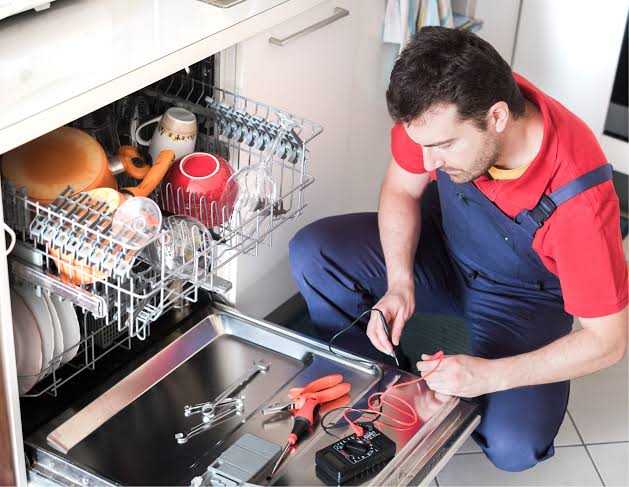
So we test under load, with water in the machine. Do the arms turn, and how hard does the spray strike the roof of the tub. What current is the pump drawing against its rated figure, and is that current steady or fluctuating in the way a cavitating or partly obstructed pump does. Only then, with the power off, do winding resistance and insulation get measured. The pump is condemned when both tests agree, not when one of them looks suspicious.
Noise deserves its own note, because a loud wash pump is often not a failing one. A constant bearing whine that persists regardless of water level is a genuine mechanical fault. Rattling or gurgling that changes as the sump fills is air, cavitation or detergent foam. A hard, intermittent clatter is something solid caught in the vanes. And some slimline machines in hard-surfaced Dubai kitchens have simply always been loud โ that is not a fault, and we would rather say so than sell a pump.
One more Dubai-specific trap is worth knowing. In summer, uninsulated rooftop tanks have been reported at 50 to 60C and villa cold lines at 35 to 40C, against a recommended dishwasher inlet of about 49C. When water arrives already hot, the heating phase is truncated and enzyme detergents can be denatured before they get to work on protein soils. Egg, milk and sauce residues bake on, the dishes come out dirty, and the wash pump takes the blame for what is actually a temperature and chemistry problem. Spray pressure in those machines is frequently perfect.
The swap itself is the easy part. Identifying the right variant and clearing whatever killed the old pump matters far more.
A bare circulation pump, or a pump with an integral flow-through heater in the same housing. Different part, different price, established before the quote rather than after.
Cabinet Decision 66/2023 requires a documented estimate and consent before work begins, and an itemised invoice afterwards. That is how we work as standard, not on request.
Machine unplugged and the supply tap closed before the base is opened, and the drain hose secured. Nothing is ever left part-dismantled for a customer to finish off.
The sump and base tray are emptied into a container first. Tilting a loaded built-in dishwasher forward without doing that is how kitchen carcasses and skirting get soaked.
Glass fragments in the sump, a collapsed filter, a foreign object in the housing, or a fill fault that starved it. Fitting a new pump into the same debris field simply buys a repeat visit.
New seals and clamps, then a full cycle with current draw, spray pressure, fill and drain all verified before we leave. Parts and labour carry a 90-day warranty.
And the longer list of things that imitate it convincingly enough to get it replaced for nothing.
If your dishwasher is still inside its manufacturer warranty, call the brand first and we will tell you so. Where we do the work, parts and labour carry a 90-day warranty โ well beyond the 15-day statutory minimum set by Cabinet Decision 66/2023.
Back to the main service page, or straight to the other pump โ the one this repair is most often confused with.
Showing a code rather than an obvious fault? Start here. Decode Your Error Code →
Our full dishwasher service across Dubai โ built-in, freestanding and slimline machines.
The other pump. Different part, different price, different symptom entirely.
Water standing at the end of the cycle, worked through from the cheapest cause up.
Dirty dishes with normal spray pressure. Temperature, dosing and loading before parts.
Model-specific notes, including the machines with an integral flow-through heater.
Tower kitchens, shared risers and tank-fed supplies across the Marina.
They are two separate motors doing opposite jobs, and confusing them is the most common reason a dishwasher repair gets misquoted. The circulation pump, also called the wash pump, draws water from the sump and forces it up through the spray arms under pressure. The drain pump takes that same water at the end of a phase and pushes it out to the waste connection. If the machine washes but never empties, that is the drain pump. If it fills and empties perfectly normally but the dishes come out dirty and the arms barely turn, that points at the circulation pump.
Usually not, and this is worth reading before anyone quotes you a motor. A wash pump that has become loud is far more often reacting to something else. Too little water in the sump lets the impeller draw air, which produces a harsh rattling or gurgling note that most people describe as a dying pump. A glass shard, a snapped cutlery tip or a fruit stone caught between the vanes makes a hard intermittent clatter. Both are cheap. A genuinely failing pump usually sounds different: a constant bearing whine or grind that does not change when the water level does.
Frequently, and those causes get checked first because they cost almost nothing. Blocked spray arm nozzles, a choked filter stack, an arm knocked off its bearing or jammed by a tall tray, a perished spray arm seal and a split feed pipe at the back of the tub all cut delivered pressure while the pump itself is in perfect health. Underfilling does the same thing, and in Dubai the usual reason for that is sediment from a building or villa water tank silting up the inlet valve mesh screen.
Under load, with water in the machine, because a pump that spins freely on the bench can still fail to develop pressure. We watch what actually happens during a wash: whether the arms turn, how hard the spray strikes the roof of the tub, the current the pump draws against its rated figure, and whether that current is steady or fluctuating the way a cavitating or partly obstructed pump does. Winding resistance and insulation are then measured with the power off. A pump is only condemned when the load test and the electrical test agree.
It changes the diagnosis and the price, so we establish it before quoting rather than after. Many current machines use a flow-through heater integrated into the circulation pump housing instead of a separate element in the base. On those, a heater failure and a pump failure can present as a single assembly fault, and the replacement part supplied is often the complete pump and heater unit. That costs meaningfully more than a bare pump. Knowing which variant your model uses is the difference between an accurate quote and a surprise on the invoice.
It depends on the age of the machine and what else is already tired, and we will give you a straight view rather than a sales pitch. On a machine under roughly seven years old with a sound tub, door seal and control board, a wash pump replacement is usually good value. On an older machine that has already had a drain pump, a heater and a board, the honest answer is often that further spending is not sensible. You get a written estimate before any work either way, so declining costs you nothing but the call-out.
The wash pump and the drain pump are different parts at different prices. We establish which one you actually need. Price agreed before any work.
Whether water is left standing at the end, whether the spray arms turn, and what the noise sounds like. Each answer points somewhere different.
+971 50 988 6591
Daily, 8:00 AM โ 6:00 PM
+971 50 988 6591
Send a short video of the wash with the sound on