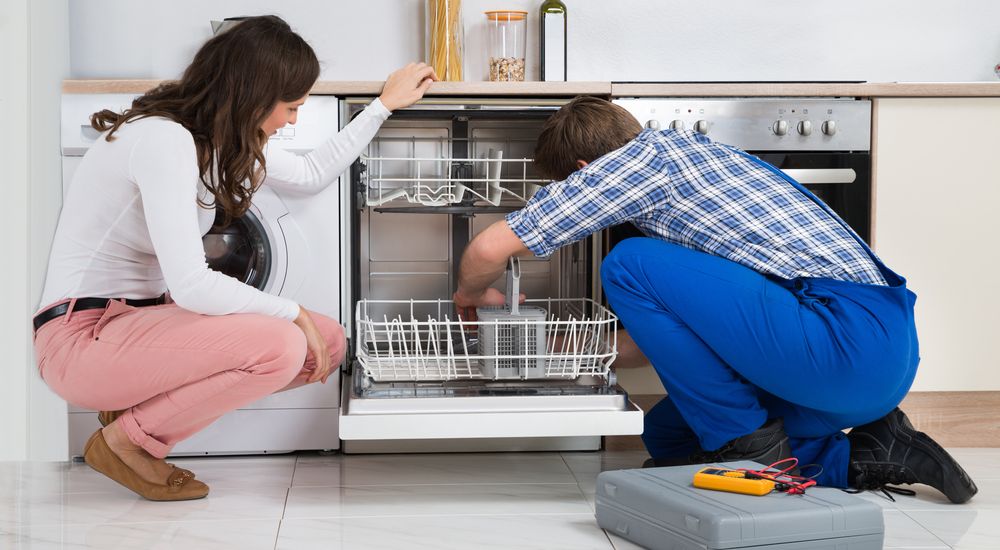
The apartments here were drawn before a dishwasher was assumed, so most of what we attend is a slimline 45cm machine wedged into a gap, a countertop unit beside the sink, or a full-size machine standing where the crockery cupboard used to be. Getting to the machine is usually harder than fixing it.
We are an independent repair company â not an authorized service center of any dishwasher brand. Brand names on this page identify only the machines we repair, and all trademarks remain the property of their owners.

Dishwasher repair in Discovery Gardens is a different exercise from the same job in a villa community, and the difference is almost entirely about space. The clusters here are low-rise, densely packed and now well into their second decade. The apartments are studios and one and two bedroom units laid out for efficiency, and the kitchens are short galley runs where every centimetre of base unit was allocated to something when the drawings were signed off. A dishwasher was not on that list.
So the machines arrived later, fitted by owners and landlords into whatever space could be surrendered. That produces three recurring installations, and we can usually guess which one we are walking into from a single photograph. The most common by a distance is a 45cm slimline built into a gap where a base unit was taken out. Second is a countertop machine standing beside the sink, plumbed to the tap and draining into the bowl or the trap. Third, and the one that causes the most domestic grumbling, is a full-size 60cm machine occupying the bay that used to hold the pans, the pressure cooker and everything else that now lives on the worktop.
None of that changes what goes wrong inside a dishwasher. Pumps still block, seals still perish, heaters still open circuit, sensors still drift. What it changes is everything around the fault. Access becomes the dominant variable in how long a visit takes. The plumbing is a retrofit rather than a design, which brings its own recurring failures. And the machine itself is often a smaller-capacity model doing full-household work, which shifts the maintenance rhythm noticeably.
The access point deserves stating honestly rather than glossed over in the way service companies usually do. In a great many of these kitchens the machine cannot be drawn forward until a cupboard beside it has been emptied. Cabinetry gets closed up after an appliance goes in, so a side panel now overlaps the machine edge. Floor tiling is frequently laid around the base rather than under it, leaving the feet sitting in a shallow well that has to be negotiated on the way out. A worktop bracket may be holding the top edge, and the screws for it are somewhere behind a run of crockery. On more than one occasion we have found the water supply and the socket both living inside the neighbouring cupboard, behind the shelf that has to come out first.
We say this early because it sets expectations correctly. If a repair needs the machine out of its opening, the first fifteen or twenty minutes of the visit is furniture and storage rather than tools. That is not padding and it is not an upsell. It is the physical cost of putting an appliance somewhere an architect did not intend, and it is the same cost whoever attends. What we can do is arrive knowing about it, with board to protect the floor and a plan for where the contents of the cupboard are going to sit while we work.
The second thing worth saying plainly is that a surprising share of Discovery Gardens call-outs are not faults at all. Water standing in the sump because the drain hose was routed flat is not a broken pump. A machine that trips a breaker because it shares a circuit with a kettle and a microwave on the same short run is not a machine with an electrical fault. A slimline that cleans badly on a full load is sometimes just a slimline that has been loaded like a full-size one. We would rather tell you that and take the diagnostic fee than sell you a part you did not need.
We cover all of the clusters and work on every domestic brand that turns up in them. Freestanding, semi-integrated, fully integrated and countertop are all ordinary work for us.
Not faults in themselves, but the conditions that shape almost every dishwasher call we take in the clusters.
45cm machines outnumber everything else here, because a 60cm one costs a full base unit of storage nobody can spare.
Six-place machines beside the sink, fed from the tap. Small, portable and entirely repairable, though parts availability varies by model.
Where a full-size machine went in, it took the pan cupboard with it. That bay is often boxed in tighter than a factory fit.
Most retrofits join the sink trap rather than a dedicated waste point, which works well until the trap or the branch silts up.
A flat, low hose run lets drained water siphon quietly back into the sump. It looks exactly like a drainage failure.
The machine will not come forward until something is emptied, unscrewed or lifted. Plan for it and the visit runs smoothly.

Three subjects account for the bulk of what we deal with in the clusters. Taken in order, they explain most of the calls and most of the misdiagnoses.
Getting the machine out. A factory kitchen leaves an appliance bay with a little clearance either side and a levelling allowance underneath. A retrofit rarely does. The gap was cut to the machine, the plinth was scribed to the floor afterwards, and anything the fitter could screw into, he screwed into. So the sequence is: empty and remove the adjacent shelf if the water and power are hiding in there, take off the plinth, release the worktop or side brackets, disconnect supply, waste and mains at the point where they are reachable, and only then walk the machine out on board. Hose and cable length is the usual limiting factor. Retrofit installs are frequently done with the shortest run that will reach, which means the machine can come forward perhaps twenty centimetres before something goes tight. Where that happens we disconnect first and pull second, rather than the other way around, and we replace a hose that has been kinked or stretched by earlier attempts.
Integrated machines add a step. The furniture door hangs on the appliance door with a spring or cable balancing it, and on a compact kitchen that panel may be catching on an adjacent handle before it opens fully. Taking the panel off before moving the machine is quicker than fighting it, and it also lets us check the door seal and the latch properly while it is exposed.
Where the waste goes. Almost every retrofit here tees into the sink trap rather than a dedicated waste point, because there is no dedicated waste point to use. That arrangement works perfectly well when it is done properly, and it produces four recurring problems when it is not. First, the blanking plug in the trap spigot is sometimes left in place, so the machine cannot drain at all from the day it was installed. Second, the trap and the short branch beyond it collect kitchen fat, and a partially blocked branch makes the sink gurgle and back up whenever the machine drains. Third, the join is often a push-fit with a jubilee clip that loosens with vibration and weeps under the cupboard, which is the origin of a good number of the damp cupboard bases we are shown. Fourth, and most often misread, is the hose route itself.
Siphon-back and standing water. A drain hose needs to rise before it falls. That rise, the high loop, is what stops water in the waste pipe tracking back down into the machine after the pump stops. In a kitchen with a shallow void and a worktop close to the machine there is often nowhere obvious to make the loop, so the hose is run flat along the cupboard base to the trap. The machine then drains correctly, and over the following hour the water quietly comes back. The owner opens the door next morning to a centimetre of dirty water in the sump and reasonably concludes the pump has failed. It has not. Bracketing the hose up under the worktop, or fitting a proper anti-siphon arrangement, fixes it for the price of the labour. We check the hose route before we touch the pump for exactly this reason, and if the fault turns out to be genuine drainage we cover that separately on our dishwasher not draining page.
Small filters, small sumps, small tolerances. A slimline machine washes roughly nine or ten place settings against thirteen or fourteen in a full-size one, but it does not get proportionally less abuse. Households load it to the roof and run it more often. The filter assembly is physically smaller, so the same scrap of rice or coffee grounds covers a larger fraction of the mesh, and the point at which flow to the spray arms starts to drop arrives sooner. The sump is shallower, which means less settling volume before debris reaches the pump chamber. The drain pump impeller is smaller in diameter, so foreign objects that a bigger machine shrugs off will stall it: bottle caps, date stones, olive pits, the little plastic clips off bread bags. None of this is a defect. It is simply a maintenance rhythm that has to be faster than the one the manual assumes, and weekly filter rinsing is worth more than any product you can buy. There is more detail on our filter and sump cleaning page.
Parts fitment is not interchangeable. This catches people out constantly. A 45cm machine is not a 60cm machine with the sides moved in. Spray arms, upper and lower baskets, rack rails, tine assemblies, the inner door panel and the door seal are all dimensioned to the cabinet width, so they carry their own part numbers even when the brand and range match exactly. Some heaters, circulation pumps and control modules are shared across a platform and some are not, and the only way to know is the full model and serial from the rating plate on the inner door edge. Ordering off a photograph of the front badge is how a part turns up that fits nothing. Countertop machines take this further again, since several are sold under multiple badges from a common design and the spares route depends on which one you have.
A short word on water, because it gets overstated. Dubai tap water is soft, not hard. The supply is overwhelmingly desalinated and then modestly re-mineralised, and the local hard-water story you will see in appliance marketing is not supported by the actual supply. It also does not vary from one Dubai neighbourhood to another. What genuinely varies is the building: sediment from tank and riser condition, and Dubai Municipality requires residential tanks to be cleaned at least twice a year for good reason. Cloudy or permanently dulled glassware in a soft-water supply is usually etching, a micro-pitting of the glass surface caused by over-dosed detergent, and it cannot be polished out. Set the machine from its manual and confirm with a test strip rather than from an internet figure. One more local point: cold feeds sitting in uninsulated rooftop tanks have been reported at 50 to 60 degrees in high summer, against a recommended inlet of around 49, and villa cold lines nearer 35 to 40, so a machine that appears to skip its heating stage in August may simply be receiving water that is already hot.
One boundary, stated plainly. Nothing above is an invitation to open up the installation yourself. Please do not work on mains wiring, and please do not dismantle a pressurised supply connection to look behind it. Rinsing the filter, checking that the trap spigot is clear from outside, and photographing the hose route are all genuinely useful and entirely safe. Everything past that point wants an isolated machine and a meter.
Six stages, arranged so that the cheapest explanations are eliminated before the machine is disturbed at all.
The machine in its opening, the cupboard under the sink and the rating plate inside the door. Width, waste arrangement and exact model, established before we set out.
Hose route, trap spigot, filter condition, door seal and latch, and whether the programme selected matches what the machine is being asked to do.
Adjacent cupboard emptied, plinth off, brackets released, floor protected. Done deliberately, because forcing a machine out of a tight gap damages flooring and hoses.
Filter stack out, sump emptied, drain pump impeller checked by hand for foreign objects, and the non-return flap inspected for debris holding it open.
Supply and earth at the appliance, door interlock continuity, then heater, pumps, valve and thermistor measured against the figures the service data expects.
What we found and what it costs, put to you before any work. Then the machine back in square and level, connections checked dry, and a full cycle run.
Worth knowing before you book, because it decides how much of the kitchen has to be dismantled and how long we need.
The list above covers a genuinely large share of what goes wrong in these kitchens, which is good news given how much furniture the alternative involves. If your fault is standing water, poor cleaning, a door that will not shut or a machine that stops part way, there is a reasonable chance we never disturb the cabinetry at all. That is also why we ask for photographs before the visit rather than after: seeing the hose route and the trap in advance often tells us which side of this page the job is going to fall on, and we can then allow the right amount of time instead of guessing.
Cabinet Decision 66/2023 sets a statutory minimum warranty of fifteen days on repair work in the UAE, plus a documented estimate with your consent before work and an itemised invoice afterwards. Ours is ninety days on parts and labour. If the machine is still inside its original manufacturer warranty, call the brand first.
Back to the main dishwasher page, or across to the faults that turn up most often in compact retrofitted kitchens like these.
Seeing a code on the display? Find out what it means before you call. Dishwasher Error Codes Explained →
Our full dishwasher service across freestanding, slimline, integrated and countertop machines.
Standing water in the sump, and how to tell a real blockage from a hose that siphons back.
The maintenance that matters most on a slimline machine, done properly rather than rinsed under a tap.
Damp cupboard bases in retrofitted kitchens usually start at the waste join, not the door.
Small sumps and shared kitchen waste branches are the two usual sources of a sour machine.
The same compact-kitchen work a few minutes along the road in Jumeirah Village Circle.
Because the kitchens are narrow and the cabinetry was laid out before a dishwasher was taken for granted. A 60cm machine eats a full base unit, which in a compact apartment is most of the dry storage. A 45cm slimline takes roughly three quarters of that width and still holds enough for a couple, so it is what most owners and landlords fit when they retrofit. Countertop units are the next step down, sitting beside the sink and plumbing into the tap. All three are ordinary machines with ordinary faults.
It is normal here and we plan for it rather than complain about it. Retrofitted machines are often boxed in by cabinetry that was closed up afterwards, held by a bracket screwed to the underside of the worktop, or standing on tiling laid around the base so it sits proud of the run. Clearing the neighbouring cupboard, lifting a plinth and easing the machine forward on protective board is part of the job. What helps is knowing in advance, so we allow the time instead of discovering it on the doorstep.
Not necessarily, and in a kitchen this size that is worth checking before anything is bought. Where a drain hose runs straight and low into the sink trap with no rise in it, the machine can drain properly and then let waste water track quietly back down into the sump afterwards. You wake to standing water and assume a pump fault. A proper high loop, or a bracket holding the hose up under the worktop, stops it. We look at the hose route before we look at the pump, because one costs a visit and the other costs a part.
In practice, yes. A 45cm machine has a smaller filter area and a shallower sump than a 60cm one, but the food coming off the plates is much the same. Debris therefore covers a greater share of the mesh per wash, and the point where flow starts to suffer arrives sooner. The drain pump impeller is smaller in diameter too, so a bottle cap, a date stone or an olive pit that a full-size machine would pass can bind it. Lifting and rinsing the filter weekly is the single most useful habit in a small kitchen.
Usually not, and ordering on the assumption that they are wastes a week. Spray arms, baskets, racks, door seals and inner door panels are all dimensioned to the cabinet, so the 45cm variant is a distinct part number even where the brand and range name match. Heaters, pumps and control modules are sometimes shared across a platform and sometimes not. This is why we photograph the rating plate inside the door and work from the full model and serial rather than the badge on the front.
Diagnosis on site, a clear explanation of what we found, and a price put to you before anything is done. If you would rather not proceed, that is a complete answer and the visit ends there. Work we do carries ninety days on parts and labour. For context, Cabinet Decision 66/2023 sets fifteen days as the statutory minimum for repair work in the UAE and requires a documented estimate, your consent before starting and an itemised invoice after. If the machine is still inside its manufacturer warranty, call the brand first and we will say so.
Tell us the width of the machine and what sits either side of it. Slimline, countertop and full-size retrofits each come out of a Discovery Gardens kitchen a different way, and knowing which one you have shapes the whole visit.
One picture of the machine in its opening, one of the cupboard under the sink, and the rating plate inside the door. Those three tell us the width, the waste arrangement and the exact model, which between them decide what we bring and how long we need.
+971 50 988 6591
Daily, 8:00 AM â 6:00 PM
+971 50 988 6591
Send photos of the machine in its gap and the pipework under the sink