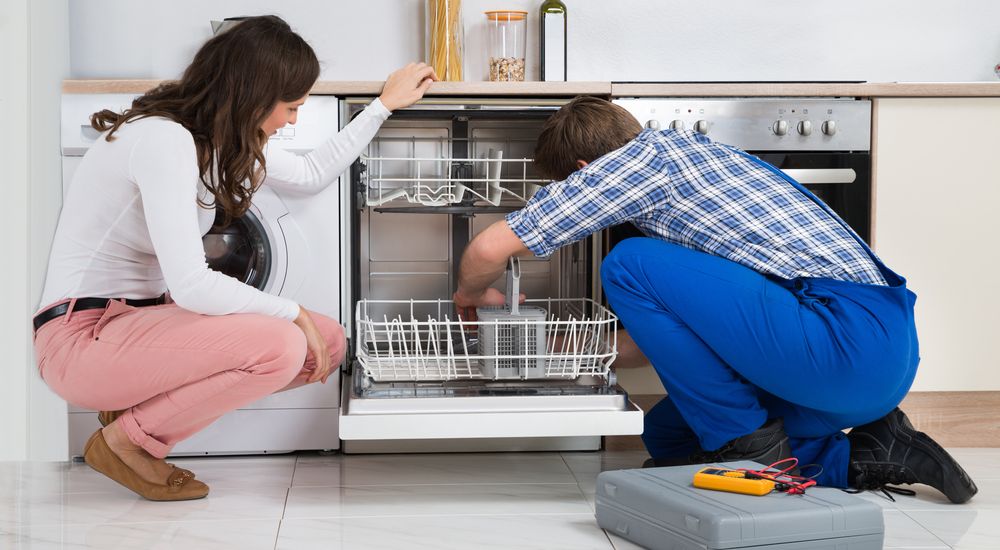
In these villas the fault is usually routine and the access is not. A machine boxed into a narrow galley run, behind a tiled plinth and joinery scribed around it, takes longer to reach than it does to mend â so we plan the extraction before we quote the repair.
We are an independent repair company â not an authorized service center of any dishwasher brand. Brand names on this page identify only the machines we repair, and all trademarks remain the property of their owners.

Dishwasher repair in The Springs and Meadows reads like the same job as anywhere else in Dubai, right up to the moment the plinth comes off. The faults themselves are ordinary enough â a drain pump that will not shift water, a heater gone open circuit, a spray arm that has stopped turning, a door seal flattened past the point of sealing. What is far from ordinary is the amount of joinery standing between a technician and the back panel of the appliance.
These are two of the earlier Emirates Living communities, and the kitchens announce their generation immediately. Springs properties are linked in short terraces; Meadows properties stand on their own plots but were fitted out to the same thinking. The cooking area runs along one wall, occasionally with a second short run facing it across a metre or so of floor, and the dishwasher was dropped into that line beside the sink with a decor panel across its front so the whole wall reads as continuous cabinetry.
The practical effect is that the machine is captive on three sides. Carcasses were scribed to it, the worktop overhangs it, and there is nowhere to put the appliance once it is out except in the doorway or in the middle of the floor with the fridge door blocked. On the narrowest runs the dishwasher door and the oven door cannot both be open, which alone dictates the order in which the work is done. None of this is a defect. It is simply what a compact galley layout costs you on the day something breaks.
The plinth is the first surprise. In a fair number of these villas the toe-kick is not a clip-on strip of laminate but a tiled face, bedded and grouted in when the floor was done. It cannot be pulled off; it has to be released carefully or worked around, and on a tiled plinth that is bonded to the screed there is no releasing it at all without damage. That single detail changes the shape of a visit, so we would rather see a photograph of it before arriving than discover it while kneeling on your floor.
Floor height is the second. Where tiling or new flooring went down after the original appliance was installed, the finished level rises and the aperture the machine must come out through shrinks. The dishwasher then sits in a shallow well, and dragging it forward simply grinds the front feet against the tile edge. It has to be lifted clear on adjustable feet, or the front edge protected and the whole body walked out, which is slower and considerably kinder to your floor than the alternative.
The services are short. Waste hose, inlet hose and flex were cut to length for a machine that was never expected to travel. Pull the appliance out past a certain point and it is tethered by its own plumbing, so the connections have to be broken at the trap and the service valve before it moves any further. That is work for somebody with the water isolated and a tray under the joint, and it is the one part of a dishwasher job we would ask you not to attempt in a villa where the shut-off valve may be twenty years old and stiff.
And the stock is old enough to matter. Plenty of these kitchens still carry their handover-era pipework â brittle plastic waste spigots, a corrugated hose that has hardened in place, a service valve that has not been turned since the villa was new. Others carry a dishwasher added years after handover by an owner or a tenant, in a slot where a cupboard used to be, with the waste teed into the sink and the electrical supply borrowed from wherever was closest. Both situations are common here and both change what we check first.
So the sequence is deliberately conservative. Everything that can be proved with the machine standing where it is gets proved there â fill, drain, heat, error history, door circuit â and the appliance only comes out of the run when the answer genuinely lives at the back of it.

None of these are faults. They are the conditions the repair has to be carried out inside, and knowing them in advance is most of the job.
Bedded and grouted rather than clipped. It sets how the machine is released and whether the front feet can be reached at all.
A galley run with a metre of floor. The appliance has nowhere to stand once it is out, so the work is staged rather than sprawled.
Drawer stacks and end panels cut around the machine. Sometimes one has to come off to gain the few millimetres of width.
Hose cut to length, trap under the sink, stack shared with the adjoining property. Little slack and no room for error.
Original valves, hardened hoses and brittle spigots from the 2000s. Old parts break when disturbed, so they get disturbed carefully.
Added after handover into a converted cupboard, with connections improvised at the time. Often the fault is in the install, not the appliance.

It is the question we field most often on villa visits, usually phrased as a suspicion: the machine has scaled up because the water out here is harder than it is in town. It is worth answering properly, because the premise is wrong twice over.
Start with the supply itself. Dubai does not draw its drinking water from a patchwork of local sources. The overwhelming majority of it is produced by desalination and pushed into a single integrated distribution network that serves the whole emirate. Desalinated water leaves that process very low in dissolved minerals and is then only modestly re-mineralised so it is stable in the pipes. The water arriving at a villa in The Meadows and the water arriving at a thirtieth-floor apartment came out of the same system. There is no separate, harder supply for the outlying communities, and there never was.
Then take the second half of the premise. The supply is soft, not hard. The idea that Dubai has punishing hard water is vendor marketing that has circulated long enough to sound like common knowledge, and acting on it does real harm: owners set the machine to a maximum hardness level it does not need, keep the salt reservoir topped up out of habit, and descale monthly on a schedule invented for a completely different water supply. On soft water, over-treating is not a neutral choice. Combined with a heavy detergent dose it is one of the routes to permanent etching on glassware â micro-pitting that is not a deposit and will not polish out, which is a very different thing from limescale.
We do not publish a hardness number here. Anybody quoting you a precise figure for your street is guessing. The right procedure is the boring one: read what your machine manual asks for, take a reading with a test strip, and set the softener to that. Once. Then leave it alone.
What does vary is your own address, not your community. A villa fills from its own storage, and tanks age at different rates depending on how they were installed and how often they are opened. A property that sits empty over the summer, or one whose tank has not been serviced in a while, can put sediment and stagnant water into a machine that a neighbour four doors down never sees â and Dubai Municipality requires residential tanks to be cleaned at least twice a year for exactly that reason. Inlet temperature in high summer is worth a thought too, since a hot feed shortens the heating phase the programme was designed around.
All of which points somewhere useful. When a Springs or Meadows machine washes badly, the honest shortlist is a blocked filter, a spray arm with plugged jets, a tired circulation pump, a heater that no longer heats, or a detergent and loading habit that was never quite right. Mineral content is near the bottom of that list, and the fix for the top of it costs a great deal less than a water treatment system somebody wants to sell you.
One caveat we will happily state against our own interest. If your glasses have gone permanently cloudy, no repair and no additive brings them back, and anyone promising otherwise is selling you something. What a visit can do is stop it happening to the next set, and that is almost always a dosing and setting conversation rather than a parts one.
Gate to gate, with the least invasive checks taken first and the machine staying in its run for as long as the evidence allows.
Villa number and street at the time of booking, visitor logged at the community gatehouse, and the van parked within a few steps of the entrance. No lift booking, no loading bay, no building approvals to chase.
Where the machine sits in the run, how the plinth is built, whether the panel is integrated, and what the floor level is doing at the front feet. Two minutes here decides the whole method.
Fill, drain, heat and door circuit checked in place, plus any stored fault read from the machine in its own service mode. A great many jobs finish at this stage without the appliance moving.
Water isolated at the service valve, waste broken at the trap with a tray beneath it, feet wound down, floor protected, and the body walked out rather than dragged over a tile lip.
What has failed, what it takes to put right, and what it comes to â put to you before a single part is fitted. If the answer is a habit rather than a component, we say that instead.
Refitted level, hoses routed with the loop the manufacturer asks for, panel realigned so the door shuts without a shove, plinth back on, and a wash cycle run before we leave.
Extraction is the expensive half of the visit in a kitchen this tight, so it is worth being clear about which faults actually require it.
When it does have to move, the extraction is planned rather than improvised. Old fittings in these villas are the risk worth naming out loud: a service valve that has not turned in fifteen years may not want to close, and a hardened waste spigot can crack the moment a hose is twisted off it. We would far rather flag that possibility to you before starting than present it afterwards as an unexpected extra. Where a fitting does need renewing to get the machine safely back in, you hear the price for it at the same moment we do.
Cabinet Decision 66/2023 Article 26 sets a statutory minimum repair warranty of fifteen days in the UAE, alongside a documented estimate, your consent before work begins and an itemised invoice afterwards. Ours runs to ninety days. If the machine is still covered by its original manufacturer warranty, call the brand first.
Back to the main dishwasher page, across to a neighbouring villa community, or straight to the symptom that brought you here.
Seeing a code on the display? Find out what it means before you call. Dishwasher Error Codes Explained →
The full dishwasher service across freestanding, built-in and integrated machines.
Standing water in the base, and how to tell an appliance blockage from a waste one.
Water on the tile under a boxed-in machine, traced before the cabinetry gets damaged.
Larger detached villas nearby, with their own tanks and their own set of quirks.
Townhouses and low-rise units with compact kitchen runs of a similar shape.
One of the most common integrated machines in these kitchens, and how we approach it.
No, and the belief that it is has cost a lot of owners money in salt and descaler they never needed. Dubai draws almost all of its drinking water from desalination, and that output feeds one integrated distribution network, so a villa in The Springs receives the same treated supply as an apartment tower in the Marina. Desalinated water is soft before it is lightly re-mineralised for stability. What genuinely differs from address to address is the storage tank a property fills from, not the community it sits in. For a hardness figure, use the machine manual and a test strip.
Almost always, but the order of operations decides whether it is a calm ten minutes or an afternoon. The plinth comes off first, then any bracket holding the appliance to the worktop or the side panels, then the feet are wound down so the top clears the underside of the counter. Where floor tile was laid after the original install, the machine sits in a shallow recess and has to be lifted rather than dragged. Occasionally a drawer stack is removed to gain the width. All of it goes back as it was.
Nothing like the arrangements a tower needs. The community gatehouse logs visitors, so give us the villa number and street when you book and either register the visit yourself or meet us at the barrier. There is no service lift to reserve, no loading bay slot and no building management approval to chase. The van parks within a few steps of your front door, which is a real advantage on this kind of job: tools, spare hoses and test gear stay close by instead of sitting in a basement car park two lifts away.
Yes, and those machines are worth a closer look at the connections than the appliance itself. A retrofit usually means a hose teed into the sink waste, an inlet spliced off the tap feed and a plug run to whatever socket was nearest. Any of those can produce symptoms that read as an appliance fault: siphoning back into the tub, weak fill, or a machine that trips the kitchen circuit. We test the installation alongside the machine. Where the electrical supply itself needs altering, that is a job for a qualified electrician rather than for us.
It can be, because the kitchen waste run in a link villa is short and joins a stack shared with the property next door. The first job is still to prove where the restriction sits. If the machine will not clear its own sump, the filter, pump or non-return valve is the candidate. If the sink gurgles and fills at the same time, the blockage is past the trap and shared with your neighbour, which makes it a plumbing and community management matter rather than an appliance repair. We tell you which of the two it is before quoting.
Ninety days on the parts we fit and the labour to fit them. For context, Cabinet Decision 66/2023 Article 26 sets fifteen days as the statutory minimum on repair work in the UAE and also requires a documented estimate, your consent before the work starts and an itemised invoice afterwards. Ask any repairer for all three. One thing we would rather say up front than after the fact: if the machine is still inside its original manufacturer warranty, ring the brand before you ring us, because paying twice for the same part helps nobody.
Two lines about the kitchen run and one about the fault save an entire wasted visit. Cause, cure and figure are agreed with you before anything is unscrewed.
Whether the machine is integrated or standing free, whether the plinth is tiled or clipped, and what the fault does. That is enough to arrive with the right tools and the right expectations.
+971 50 988 6591
Daily, 8:00 AM â 6:00 PM
+971 50 988 6591
Send a photo of the machine in its run and one of the plinth below it