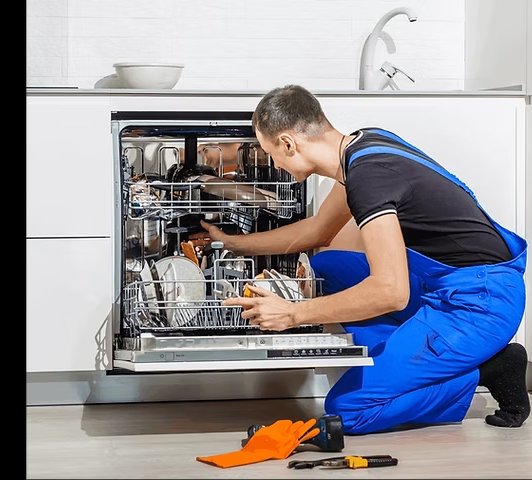
Here the storage tank and the pressure equipment belong to the household, not to a building. That changes what turns up inside the machine, so it changes where we look first.
We are an independent repair company â not an authorized service center of any dishwasher brand. Brand names on this page identify only the machines we repair, and all trademarks remain the property of their owners.

Dishwasher repair in Arabian Ranches begins from a fact that applies to none of our tower pages. In this community the water storage and the pressure equipment are household property. There is no plant room, no building manager, and no facilities contractor quietly keeping anything in order. The tank stands on your plot. The booster pump and pressure vessel serve your house and nothing else. When any link in that chain drifts, the appliances downstream register it first, and the dishwasher tends to be the loudest complainer of the three.
Almost all appliance advice written for Dubai assumes an apartment. It assumes shared risers, a serviced plant room and somebody else holding the maintenance file. Swap that for a villa and half of it stops applying. So the order in which we check things here is deliberately different from the order we use in Dubai Marina or JLT, where the building answers for the water and the resident answers only for the machine.
Start with the tank, because that is where the difference bites hardest. Dubai Municipality sets a floor of two cleans a year for residential storage. In a tower that obligation sits with a contractor and is discharged on a schedule the resident never has to think about. In a villa it sits with whoever holds the keys, and it slips â not through neglect, but because nothing reminds you it is due. A tank left eighteen months develops a settled layer across its floor: fine sand, scale carried down from upstream pipework, whatever found its way in during a supply interruption. Draw heavily on the line, or refill after an outage, and that layer lifts and travels.
It comes to rest in two places inside a dishwasher. The first is the small mesh screen behind the inlet valve, right where the hose couples to the machine. Silt that screen and the fill slows; slow it far enough and the control decides no water is arriving at all and halts with a fault. The second is the sump under the filter, where grit settles and grinds against the pump. Neither of those is a failed component. Both are the reason we open the water side before we go anywhere near the electronics.
There is a practical consequence to owning the whole chain, and it is not all bad news. In a tower, a resident who suspects the water is at fault has to raise a ticket and wait for somebody else to investigate a plant room they will never see. Here, the tank is fifteen paces away and you can open it. If you last had it cleaned when you moved in and that was three years ago, you already know more about the likely cause than any fault code will tell you. Booking the clean is cheaper than most appliance repairs, and it protects the water heater and the washing machine at the same time.
One correction while we are here, because it changes what you should be buying. Dubai water is not hard. Very nearly all of it starts as seawater through desalination and is re-mineralised only modestly before distribution, so the mineral load arriving in Arabian Ranches is low against most European or North American supplies. The hard-water claim recycled through local appliance marketing has no published source behind it, and the descalers and salt regimes it sells you are not what your machine needs. Set the appliance from its own manual and a test strip, and treat sediment as the real local adversary â because it is.
None of these are exotic faults. They are ordinary ones with a villa-shaped cause behind them.
No contractor is cleaning it on a schedule you never see. Where the twice-yearly minimum lapses, grit reaches the inlet screen and the sump.
A pressure vessel with no air charge left makes the booster pump cycle in bursts. The machine fills against a moving target instead of a steady one.
Pipework that crosses a plot and runs outside for part of its length arrives warm in summer, which shortens the heating phase to nothing.
Across two storeys the kitchen can sit a long way from storage. More standing volume in the line means more time for it to warm and more to flush through.
Fine grit plus protein soils that never got broken down properly. The filter well fills sooner than the manual leads you to expect.
Villa kitchen drainage often takes a longer route out than an apartment stack. Falls, traps and the high loop all get checked on site.

Behind most villas here sits a booster pump and, alongside it, a pressure vessel â a steel or composite bottle with a rubber diaphragm and a cushion of air on the far side. The air cushion is what lets the pump rest between demands. When it leaks away, and over years it does, the diaphragm has nothing to push back against. The pump then starts and stops every few seconds under any small draw, and pressure at the fixtures rises and falls instead of holding a line.
A dishwasher notices that before you do. Machines fill either against a timer or against a flow meter, and both assume the supply is reasonably steady. Feed one a pulsing line and you get short fills, cycles that stop early with a fill fault, and wash quality that varies from one load to the next with no change in what you loaded. Owners usually blame the appliance, sometimes replace it, and inherit the same behaviour from the new one. That is the outcome we would rather you avoid, so we gauge pressure and time an actual fill at the machine before touching anything internal.
If the reading points at the pump or the vessel, we will say so directly. That is a plumbing job, not an appliance one, and it is not work we will invent a dishwasher fault to cover. The same applies to the isolating valve under your sink: a partially closed or corroded valve throttles the supply just as effectively as a failed pump, and it costs a fraction to put right.
What you can safely do yourself is limited but useful. Close the isolating valve, unplug the machine at the socket, and look at the filter well with a torch â if you can see sand sitting in it, you have your answer about the tank. Many villas here also have an inline sediment cartridge under the sink or near the tank; if yours does and it has never been changed, change it. What you must not do is break into pressurised pipework or unwire anything. A supply line under booster pressure is not a hand-tight fitting, and dishwashers sit close enough to their electrics that the two problems become one quickly.
Age of build matters too. The older phases of the community have pipework and pressure equipment that has now been in service a long time, and vessels are rarely replaced until something forces the issue. Newer plots tend to have healthier equipment but longer, more convoluted runs to reach a kitchen at the back of the plan. Neither is better or worse for an appliance; they simply fail in different ways, and knowing which you have shortens the visit. If you know when the pump was last looked at, tell us when you book â it is more useful to us than the model number.
Summer adds the last complication. An uninsulated tank in the open has been reported between 50 and 60 degrees during the hot months, and a villa cold line between 35 and 40, against the roughly 49 degrees manufacturers want at the inlet. Water delivered at or above its own target leaves the heating stage with no work to do, and enzyme detergents are denatured before they can act on protein residue. The residue then arrives in the sump as solid matter rather than leaving in solution, which is why poor cleaning results and a silted filter so often show up in the same visit.
Water side before electrical side, and the cheapest likely cause before the expensive one.
Your name and ours at the community security desk when you book, or your phone to hand on arrival. No lift booking and no building permit needed here.
Pressure gauged and a real fill timed at the appliance connection, so we know whether the machine is being fed properly before we blame it.
The hose uncoupled with the isolator closed and the screen inspected. Villa sediment shows here first, and it rinses clear rather than needing a part.
Filter stack out, sump well emptied and checked for grit, spray jets held to the light. Glass fragments are lifted with pliers, never by hand.
Hose, high loop, trap and the longer waste route a villa kitchen usually has. A restriction out there mimics a failed pump convincingly.
Fault, remedy and price set out and agreed before a component is fitted. If flushing the screen and clearing the sump fixed it, that is the invoice.
Plenty of what gets blamed on the community is simply how dishwashers behave.
Unitech holds trade licence 134585, issued in Ajman. Dubai â Arabian Ranches included â is a service area we travel to, and we would rather state that plainly than let a badge imply otherwise.
Cabinet Decision 66/2023 Article 26 sets a statutory minimum repair warranty of fifteen days in the UAE, together with a documented estimate, your consent before work begins, and an itemised invoice afterwards. Ours runs to ninety days. If the machine is still inside its original manufacturer warranty, call the brand first.
Back to the main dishwasher page, or straight to the symptom that brought you here.
Seeing a code on the display? Find out what it means before you call. Dishwasher Error Codes Explained →
The full dishwasher service across Dubai â freestanding, built-in and integrated machines.
The symptom villa sediment causes most often, worked through in order.
Screen flushed and the valve tested before a replacement is ever quoted.
Warm inlet water and blocked jets are the usual pair behind gritty results.
Fault codes read off the machine rather than guessed at from a forum thread.
No, and it is not hard anywhere in the emirate. The supply reaching this community is the same desalinated water the rest of Dubai receives, re-mineralised only lightly on its way out, so the dissolved mineral content is low by international standards. The hard-water line repeated across local appliance advertising has no published source behind it. What genuinely varies from one address to the next is storage â how recently your tank was cleaned and what has settled on its floor. That is suspended sediment, a mechanical problem, and it needs a different answer entirely.
Because in a villa nobody else is booking it. The municipal floor for residential storage is two cleans a year, and in a tower a facilities contractor absorbs that quietly. Here it is your call to make, and it is the sort of job that slips because nothing prompts you. When it lapses, a settled layer builds on the tank floor and lifts whenever the supply is drawn hard. Inside the machine it lands first on the mesh screen behind the inlet valve, slowing the fill, and then in the sump under the filter.
Frequently, yes. A villa runs its own booster pump and pressure vessel, and both wear. A vessel that has lost its air charge makes the pump switch on and off in quick bursts, so pressure at the tap pulses rather than holding a steady line. A dishwasher fills against a timer or a flow meter and copes badly with that. You see short fills, a fault part way through, or wash results that swing week to week. We measure at the machine first, because a pump problem is a plumbing job and we will tell you so.
Less than a tower needs, but it is not nothing. There is no service lift to reserve and no building work permit to arrange, which is what usually delays a visit in Marina or JLT. What we do need is entry at the gate â leave our name and vehicle with the community security desk when you book, or keep your phone to hand when we arrive. Parking is on your own driveway. If the machine has to come out of a cabinetry run, please empty the sink cupboard and leave floor space alongside it.
It can, particularly across a two-storey villa where part of the run sits outside. Through the hot months an uninsulated tank has been reported between 50 and 60 degrees and a villa cold line between 35 and 40, against an inlet temperature manufacturers set near 49. Water arriving already at target leaves the heating phase with nothing left to do, and enzyme detergents are denatured before they reach the protein soils they were meant to break down. Drawing the kitchen tap cold for half a minute before you start a cycle helps more than it sounds like it should.
Ninety days on the part we fit and the labour to fit it. For context, Cabinet Decision 66/2023 Article 26 sets fifteen days as the statutory minimum on repair work in the UAE, and obliges a repairer to give you a documented estimate, take your consent before starting, and hand over an itemised invoice at the end. Ask for all three from anybody. And one thing we say on the phone rather than at your door: if the machine is still inside its original manufacturer warranty, call the brand before you call us.
Pressure and flow measured at the machine, inlet screen and sump opened, then the fault and the price agreed with you before any part is fitted.
Slow fill, a cycle that stops early, grit in the base, or dishes coming out gritty rather than dirty. Each of those points somewhere different in a villa.
+971 50 988 6591
Daily, 8:00 AM â 6:00 PM
+971 50 988 6591
Send a photo of the filter well and your under-sink pipework