🏛️ Licensed & Registered — Trade License No. 134585 🕒 Open Daily 8:00 AM – 6:00 PM 📞 +971 50 988 6591
📳 Vibrating & Shaking

Washing Machine Shaking and Vibrating — the Mechanics of Movement

Holding a wet, off-balance drum steady at 1,200 rpm is a genuine engineering problem, solved by four components working together. When a machine shakes, one of them has stopped doing its job — and two of the possible answers cost nothing at all.

⚡ Same-Day Visits 🛡️ 90-Day Warranty 💲 Quote Before Any Work 🏛️ License No. 134585
ℹ️

We are an independent repair company — not an authorized service center of any washing machine brand. Brand names on this page are used only to identify the machines we repair. All trademarks belong to their respective owners.

💡 Check the Transit Bolts First — Especially If You Have Moved

Every washing machine leaves the factory with bolts through the rear panel that lock the drum rigid so it cannot swing during transport. They must be removed before the machine is ever used.

Here is why this matters in Dubai specifically: people move often, and when a machine is moved between homes those bolts are frequently refitted to protect the drum in transit — then not taken out again at the other end. The machine then runs with no working suspension at all. It shakes violently, bangs hard, and sounds like something serious has broken.

Look at the back panel for three or four large bolts, often with plastic collars. If they are fitted and the machine is in use, that is your answer. Removing them takes a few minutes, costs nothing, and completely transforms the machine. This is comfortably the most common "serious fault" we are called to that turns out not to be a fault at all.

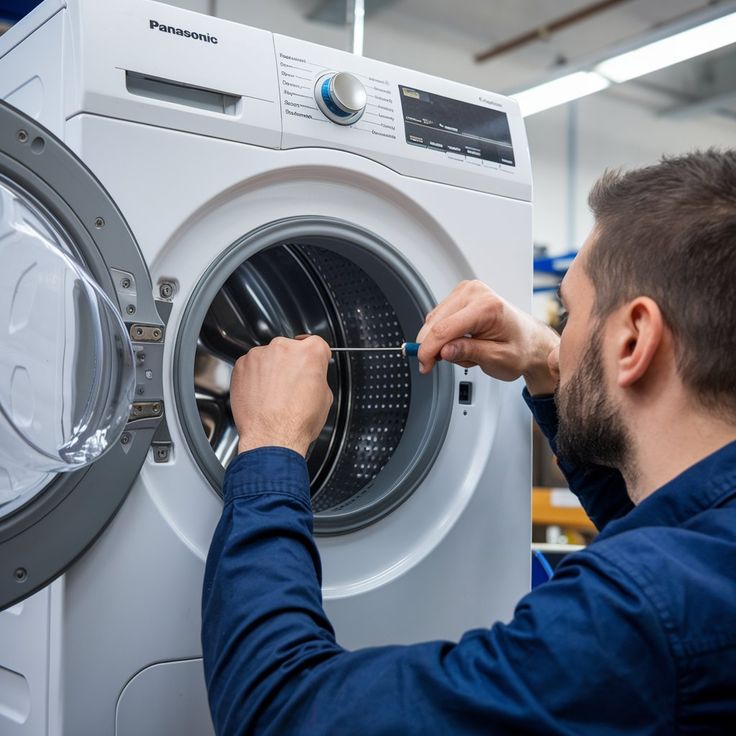
Technician inspecting the suspension and counterweights of a washing machine
The Four Things Keeping It Still

What Actually Holds a Drum Steady at Full Spin

A drum full of wet laundry spinning at over a thousand revolutions a minute wants to move. Four components stop it, and a vibration problem is always one of them failing.

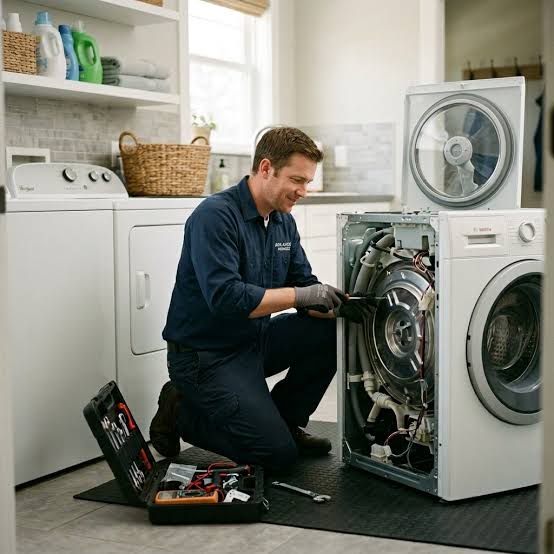
Counterweights. Heavy concrete or composite blocks bolted to the outer tub. They add mass so the assembly resists being thrown around. They rarely fail — but their mounting bolts can work loose over years of vibration, which produces a heavy knocking that people often mistake for bearings.

Suspension springs. These hold the drum assembly up inside the cabinet. A broken spring lets the drum hang low and off-centre, and you can usually see it sitting unevenly behind the door.

Shock absorbers. These damp the drum's movement — they turn oscillation into heat instead of letting it build. Worn absorbers are the single most common cause of a machine that walks across the floor: the drum swings and nothing slows it down, so the wobble compounds as the spin accelerates.

The feet. Four adjustable feet that must put the machine solidly on the floor with no rocking. Get these wrong and the other three components cannot do their jobs, no matter how good they are.
Do This Properly

How To Level a Washing Machine — the Full Procedure

Most people adjust one foot until the rocking stops. That is not levelling, and it comes undone within weeks. This is the whole job, and it takes about ten minutes.

  • Switch off at the socket and pull the machine out far enough to reach all four feet comfortably. Do not attempt this with the machine wedged in place.
  • Loosen the locking nut on each foot. Almost every adjustable foot has a nut that tightens up against the machine's base. If you adjust the foot without loosening this first, you are fighting it.
  • Get it sitting firmly on all four feet. Push each top corner in turn. If the machine rocks in any direction, adjust the diagonally opposite foot until it does not. Work round all four rather than fixing one and stopping.
  • Check it with a spirit level. Across the top side to side, then front to back. A phone level app is accurate enough. Adjust the feet until both readings are level.
  • Tighten every locking nut back up against the base. This is the step almost everyone skips, and it is why the problem returns. An unlocked foot vibrates loose again within weeks.
  • Push it back with a small clearance gap. The machine should not be touching the walls or the cabinet sides. Contact transmits vibration straight into hard surfaces and amplifies it dramatically.
  • Test with a spin-only cycle on a small, evenly distributed load and listen to the difference.
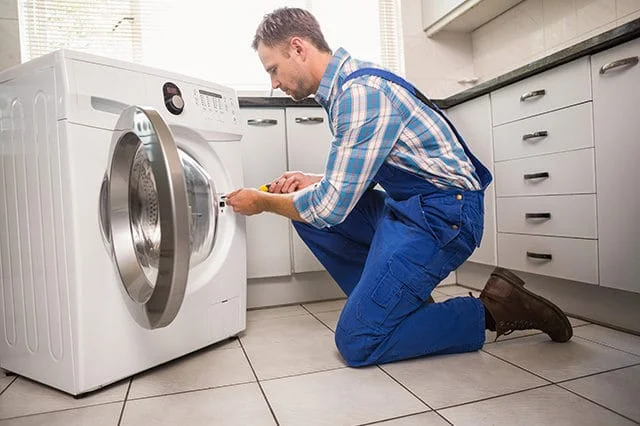
Technician adjusting and levelling a washing machine during a repair
Ranked By How Often We Find It

Why a Washing Machine Vibrates

In the order we actually encounter them. The first three cost nothing to resolve.

1. Transit Bolts Still Fitted

No working suspension at all. Violent shaking and hard banging. Free to fix, and the most common non-fault we attend — particularly after a house move.

2. Unbalanced Load

A duvet, bath mat or bundled towel to one side. Redistribute by hand and run a spin-only cycle. If it is smooth, there was no fault.

3. Feet Not Levelled or Not Locked

The machine rocks, or a foot has vibrated loose. Correct levelling with the locking nuts tightened transforms it.

4. Worn Shock Absorbers

The drum oscillates and nothing damps it, so the wobble builds as the spin accelerates. The most common genuine fault here, and an inexpensive part.

5. Broken Suspension Spring

The drum hangs low and off-centre — often visible behind the door. Dramatic but straightforward to replace.

6. Loose Counterweight Bolts

Heavy knocking as the counterweight shifts against the tub. Frequently mistaken for bearings, and often just needs re-torquing.

7. Machine Touching Walls or Cabinet

Contact transmits vibration into tiles and joinery. The movement may be normal; the noise is not. Clearance fixes it.

8. Uneven or Sloped Floor

Balcony floors are deliberately laid with a slope to a drain, which is one of the hardest surfaces to stabilise a machine on.

9. Worn Drum Bearings

Only if there is also a deep grinding that rises with spin speed and the drum rocks by hand. Different problem, much bigger job.

Technician setting a washing machine level in a kitchen installation
Local Factors

Why This Is Worse in Some Dubai Homes Than Others

Two installation situations make vibration considerably harder to control, and both are common here.

Balcony and utility-alcove installations. Balcony floors are deliberately laid with a fall towards a drain, so the surface is not level by design. Getting a machine stable on a sloped floor takes more careful foot adjustment than a flat kitchen floor, and it is easy for a foot to work loose and put the machine back out of true.

Tight recesses with tiled walls. Where a machine is fitted into a narrow bathroom or utility recess, it often ends up touching a wall or a pedestal. Tiles are hard and resonant, so contact turns ordinary drum movement into a noise that sounds like a mechanical failure. In these installations, establishing a genuine clearance gap can matter more than any part.

Neither of these is a fault in the machine. Both are why we check the installation as carefully as the components — and why we re-level the machine before leaving on every visit, whatever we were originally called for.

Our Repair Process

What the Technician Does On Arrival

Check the Transit Bolts

First thing, every time. It is free to resolve and it accounts for a real share of these callouts.

Test Load Balance

A spin-only cycle on an even load, to separate a genuine fault from a lopsided duvet.

Level and Lock the Feet

All four feet set with a level and the locking nuts tightened, plus clearance from walls and cabinets.

Test the Suspension

Shock absorbers, springs and counterweight mountings checked by hand and under power.

Rule Out Bearings

Drum play tested, so a suspension quote is never given for what is actually a bearing failure.

Related Pages

Related Washing Machine Problems

This page covers the movement. If you are trying to identify a sound, start with the noise guide.

Showing a code rather than just a symptom? Start here. Decode Your Error Code →

🔊

Making Loud Noise — Start Here

The noise decoder: telling grinding from knocking from rattling from humming. Start here if it is a sound rather than movement.

Making Noise →

⚙️

Drum Bearing Replacement

If there is grinding as well as movement, this is the page you need. Includes the drum-play test.

Drum Bearings →

🌀

Not Spinning

Worn suspension can make a machine abandon its spin entirely through unbalance detection.

Not Spinning →

🧺

Main Service Page

Everything we repair on washing machines — all types and all brands.

Washing Machine Repair →

🌡️

Balcony Installations

Heat and sloped floors together make this the hardest install to stabilise.

Motor City →

🚿

Tight Tiled Recesses

Where clearance matters more than any component. Bathroom installations explained.

Discovery Gardens →

FAQ

Vibrating & Shaking — Your Questions

My machine started shaking violently right after we moved. Why?

Almost certainly the transit bolts. Every new washing machine ships with bolts through the rear panel that lock the drum solid so it cannot swing during transport, and they must be removed before the machine is used. When a machine is moved between homes those bolts are frequently refitted to protect it — and then not taken out again. The result is a machine with no working suspension at all, which shakes hard and sounds alarming. It is completely free to fix.

How do I level a washing machine properly?

Switch it off and pull it out enough to reach the four feet. Loosen the locking nut on each foot, then adjust the feet so the machine sits firmly on all four with no rocking — test by pushing each top corner in turn. Use a spirit level across the top from side to side and front to back. Then tighten each locking nut back up against the base, because a foot that is level but not locked will work loose again within weeks. Finally push the machine back leaving a small gap from the walls.

What is the difference between worn shock absorbers and broken springs?

The springs hold the drum up; the shock absorbers damp its movement. Worn shock absorbers let the drum oscillate for too long, so the machine builds up a violent wobble as it accelerates into the spin and often walks across the floor. A broken spring is more dramatic — the drum hangs low and off-centre, and you can usually see it sitting unevenly behind the door. Both are replaceable and neither is among the expensive repairs.

Does the floor make a difference?

A significant one. A machine on a solid, flat tiled floor transmits far less than the same machine on an uneven surface, and a balcony floor deliberately laid with a slope to a drain is one of the hardest places to keep a machine stable. Tight recesses matter too — where the machine sits close to tiled walls or a cabinet, vibration transmits into hard surfaces and sounds far worse than the actual movement warrants.

Can an unbalanced load really cause this?

Yes, and it is worth ruling out before anything else. A single heavy item such as a duvet, a bath mat or a bundled towel sits to one side and the drum spins off-centre. Most machines detect this and either reduce the spin speed or abandon it, but some will still attempt it and shake hard. Open the door, spread the load evenly, remove any single heavy item and run a spin-only cycle. If it is smooth, there was never a fault.

When is vibration actually a bearing problem?

When it comes with a deep grinding or rumbling noise that rises as the spin speed increases, and when you can rock the drum by hand with the power off. Suspension faults produce knocking, banging and movement without that grinding character. The distinction matters because suspension parts are inexpensive while bearings are the largest repair on the machine, so it is worth establishing which one you have before committing.

Check the Transit Bolts, Then Call Us

If the back panel is clear and the load is balanced and it still shakes, it is the suspension — and those are inexpensive parts. Send us a video of the spin.

Book a Repair

Tell Us What You Have Already Checked

Whether the machine has been moved recently, whether the transit bolts are out, and whether it rocks when you push the top corners. Those three answers narrow it immediately.

📞 Phone

+971 50 988 6591
Daily, 8:00 AM – 6:00 PM

💬 WhatsApp

+971 50 988 6591
A ten-second video during the spin is ideal

Request a Vibration Diagnosis

Opens WhatsApp with your request pre-filled — nothing is stored on this site.

Your details go directly to our team on WhatsApp. See our Privacy Policy.

Call Now+971 50 988 6591 WhatsAppInstant chat reply