🏛️ Licensed & Registered — Trade License No. 134585 🕒 Open Daily 8:00 AM – 6:00 PM 📞 +971 50 988 6591
📋 Error Codes — All Brands

Washing Machine Error Codes Explained — Every Major Brand

Look your code up by what the machine is actually doing, across fifteen brands. And read the part most code lists leave out: which manufacturers publish schemes you can rely on, and which do not.

⚡ Same-Day Visits 🛡️ 90-Day Warranty 💲 Quote Before Any Work 🏛️ License No. 134585
ℹ️

We are an independent repair company — not an authorized service center of any washing machine brand. Brand names on this page are used only to identify the machines we repair. All trademarks belong to their respective owners.

💡 Read This Before You Trust Any Code List — Including Ours

Almost every washing machine error code page online presents its table as though all brands work the same way. They do not, and that gap causes real misdiagnosis.

Some manufacturers genuinely do publish consistent, well-documented schemes. Bosch and Siemens share the BSH code family. Whirlpool, Ariston, Indesit and Hotpoint share a Whirlpool-group F-code system. Electrolux, AEG and Zanussi share a structured Electrolux E-code system. Samsung and LG each maintain their own consistent sets. For all of those, a code list is dependable.

Other brands simply do not work that way. Beko uses more than one indication method across generations. Candy has changed schemes between model families. Daewoo-branded machines have come from more than one manufacturer. Hitachi sells both Japanese-domestic and regional-export variants in this market. For those, a generic table may accurately describe a completely different machine from the one in your home.

We have set out below which is which. It is the honest version, and it is why we ask for your model number alongside the code rather than just looking the code up.

Look Up By Symptom

What Your Code Means, Across Every Brand

Find what the machine is doing, then read across to your brand. This is more reliable than searching a code in isolation.

🚱 Water not draining

  • Samsung — 5E / 5C / E2
  • LG — OE
  • Bosch & Siemens — E18 / F18
  • Electrolux & AEG — E20 / E21
  • Whirlpool, Ariston & Indesit — F05
  • Beko, Candy, Daewoo, Hitachi, Super General — varies; diagnose by symptom

Full drain diagnostic guide → · Pump replacement →

🚰 Not filling with water

  • Samsung — 4E / 4C / E1
  • LG — IE / 1E
  • Bosch & Siemens — E17 / F17
  • Electrolux & AEG — E10 / E11
  • Whirlpool, Ariston & Indesit — F10 / F11 (pressure or fill)
  • All brands — check the tap and the inlet gauze filter first

Blocked inlet filters are extremely common in the UAE because of sediment carried from building storage tanks.

🔒 Door fault or door will not open

  • Samsung — dC / DC / dE
  • LG — dE / dE1 / dE2
  • Bosch & Siemens — F16, F34, F36
  • Electrolux & AEG — E40 / E41 / E42
  • Whirlpool, Ariston & Indesit — F06, FdL, FdU

Safe door release guide →

🔩 Motor or drum not turning

  • Samsung — 3E / 3C
  • LG — LE / LE1, CE
  • Bosch & Siemens — F21, F43
  • Electrolux & AEG — E50–E54
  • Whirlpool, Ariston & Indesit — F01, F02

On brushed motors this is often just worn carbon brushes. Motor guide →

🌡️ Not heating water

  • Samsung — HE / HC (heating), tE / tC (sensor)
  • LG — tE
  • Bosch & Siemens — F19 (heating), F22 (NTC sensor)
  • Electrolux & AEG — E60–E62, E70–E74
  • Whirlpool, Ariston & Indesit — F03, F07, F08, F10

Check on a hot cottons cycle, not eco. Heating guide →

💧 Leak detected

  • Samsung — LE / LC
  • LG — AE
  • Bosch & Siemens — E23 / F23 (Aquastop)
  • Electrolux & AEG — E13
  • All brands — switch off at the socket and close the tap immediately

A leak code means the base-tray sensor has triggered. Leak location guide →

🌀 Unbalanced load or will not spin

  • Samsung — UE / UB
  • LG — UE / uE
  • Electrolux & AEG — often no code; spin reduced silently
  • All brands — if there is water in the drum this is a drain fault, not a spin fault

Spin diagnostic guide → · Vibration →

🫧 Excess suds & other

  • Samsung — SUD / SUdS
  • LG — SUD; also PF (power failure), CL (child lock, not a fault)
  • Electrolux & AEG — EF0 (foam or restricted drain)
  • Bosch & Siemens — F63, E67 (control module)
  • Whirlpool, Ariston & Indesit — F09, F12, F18 (software / communication)

Suds codes are frequently a detergent-dose issue rather than a mechanical fault.

The Honest Reliability Guide

Which Brands Publish Code Schemes You Can Rely On

This is the part other code pages leave out. It determines whether a published list is trustworthy for your machine.

✅ Bosch & Siemens

Reliable. Shared BSH code family, consistent across equivalent models. Codes vary a little between generations but the scheme holds.

Bosch → · Siemens →

✅ Electrolux, AEG & Zanussi

Reliable, and systematic. The EWM scheme groups by subsystem — first digit tells you the area. The best-organised set of any brand.

Electrolux → · AEG →

✅ Whirlpool group

Reliable on European models. Shared F-code family across Whirlpool, Ariston, Indesit and Hotpoint. Note American-built Whirlpool uses a different paired format.

Whirlpool → · Ariston → · Indesit →

✅ Samsung

Reliable. Consistent set, with older models using letter-E codes and newer ones letter-C for the same faults.

Samsung codes →

✅ LG

Reliable. Consistent two-character set across the front-load range. Direct Drive changes what the codes mean mechanically.

LG codes →

⚠️ Beko

Not a single scheme. Display models show codes; dial-based models flash programme lights instead. Meanings shift between generations.

Beko symptom guide →

⚠️ Candy

Changed between families. Some models display a code, others use flashing indicator lights. Online tables often describe a different machine.

Candy symptom guide →

⚠️ Daewoo

More than one manufacturer. The badge has covered machines built by different producers, so internals — and codes — differ between them.

Daewoo symptom guide →

⚠️ Hitachi, Miele & Super General

Variant or documentation issues. Hitachi has import and export variants here; Miele's set is not reliably public; Super General is largely display-less.

Hitachi → · Miele → · Super General →

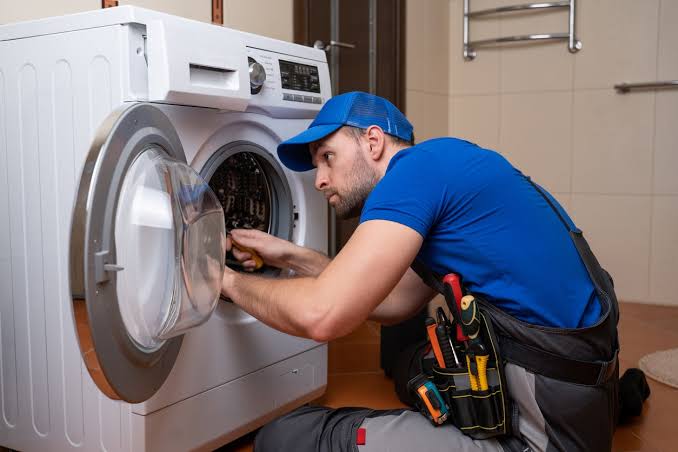
Technician reading and testing against a washing machine error code
What a Code Does Not Tell You

The Code Names the System, Not the Broken Part

This is the most useful thing to understand about every code on this page, whichever brand you own.

A drain code tells you the machine did not empty in time. It does not tell you whether the pump has burnt out, whether a coin is jamming the impeller, whether the sump hose has a sock in it, or whether the building's waste stack is blocked. All four produce the same code, and only one of them involves buying a part.

An unbalance code tells you the drum was moving too much. It does not distinguish a genuinely lopsided duvet from collapsed shock absorbers. A motor code tells you the drive system reported a problem — not whether that is worn carbon brushes at modest cost or a failed motor at considerably more.

So the code is a genuinely valuable starting point, and it is why we ask you to send it. But the component still has to be confirmed by testing. Replacing the part a code points at, without establishing why, is the most common way a repair gets done twice.

No Code Showing?

Machines That Cannot Tell You Anything

Plenty of machines in UAE homes have no way to display a code. That is normal, not a problem.

💡 Flashing programme lights

Machines without a digital display often report faults through which indicator lights flash and how many times. The pattern is readable — photograph or video it and send it with your model number.

🎛️ Twin-tub and semi-automatic

Purely mechanical machines have no fault reporting at all. They are diagnosed by testing the timer, motors, drain valve and switches — which is how they have always been serviced.

📱 App-reported codes

On smart machines the app shows the same code the control board is holding. A screenshot is exactly as useful to us as a photo of a display.

🔁 Try one reset first

Off at the socket for five to ten minutes, then back on. This clears genuine one-off lock-ups, especially after a power cut. If the code returns, it is real.

🔍 Find the model number

Usually on a sticker inside the door rim or on the rear panel. It matters as much as the code, because code sets differ between generations.

📵 Not every symbol is a fault

A key or padlock icon is the child lock. A countdown is a delay-start timer. Neither is a fault, and both are cleared from the control panel.

All 15 Brand Guides

Full Code and Fault Guides By Brand

Each page covers that brand's codes or symptoms, its known weak points, and the repair economics.

Samsung

Full code table — 4E, 5E, UE, DC, 3E and more.

Samsung →

LG

Full code table plus Direct Drive diagnosis.

LG →

Bosch

E18, F21, E23 Aquastop and the BSH family.

Bosch →

Siemens

iQ range, shared BSH platform and parts.

Siemens →

Whirlpool

Two code systems — European and American.

Whirlpool →

Ariston

The full Whirlpool-group F-code table.

Ariston →

Indesit

Value tier of the same group and code family.

Indesit →

Electrolux

The systematic EWM E-code table explained.

Electrolux →

AEG

Premium tier, same EWM scheme, group parts.

AEG →

Beko

Symptom-led — multiple indication schemes.

Beko →

Candy

Symptom-led — slim-depth specialist.

Candy →

Miele

Symptom-led, plus premium repair economics.

Miele →

Hitachi

Symptom-led — import vs regional variants.

Hitachi →

Daewoo

Symptom-led — model number over badge.

Daewoo →

Super General

Symptom-led — twin-tub and semi-automatic.

Super General →

Another brand?

We repair all brands sold in the UAE. Send us the code and model.

All brands →

Diagnostic Guides

Or Start From the Symptom Instead

If you would rather work from what the machine is doing than from a code, start here.

🚱

Not Draining

Not Draining →

🌀

Not Spinning

Not Spinning →

💧

Leaking Water

Leaking Water →

🔌

Not Starting

Not Starting →

🔊

Making Noise

Making Noise →

🔒

Door Won't Open

Door Won't Open →

🌡️

Not Heating

Not Heating →

👕

Not Drying

Not Drying →

📳

Vibrating

Vibrating →

🦠

Bad Smell

Bad Smell →

⚙️

Drum Bearings

Drum Bearings →

🔧

Drain Pump

Drain Pump →

🔩

Motor

Motor →

🔌

Control Board

Control Board →

🧺

Main Service Page

Washing Machine Repair →

📍

Find Your Area

Marina → · JLT →

FAQ

Washing Machine Error Codes — Your Questions

Do all washing machine brands use reliable published error codes?

No, and this is worth knowing before you trust any code list. Some manufacturers use a consistent, well-documented scheme across their range — Bosch and Siemens, the Whirlpool group brands, and the Electrolux group brands all do. Others do not. Beko uses more than one indication method across generations, Candy has changed schemes between model families, Daewoo has covered machines from different manufacturers, and Hitachi sells both Japanese-domestic and regional-export variants here. For those brands a generic code list can easily describe a different machine than yours.

What does the error code actually tell a technician?

It identifies the system that reported a problem, not the part that failed. A drain code appears whether the pump has burnt out or a single coin is jamming the impeller. An unbalance code appears whether the load is genuinely lopsided or the suspension has collapsed. The code narrows where to look, which is genuinely useful — but the failed component still has to be confirmed by testing. Replacing the part the code points at, without checking why, is how people end up paying twice.

My machine has no display. How can I tell what is wrong?

Many machines without a digital display report faults through a pattern of flashing programme indicator lights instead — which lights flash and how many times. That pattern is readable, so photograph or video the panel while it is flashing and send it with your model number. Purely mechanical machines such as twin-tubs and semi-automatics have no fault reporting at all and are diagnosed entirely by testing, which is completely normal for those machines.

Is it worth sending you a photo of the code before booking?

Yes, and it is the single most useful thing you can do. A photo of the display plus the model number from the sticker inside the door rim often lets us identify the likely component before the technician sets off, which means the right part comes on the first visit rather than the second. On app-connected machines a screenshot of the fault in the app works just as well.

Can I just reset the machine to clear the code?

It is worth trying once, and it costs nothing. Switch the machine off at the wall socket, leave it for five to ten minutes so the control board fully discharges, then switch it back on and run a short programme. This clears genuine one-off electronic lock-ups, particularly after a power cut. If the same code returns, the fault is real and the machine is telling you something true.

My code is not on this page. What now?

Send us a photo of the display along with the model number and we will tell you what it points to. Code sets vary between generations even within a single brand, so no published list covers every machine ever sold. We read the code against the correct model family rather than a generic table, which is exactly why the model number matters as much as the code itself.

Send Us the Code and the Model Number

Two photos — the display and the sticker inside the door rim — often let us identify the part before the technician leaves. That is the difference between one visit and two.

Book a Repair

Tell Us the Code, the Model and the Symptom

All three together give us the strongest chance of arriving with the right part. If there is no code, just describe what the machine is doing.

📞 Phone

+971 50 988 6591
Daily, 8:00 AM – 6:00 PM

💬 WhatsApp

+971 50 988 6591
Send photos of the display and the model sticker

Send Us Your Error Code

Opens WhatsApp with your request pre-filled — nothing is stored on this site.

Your details go directly to our team on WhatsApp. See our Privacy Policy.

Call Now+971 50 988 6591 WhatsAppInstant chat reply