A completely dead machine and a machine that lights up but refuses to run are two entirely different faults. Answer one question first and you will know which one you have — and several of the causes cost nothing at all to fix.
We are an independent repair company — not an authorized service center of any washing machine brand. Brand names on this page are used only to identify the machines we repair. All trademarks belong to their respective owners.

Press a button and look carefully. Is there a single light, a display, a beep, a click from the door lock — anything? That answer splits the diagnosis completely, and it is the first thing our technicians establish on the phone.
No signs of life at all. The machine is not receiving power, or it is receiving power and cannot use it. That points to the supply side: the wall switch, the socket, the breaker, the power cable, or the mains filter where the cable enters the machine. Notably, several of these are outside the machine entirely and cost nothing to resolve.
Lights or display work, but the cycle will not begin. The electronics are alive and something is preventing the machine from proceeding. That points to the door interlock, the child lock, a delay timer, the start button, or the control board. The door interlock is by far the most common answer here.
Work out which of these two you have before anything else, because the entire rest of the diagnosis follows from it.
Listed in the order we actually find them. The first three are outside the machine.
Many UAE kitchens have a switched spur beside or behind the machine. It gets knocked when the machine is pushed back or the counter is cleaned. Genuinely one of the most common causes.
Check the distribution board. A tripped residual current device often means moisture or a fault somewhere on that circuit — worth noting if it trips again immediately.
Test the socket with a lamp or phone charger. If nothing else works there either, the fault is the socket or the circuit, not your washing machine.
The suppressor where the cable enters the machine. Among the first components damaged by voltage spikes, and a very common cause of a totally dead machine. Inexpensive to replace.
Crushed behind the machine, or the plug itself has failed. Visible inspection usually finds it quickly.
The board's own low-voltage supply section has failed. Tested only after everything simpler has been ruled out.
On some machines a failed interlock can prevent the board powering up at all, not just block the cycle.
A corroded or disconnected connector inside the machine, more common on older machines and in humid locations.
Some machines have a safety cut-out that opens after overheating and will not reset until the cause is found.
The electronics are working. Something is blocking the machine from proceeding.
The machine will not start until the interlock confirms the door is shut and locked. Push it firmly until it clicks. A worn catch or misaligned hinge is a common cause.
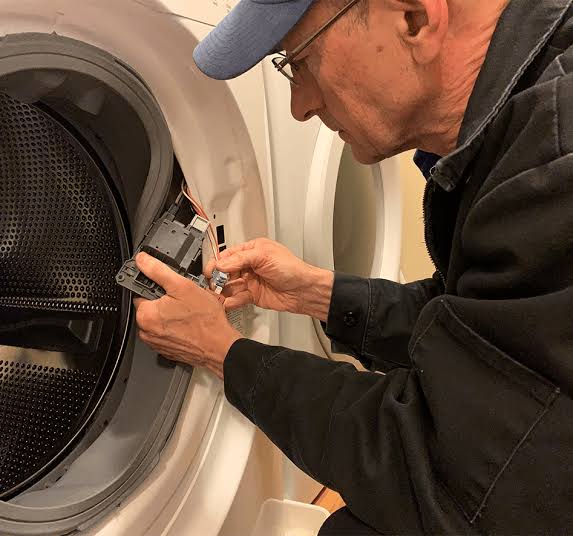
The door looks and feels closed but the lock never reports it. The single most frequent cause in this category, and a standard part to replace.
A key or padlock symbol on the display and no button responding. Usually cleared by holding two marked buttons for a few seconds. Not a fault.
The machine is waiting, not broken. Easy to set by accident, and it looks identical to a fault until you notice the countdown.
The button or its contact has worn out. Common on machines that have run many thousands of cycles.
The selector dial or encoder is not telling the board which programme has been chosen.
Some machines appear not to start when in fact they are waiting for water. Check the tap is open and the inlet hose is not kinked.
The board is not driving the cycle. Real, but far less common than people assume, so it is confirmed last.
An earlier fault has locked the machine into an error state that a full power-off reset may clear.

Every one of these is safe to do yourself, and between them they resolve a meaningful share of the "not starting" calls we receive.
Still nothing? Then the fault is inside the machine, and it is almost certainly the mains filter, the door interlock or the control board — all of which we repair.
Do not open the machine's casing yourself. A washing machine holds mains voltage at several points inside, and capacitors on the control board can retain a charge even after the machine is unplugged. The outside checks on this page are safe; opening the machine is not.
If the breaker trips again immediately, leave it off. A residual current device that trips the moment you reset it is detecting a genuine earth fault, very often moisture that has reached something electrical inside the machine. Repeatedly resetting it is not safe. Switch it off at the board and call us.
Socket, switch and circuit are verified first, so we never charge you to repair a machine that was never the problem.
Cable, mains filter and board supply checked in sequence to find exactly where the power stops.
Door interlock, start switch and programme selector tested before any board is considered.
Exact price for parts and labour before anything is replaced. Nothing proceeds without your approval.
A complete cycle is run to confirm the machine starts, fills, washes, drains and spins properly.
A machine that will not start is often confused with one that will not release its door.
Showing a code rather than just a symptom? Start here. Decode Your Error Code →
The interlock that blocks the start is the same one that holds the door. This page covers the safe release.
A machine stuck mid-cycle with water inside can look like it has failed to start.
Everything we repair on washing machines — all types and all brands.
Start outside the machine. The most common causes are a wall switch that has been knocked off, a tripped breaker or residual current device in the distribution board, or a faulty socket. Test the socket with something else such as a lamp or a phone charger. If the socket is live and the machine is still completely dead, the fault is usually the mains filter, the power cable or the board's power supply.
That is a different fault from a dead machine, and it is good news because the electronics are alive. The usual causes are the door not latching so the interlock never confirms, the child lock being active, a delay start being set without the owner realising, a failed start button or programme selector, or a control board fault. The door interlock is the most common of these by a wide margin.
The mains filter, sometimes called a noise suppressor, sits where the power cable enters the machine and smooths electrical interference. It is one of the first components to be damaged by voltage spikes and fluctuations, and when it fails the machine typically goes completely dead even though the socket is live. It is an inexpensive part and a quick replacement.
Most machines show a key or padlock symbol on the display when the child lock is active, and the machine will accept no button presses. It is usually cleared by holding down a specific pair of buttons for three to five seconds — often the two buttons that have a small lock icon printed above or between them. It is worth checking before booking a callout, because it is not a fault.
Yes, and it costs nothing. Switch the machine off at the wall socket, leave it for five to ten minutes so the control board fully discharges, then switch it back on and try a short programme. This clears a surprising number of one-off electronic lock-ups, particularly after a power cut. If it comes back dead or still will not start, the fault is real.
We handle everything inside the machine — the mains filter, the power cable, the door interlock, the start switch and the control board. If the fault turns out to be in your apartment's wiring, the distribution board or the socket itself, that is outside the appliance and we will tell you clearly so you can get the right trade rather than paying us to work on the wrong thing.
Tell us whether it is completely dead or lit up but idle. That one detail tells us which parts to bring, so the repair finishes in a single visit.
Completely dead, or lights on but nothing happens? Plus whether the socket tested live and whether the breaker has tripped.
+971 50 988 6591
Daily, 8:00 AM – 6:00 PM
+971 50 988 6591
Send a photo of the display or control panel