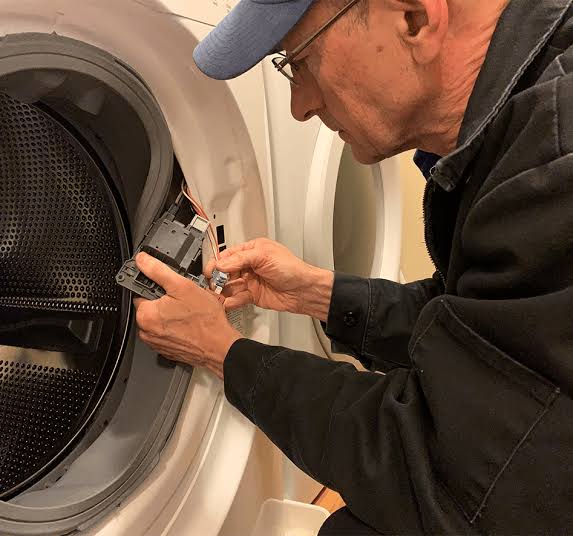
Washing trapped inside and the door will not budge? In most cases the machine is doing exactly what it was designed to do, and there is a safe way to release it. Here is why it locks, what to try, and the one thing you must not do.
We are an independent repair company — not an authorized service center of any washing machine brand. Brand names on this page are used only to identify the machines we repair. All trademarks belong to their respective owners.

A front-loading washing machine will not open on demand, and that is deliberate rather than a design flaw. The interlock holds the door until all three of the following are true.
One: the drum has emptied. If the pressure sensor still detects water, the door stays locked. Opening a full drum would put thirty or forty litres across your floor, so the machine simply refuses.
Two: the drum has stopped rotating. After a 1,200 rpm spin the drum keeps turning for a while, and the lock stays engaged until it is genuinely still.
Three: the interlock has cooled. Most machines use a thermal lock — a small heating element keeps it engaged during the cycle, and it only releases as it cools. That takes a couple of minutes after the programme ends, which is the single most common reason a perfectly healthy door appears stuck.
So before assuming anything has broken, the question is which of those three conditions is not being met.
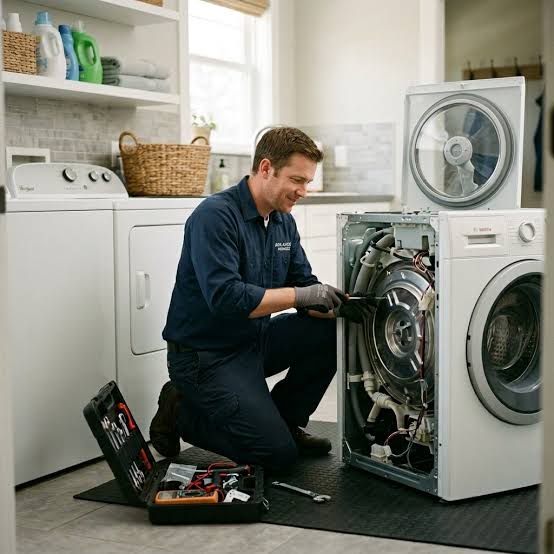
This is the one action that reliably turns a small problem into an expensive one. Levering the door with a screwdriver, or pulling hard on the handle, breaks the handle mechanism, snaps the plastic hook that engages the lock, or cracks the door glass. You then pay for that damage on top of whatever was actually wrong.
If the drum still holds water, forcing the door has a second consequence: the contents come out across the floor. In an apartment above another home, that is not a mopping job — it can become a claim against you. Every safe route to opening the door is set out below, and none of them involves force.
Work down the list. Most doors open at step one or step two without any repair at all.
Switch the machine off at the socket and wait. Thermal interlocks release as they cool, and this alone opens a large share of "stuck" doors. Costs nothing, works often.
Look at the bottom of the door glass. If there is water, it is a drainage fault — the lock is behaving correctly. Drain it first and the door will normally release.
Power off. Open the flap at the bottom front, pull out the short drain hose, hold it below drum level and empty into a shallow tray. Expect several trays.
If the machine has power and the drum has water, selecting a drain-only or spin-only cycle often clears it and releases the door by itself.
A key or padlock symbol means the controls are locked. Hold the two marked buttons for a few seconds. It is not a fault and it is easily missed.
Many machines have a small cord or tab beside the pump filter that mechanically frees the catch. Power off and drum drained first. If yours has none, stop here.
If the supply failed mid-cycle the lock may have stayed engaged. Restore power, let the machine complete or cancel the programme, and it should release.
Pressing the door gently inward while pressing the handle can help a slightly misaligned catch disengage. Gentle pressure only — never a tool.
If none of the above works, the interlock or the handle mechanism has failed and needs replacing. That is a technician job, and an inexpensive one.

Once the simple explanations are ruled out, these are the faults behind a genuinely stuck door:
If your machine is displaying a code alongside the stuck door, it is probably one of these.
dC / DC / dE — door fault or door not closed.
Samsung repair details →
dE / dE1 / dE2 — door error.
LG repair details →
F06, FdL, FdU — door lock or unlock failure.
Whirlpool → · Ariston →
The door is released using the correct method for your model, so nothing is broken getting in.
If water is trapped, it is emptied in a controlled way before the door is opened — not onto your floor.
Interlock, handle, catch and drainage all tested, because a stuck door is often a drainage fault in disguise.
Exact price for parts and labour before anything is replaced. Nothing proceeds without your approval.
A full cycle is run to confirm the door locks and releases correctly every time before we leave.
A locked door is very often a symptom of something else. These pages cover the usual culprits.
Showing a code rather than just a symptom? Start here. Decode Your Error Code →
The usual hidden cause. If there is water in the drum, fix the drainage and the door follows.
The same interlock that holds the door also blocks the start. One failed part, two symptoms.
A machine that cannot confirm the door is locked will refuse to spin at all.
Everything we repair on washing machines — all types and all brands.
A front loader keeps the door locked until three conditions are met: the drum has emptied, the drum has stopped rotating, and the thermal element inside the interlock has cooled. If any one of those is not satisfied the door stays shut. The most common reasons are water still sitting in the drum, an interlock that needs a couple of minutes to cool, or a failed door lock assembly.
Give it at least three to five minutes after the cycle ends. Most machines use a thermal interlock — a small heating element holds the lock closed and it only releases once it has cooled. That delay is completely normal and is often mistaken for a fault. Switching the machine off at the socket and waiting five minutes is the single most effective first step.
No. Levering the door with a screwdriver or pulling hard on the handle typically breaks the handle mechanism, snaps the plastic hook that engages the lock, or cracks the door glass. You then pay for that damage on top of the original fault, and if the drum is full of water you also risk emptying it across the floor. Every safe route to opening the door is on this page.
That is a drainage fault, not a door fault — the machine is holding the door shut precisely because it detects water. Switch it off at the socket, open the flap at the bottom front, and drain the machine through the emergency drain hose into a shallow tray. Once the drum is empty the lock will usually release. Do not run another cycle to try to clear it.
Many front loaders do. Behind the small flap at the bottom front, alongside the pump filter, some machines have a short cord or a small tab that mechanically releases the door catch when pulled. Not every model has one, and it should only be used with the power off and the drum drained. If you cannot find one, do not improvise — call us instead.
No, it is one of the more affordable washing machine repairs. The door interlock is a standard component, widely available for all the major brands sold in the UAE, and replacing it is quick. Our technician confirms the lock is genuinely the fault rather than a drainage problem masquerading as one, then gives you the fixed price before starting.
Do not force it. Call us and a technician will open the door without damaging it, find what actually caused the lock, and quote the repair before starting.
Whether there is water in the drum, whether a code is showing, and whether the machine still has power — those three answers usually identify the cause.
+971 50 988 6591
Daily, 8:00 AM – 6:00 PM
+971 50 988 6591
Send a photo of the display and the door