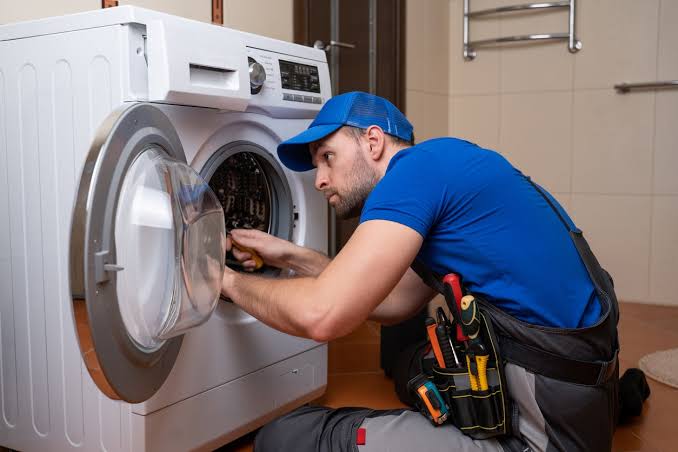
Water sitting in the drum after the cycle is the most common washing machine fault we are called to, and usually one of the cheapest to fix. Here is what actually causes it, what you can safely check yourself, and when to stop and call a technician.
We are an independent repair company β not an authorized service center of any washing machine brand. Brand names on this page are used only to identify the machines we repair. All trademarks belong to their respective owners.

At the end of a wash, the drain pump is supposed to empty the drum before the machine goes into its spin. The machine checks the water level with a pressure sensor, and if that sensor still reports water after the drain phase should have finished, the programme stops. It will not spin, and on most machines it will not release the door either.
That last part is deliberate, not a fault. The door stays locked because a manufacturer would rather you called someone than opened a full drum onto your kitchen floor. It is also why forcing the door is the single most expensive mistake people make with this problem β a broken interlock turns a cheap job into a more costly one.
So the machine is not broken in some mysterious way. Something between the drum and your drain is blocked, or the pump that moves the water is no longer moving it.
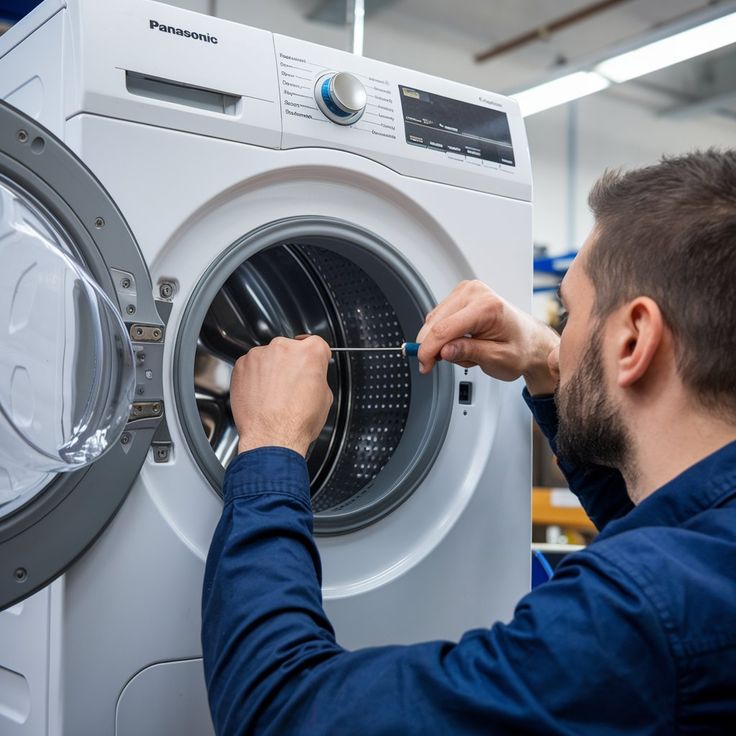
These are listed in the order we actually find them, not in textbook order. The first two account for most callouts.
Behind the small flap at the bottom front. Coins, hair clips, buttons, tissue and lint collect here and eventually block the flow completely. This is the single most common cause and often needs no parts at all.
The hose running from the machine to your waste pipe. It kinks behind the machine when the machine is pushed back, or silts up internally with detergent residue and lint.
If the hose end sits too deep in the standpipe, the machine siphons and drains continuously, or fails to drain properly. A common fault right after a machine has been moved or reinstalled.
The pump motor burns out, or the impeller is jammed or broken. You often hear a humming with no water movement β that is the pump trying to turn against a jam.
The wide hose between the bottom of the drum and the pump. A sock or a small garment can lodge here, and it is invisible from outside the machine.
The sensor or its thin hose is blocked, split or disconnected, so the machine wrongly believes there is still water inside and refuses to move on.
The board is no longer switching power to the pump. Genuinely the least common cause β and always tested last, after everything cheaper has been ruled out.
Occasionally the machine is fine and the building's waste pipe is blocked. We check this before condemning any part of your machine.
Heavy suds can stop a pump moving water properly and trigger a drain error. Common with non-HE detergent in a front loader.

Two of these can genuinely solve the problem without a callout. Work through them in order, and stop at the point where you are not comfortable.
If it still will not drain after all of that, the fault is inside the machine β the pump, the sump hose or the sensor β and it needs a technician.
Do not run another cycle to "flush it through". The drum is already full. Another cycle adds more water and is the most common way this fault ends in water on the floor β and in an apartment, in the unit below.
Do not force the door open. The interlock is holding it shut on purpose. Forcing it breaks the lock assembly, and you then pay for that as well as the original fault.
Do not pour drain cleaner into the drum. Chemical drain cleaners are made for pipework, not for the rubber seals, plastic sump and pump impeller inside a washing machine. They can damage components that were otherwise fine.
Nearly every brand has a specific code for a drain failure. If your display is showing one of these, this page is the right page.
5E / 5C / E2 β drain error.
Samsung repair details β
OE β outlet/drain error.
LG repair details β
E18 / F18 β drain fault.
Bosch repair details β
Siemens, Whirlpool, Ariston, Indesit, Beko and others all use their own drain codes. Send us a photo of the display.
The drum is emptied in a controlled way before anything is moved, so nothing ends up on your floor.
Filter, impeller and drain hose checked before any part is condemned β the cheapest causes are ruled out first.
The pump is tested electrically and mechanically to confirm whether it is jammed, burnt out or simply blocked.
You get the exact price for parts and labour before anything is replaced. Nothing proceeds without your yes.
A complete drain and spin cycle is run to confirm the fix, and the area is left clean and dry.
A drain fault often gets confused with a spin fault. These pages explain the difference.
Showing a code rather than just a symptom? Start here. Decode Your Error Code →
If the machine will not spin and there is water inside, it is a drain problem β not a spin problem. This page explains why.
Sometimes clearing a blocked filter reveals a leak that the blockage was masking.
Everything we repair on washing machines β all types and all brands.
Area guides for gated communities and premium towers.
In the large majority of cases it is one of four things: a blocked pump filter, a blocked or kinked drain hose, a drain hose pushed too far into the standpipe, or a drain pump that has failed. Less often it is the sump hose between the drum and the pump, the pressure sensor that tells the machine how much water is inside, or the control board.
Do not force it. Most machines deliberately keep the door locked while they detect water inside, precisely to stop the contents emptying onto your floor. Forcing the door can break the interlock and turn a cheap repair into an expensive one. Switch the machine off at the socket and drain it through the emergency drain hose behind the filter flap first.
No. If the machine cannot drain, running another cycle adds more water to a drum that is already full and risks overflowing onto the floor. In an apartment that can reach the unit below. Switch it off at the socket and leave it until the water has been drained out.
Switch the machine off at the socket first. Open the small flap at the bottom front. Most machines have a short emergency drain hose tucked beside the filter β pull it out, hold the end below the level of the drum, remove its cap and let the water run into a shallow tray, emptying the tray as it fills. Only then unscrew the filter itself, keeping towels underneath.
It is normally one of the least expensive washing machine repairs. A blocked filter costs nothing but the callout, and a drain pump is an inexpensive part fitted quickly. Our technician gives you the fixed price for parts and labour before any work starts, so you know exactly what it costs before agreeing.
We hold same-day slots across Dubai, Sharjah, Abu Dhabi and Ajman during our working hours of 8:00 AM to 6:00 PM daily. A machine full of standing water is treated as a priority because of the flooding risk, especially in apartments.
Switch it off at the socket and call us. A licensed technician will drain it safely, find the actual blockage, and quote the fix before starting.
Let us know the brand, whether there is an error code, and whether you have already tried the filter β it saves time on the visit.
+971 50 988 6591
Daily, 8:00 AM β 6:00 PM
+971 50 988 6591
Send a photo of the display or the filter area