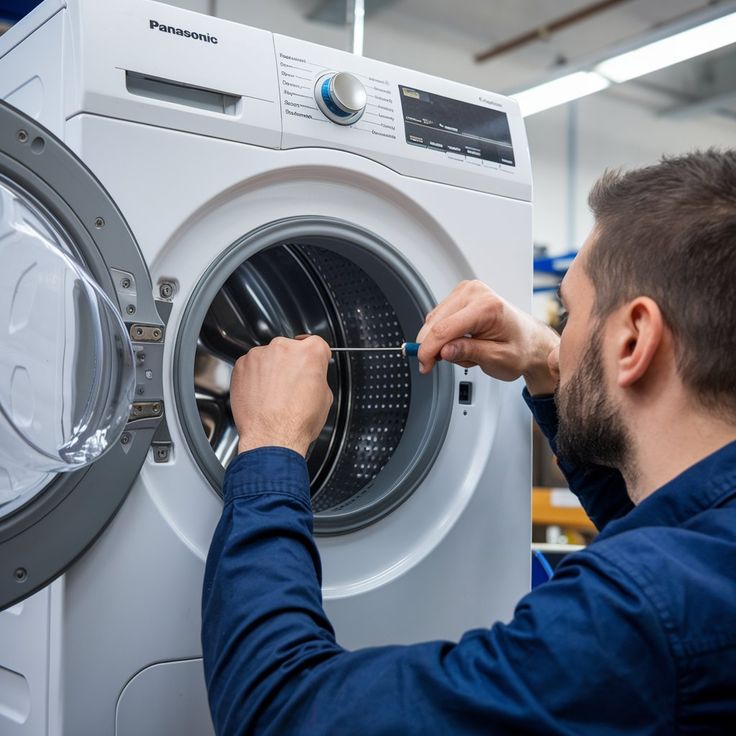
Clothes coming out soaking wet at the end of the cycle? Before anyone touches the motor, there is one question that decides the whole diagnosis. Here is how to work out what is actually wrong — and what the repair involves.
We are an independent repair company — not an authorized service center of any washing machine brand. Brand names on this page are used only to identify the machines we repair. All trademarks belong to their respective owners.

This one question splits the diagnosis in half, and getting it wrong is how people end up paying for a motor repair they never needed.
If there is water in the drum, your machine does not have a spin fault. It has a drainage fault. Washing machines will not enter the spin phase while the pressure sensor still detects water inside — spinning a full drum at 1,200 rpm would throw water everywhere and unbalance the machine violently. So the machine drains first, always. No drain, no spin. Fix the drainage and the spin returns on its own.
If the drum is empty and it still will not spin, then it is a genuine spin fault, and the causes below apply. That is the point at which brushes, belts, door locks and motors come into the conversation.
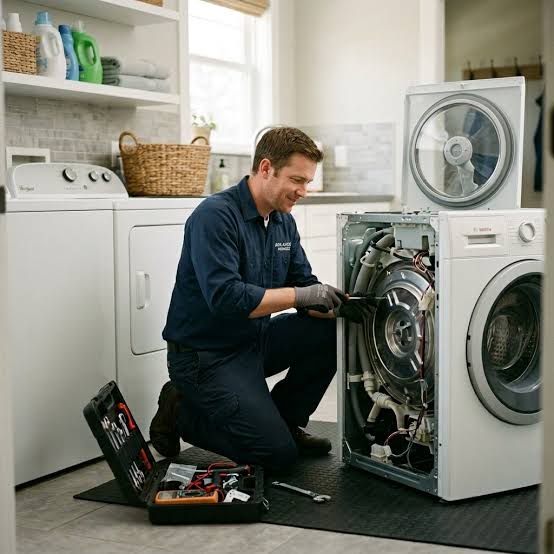
Assuming the machine has drained properly, these are the causes in the order we actually encounter them.
A duvet, a bath mat or a single heavy towel sitting on one side. The machine detects the imbalance and refuses to spin rather than damage itself. Redistribute by hand and run a spin-only cycle — no fault, no cost.
On brushed motors, two small carbon blocks wear down over the machine's life. The drum still turns slowly to wash but cannot reach spin speed. An inexpensive part and a very common fix.
You hear the motor running but the drum barely moves, and the drum turns very freely by hand. Belt-driven machines only — Direct Drive machines have no belt at all.
The machine will not spin unless the lock reports the door as safely closed. A failing interlock stops the spin even though the door looks and feels shut.
Collapsed suspension lets the drum move too far, so the machine's own unbalance detection cuts the spin short every time — even with a perfectly even load.
On Direct Drive machines, the hall sensor or rotor position sensor. On brushed machines, the tacho coil that reports speed back to the board.
Loud grinding that gets worse with speed. The machine may cut the spin to protect itself. The biggest job on this list, so it is always confirmed properly first.
The board no longer drives the motor into the spin phase. Less common than assumed, and tested only after everything cheaper is ruled out.
Heavy suds cushion the load and confuse the sensors, and some machines abandon the spin as a result. More common than people expect in front loaders.

Work through these in order. The first one alone resolves a surprising number of the calls we take.
A short video of the machine attempting to spin, sent on WhatsApp, is genuinely one of the most useful diagnostic tools we have. The sound alone often identifies the fault before we arrive.
Spin-related codes usually report either an unbalanced load or a motor fault. Both are listed here.
UE / UB — unbalanced load.
3E / 3C — motor or hall sensor.
Samsung repair details →
UE / uE — unbalanced load.
LE / CE — locked motor or overcurrent.
LG repair details →
F21 — motor fault, often carbon brushes.
F43 — drum not turning.
Bosch repair details →
Siemens, Whirlpool, Ariston, Indesit, Beko and others each use their own unbalance and motor codes. Send us a photo of the display.
Drainage is verified first, so we are certain we are solving a spin fault and not a drain fault.
Brushes, belt, drum resistance by hand and motor rotation are all checked before anything is condemned.
Door interlock, tacho or hall sensor and suspension are tested — several of these mimic a motor failure.
The exact price for parts and labour before anything is replaced. Nothing proceeds without your approval.
A complete cycle is run at full spin speed, and the machine is re-levelled so it does not move on the floor.
Spin faults sit close to drainage faults and noise faults. These pages cover the neighbours.
Showing a code rather than just a symptom? Start here. Decode Your Error Code →
The fault that is misdiagnosed as a spin problem more often than any other. Check here first if there is water in the drum.
Worn suspension and hard spinning can loosen hose clips and start a leak.
Everything we repair on washing machines — all types and all brands.
Heavy villa loads wear suspension and bearings fastest.
Start by checking whether there is water left in the drum. If there is, the real fault is drainage, not spin — machines refuse to spin until they have emptied. If the drum is empty and it still will not spin, the likely causes are an unbalanced load, worn carbon brushes on brushed motors, a broken or slipped drive belt, a door interlock not confirming, worn shock absorbers triggering unbalance detection, or a motor or control board fault.
No, and this is the single most common misdiagnosis. A washing machine will not enter its spin phase while the pressure sensor still detects water in the drum. So a machine full of water that will not spin has a drainage fault, and fixing the drain fixes the spin. Repairing the motor or belt in that situation solves nothing.
Brushed motors use two small carbon blocks that press against the rotating part of the motor to carry current into it. They wear down over the life of the machine. As they get short, the motor can still turn the drum slowly for washing but cannot reach spin speed. Replacing them is a relatively inexpensive repair and it is one of the most common causes of a machine that washes fine but will not spin.
Yes. If the machine detects that the load is heavily to one side, it will refuse to spin at high speed rather than risk damaging itself. A single heavy item such as a duvet or a bath mat is the usual culprit. Redistribute the load by hand and run a spin-only cycle. If it now spins normally, there was never a fault.
No. LG Direct Drive machines bolt the motor straight onto the drum shaft with no belt and no pulley. So a Direct Drive machine that will not spin needs a completely different diagnosis — normally the hall sensor, the rotor position sensor, a loose rotor bolt or the control board rather than any drive component.
In most cases yes, because the two most common causes — carbon brushes and drive belts — are inexpensive parts. The exception is worn drum bearings on an older machine, which is a much bigger job. Our technician tells you which it is and gives you the fixed price before starting, so you can decide with the real numbers in front of you.
Send us a short video of the machine trying to spin. The sound usually tells us the fault before we arrive — and that means one visit, not two.
Motor humming with no movement, drum turning freely, or a grinding that rises with speed — each points somewhere different. Tell us which, or send a video.
+971 50 988 6591
Daily, 8:00 AM – 6:00 PM
+971 50 988 6591
Send a video of the spin attempt for faster diagnosis