🏛️ Licensed & Registered — Trade Licence 134585 (Ajman) 🕒 Open Daily 8:00 AM – 6:00 PM 📞 +971 50 988 6591
🩹 AC Gas Leak Repair

AC Gas Leak Repair in Dubai — Find It Before You Refill

Refilling a leaking system is a countdown, not a repair. This page is about the other half of the job: locating the leak, repairing it properly, and proving the system is tight before any refrigerant goes back in.

⚡ Same-Day Visits 🛡️ 90-Day Warranty 💲 Quote Before Any Work 🏛️ Licence No. 134585
ℹ️

We are an independent repair company — not an authorized service center of any air conditioning brand. Brand names on this page are used only to identify the systems we repair, and all trademarks remain the property of their owners.

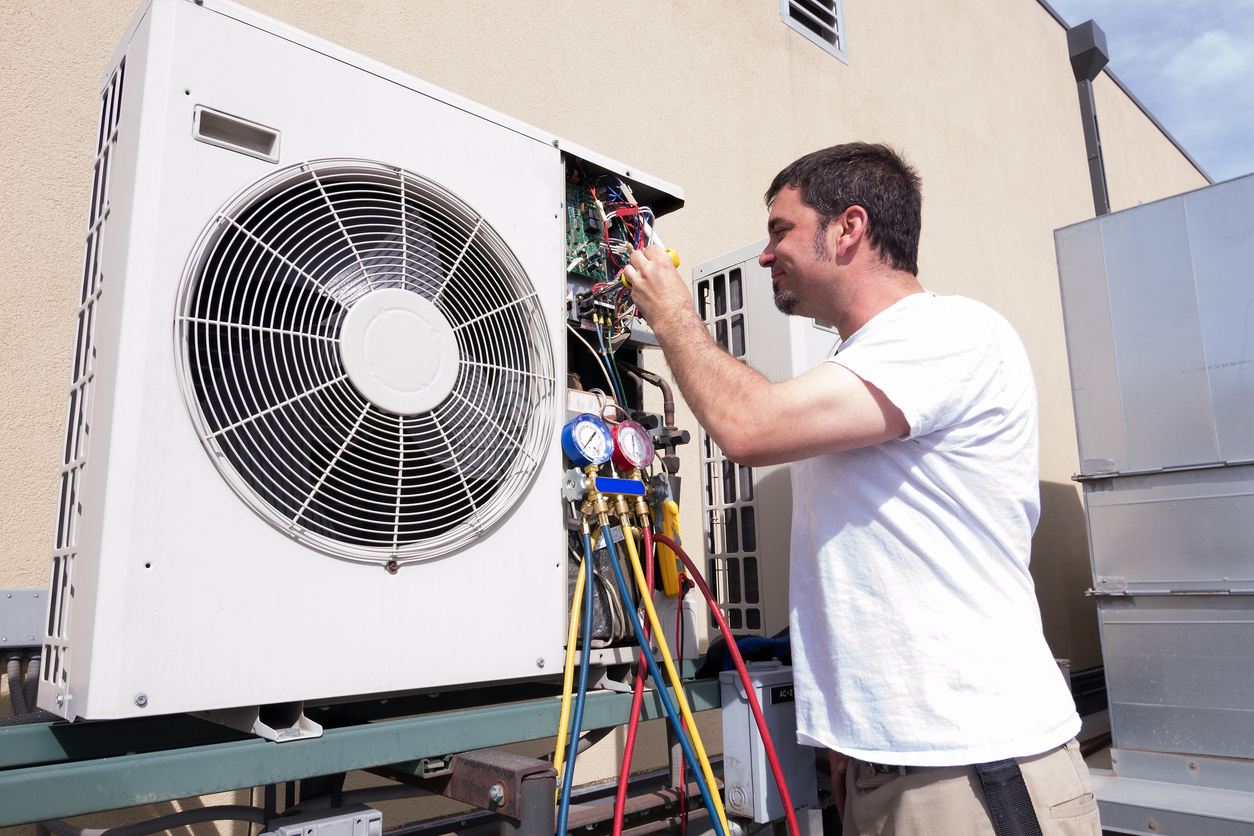
Nitrogen pressure testing an air conditioning circuit to locate a refrigerant leak in Dubai
The Half of the Job That Gets Skipped

Finding the Leak Is the Repair. Refilling Is Just Refilling.

AC gas leak repair in Dubai exists as a separate service for a specific reason: the local market routinely sells the refill without the repair, and that is why so many systems are on their third or fourth top-up.

The logic is unavoidable. A refrigerant circuit is sealed and does not consume refrigerant. If the charge is low, refrigerant has escaped through a physical opening. Put more in without closing that opening and the same thing happens again, on the same timescale.

What makes it worse is what happens in between. A system running undercharged is also running poorly lubricated and poorly cooled, because refrigerant carries oil around the circuit and removes heat from the compressor. Months of that does real mechanical damage. So the repeated top-up is not merely a recurring bill — it is quietly consuming the most expensive component in the system.

This page is about the other half of the job. Locating the leak, repairing it properly, proving the system is tight, and only then putting refrigerant back in — weighed to the manufacturer's figure rather than guessed by feel.
Where Leaks Happen

Six Locations That Account For Most Leaks

Roughly in order of how often we find them, and the first three are the good news.

🔩

Flare Connections

The most common by far. A flare formed poorly at installation or loosened by vibration. Accessible, and a durable repair once remade properly.

🚰

Service Valves and Cores

Valve cores and caps weep over time. Inexpensive to put right and easy to overlook if nobody checks them specifically.

🔥

Brazed Joints

Joints made without proper nitrogen purging can develop faults internally. Repairable where the pipework is accessible.

🧂

Coil Hairpins

Corrosion perforating the coil itself, far more common near the coast. The expensive branch, because neighbouring metal is usually similar.

🧱

Buried Line Sets

Pipe running through walls or roof voids, damaged by other trades or degraded over years. Access is the problem, not the repair.

🌀

Vibration Fatigue

Pipework rubbing against a bracket or another pipe over years until it wears through. Fixable, and worth correcting the cause too.

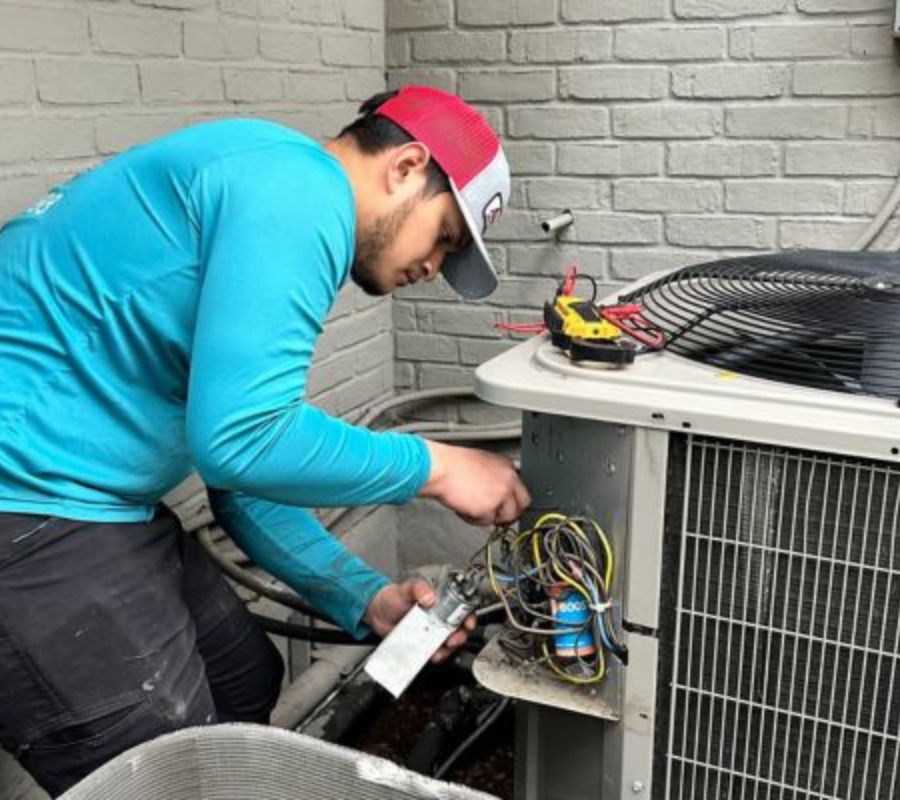
Electronic leak detection and soap testing on air conditioning pipework in Dubai
The Detection Sequence

No Single Method Finds Every Leak

Leak detection works in layers because each method has blind spots, and a leak missed is a repair that fails.

Electronic detection comes first — a detector swept slowly across flare nuts, valves, joints, coil faces and the line set. It is sensitive and fast, and it is where most leaks are found.

Soap solution confirms anything the detector flags. A detector can respond to other substances in the air; a visible bubble at a joint is proof rather than an indication.

Ultraviolet dye handles the awkward category — leaks slow enough that nothing shows on the day. Dye is introduced, the system runs, and the suspect areas are rechecked later under UV light where the residue marks the exact spot.

Nitrogen pressure testing is the decisive step. The circuit is pressurised with dry nitrogen and held, and the pressure is watched over time. A stable reading proves the system is tight. A falling one proves it is not, regardless of what any detector did or did not find.

That last test is also what distinguishes a repair that has been verified from one that has merely been performed. It is the difference between believing the leak is fixed and knowing it.

The Repair Sequence

What Happens After the Leak Is Found

Six steps. Skipping any of them is how a repaired system fails early.

1. Recover, never vent

Remaining refrigerant is recovered into a cylinder. Releasing it to atmosphere is an environmental offence and a marker of a contractor to avoid.

2. Repair the leak properly

Re-flare or re-braze the joint, or replace the affected pipe section. On a coil hairpin, assess repairability honestly against replacement.

3. Purge with nitrogen while brazing

Brazing without a nitrogen purge forms oxide scale inside the pipe, which then circulates and blocks the metering device. It is a step people skip and it causes real damage.

4. Fit a new filter drier

Opening the system exposes it to moisture. A new drier removes it and traps contaminants. Inexpensive, and it protects the compressor.

5. Pressure test, then evacuate deeply

Nitrogen test to prove the repair holds, then evacuate to a deep vacuum and hold it with the pump isolated to prove the system is dry and tight.

6. Weigh in the charge

The nameplate charge, weighed rather than guessed, then verified on superheat and subcooling with current checked against the rated figure.

Straight Answers

When Repair Makes Sense — and When It Does Not

We would rather give you the reasoning than a quotation with no context.

Usually worth repairing

  • Flare connections at either unit
  • Service valve cores and caps
  • Accessible brazed joints on visible pipework
  • Pipe damaged by vibration where the run can be reached
  • Any leak on a system that is otherwise sound and not old

Needs a proper conversation

  • Perforated coil hairpins, where neighbouring metal is in similar condition
  • Line sets buried in walls, where access means building work
  • Older systems using a refrigerant that is being phased out
  • Systems where the compressor has already run undercharged for a long period
  • Cases where several of the above apply at once

We do not publish fixed prices for refrigerant work, because the honest cost depends on the refrigerant, the charge weight and what the leak turns out to be. You get a firm quotation after diagnosis and before any work.

Related Pages

More AC Repair Help

Back to the main service page, or to the related refrigerant work.

Showing a code rather than an obvious fault? Start here. Decode Your Error Code →

❄️

Main Service Page

Our full AC service — split, window, ducted and chilled-water systems across all four emirates.

AC Repair & Maintenance →

🧯

AC Gas Filling

The recharge itself — how a charge is weighed in properly once the system is proved tight.

AC Gas Filling →

🌡️

AC Not Cooling

Where refrigerant sits in the ranked cause list, and the three faults that look identical.

AC Not Cooling →

🔧

Compressor Replacement

What months of running undercharged eventually costs, and why the leak must be fixed too.

Compressor Replacement →

📍

Coastal Areas

Corroded coil joints are the classic coastal leak location.

Palm Jumeirah →
Jumeirah →

🏘️

Villa Areas

Roof-void line sets and older systems are where the harder leaks tend to live.

Springs & Meadows →
Arabian Ranches →

FAQ

AC Gas Leak Repair — Your Questions

How do you actually find a refrigerant leak?

In layers, because no single method finds everything. We start with an electronic leak detector swept slowly across the likely locations — flare nuts, service valves, brazed joints, coil hairpins and the line set. Soap solution then confirms anything the detector flags, because a detector can respond to other things and a visible bubble is proof. For slow or intermittent leaks that neither method catches on the day, ultraviolet dye can be introduced and the system rechecked later. And the decisive test is pressurising with dry nitrogen and watching for a pressure drop over time.

Why nitrogen rather than just using refrigerant to test?

Three reasons, and they all matter. Nitrogen is inert and dry, so it introduces no moisture into a circuit where moisture causes long-term damage. It can be taken to a proper test pressure, which reveals leaks that would stay hidden at normal operating pressure. And it is not a refrigerant, so nothing is released to atmosphere during testing — venting refrigerant is an environmental offence as well as being wasteful. Pressurising and holding, then watching for decay, is the test that actually proves whether a system is tight.

Where do leaks usually occur?

A short list covers most of them. Flare connections at the indoor and outdoor units are the most common, particularly where a flare was formed poorly at installation or has loosened with vibration. Service valve cores and their caps are next. Brazed joints can develop faults, especially where they were made without proper purging. Coil hairpins corrode and perforate, which is much more common near the coast. And line sets buried in walls or running through roof voids can be damaged by other trades or degrade over time — that last category is the expensive one.

Can every leak be repaired?

Technically many can, but the honest question is whether it is worth doing. An accessible flare or valve leak is usually straightforward and durable — remake the joint properly and it is solved. A leak in a brazed joint on accessible pipework is likewise repairable. Where it becomes a genuine decision is a perforated coil hairpin, because the surrounding metal is usually in similar condition so a second leak often follows the first, or a buried line set, where accessing the pipe means opening walls. In those cases we set out the options and the reasoning rather than pushing a repair we do not expect to last.

Why do you fit a new filter drier every time?

Because opening a sealed system exposes it to atmospheric moisture, and the filter drier is what removes that moisture and traps contaminants afterwards. A drier that has already been in service has finite capacity and may be partially spent. Fitting a new one is inexpensive relative to the job and it protects everything downstream, particularly the compressor. Skipping it saves very little and materially raises the risk of an early repeat failure, which is why it is not something we treat as optional.

What is a deep vacuum and why does it matter?

After a repair, the system is evacuated with a vacuum pump to remove air and moisture before refrigerant goes back in. Pulling a deep vacuum and then holding it with the pump isolated does two jobs at once: it proves the system is dry, and it proves the system is tight, because a vacuum that rises indicates either remaining moisture boiling off or air leaking back in. It is the final verification that the repair worked. Charging a system that has not been properly evacuated is one of the more common causes of premature compressor failure.

Gassed More Than Once? Let Us Find the Leak.

Nitrogen pressure test, located repair, new filter drier and a proved vacuum. That is what stops you paying for the same refill next season.

Book a Leak Investigation

Tell Us the Gas History

How many times the system has been gassed and how long each refill lasted. That history is genuinely diagnostic — a fast loss and a slow weep are different searches.

📞 Phone

+971 50 988 6591
Daily, 8:00 AM – 6:00 PM

💬 WhatsApp

+971 50 988 6591
Send a photo of the outdoor unit rating plate

Request a Leak Investigation

Opens WhatsApp with your request pre-filled — nothing is stored on this site.

Your details go directly to our team on WhatsApp. See our Privacy Policy.

Call Now+971 50 988 6591 WhatsAppInstant chat reply