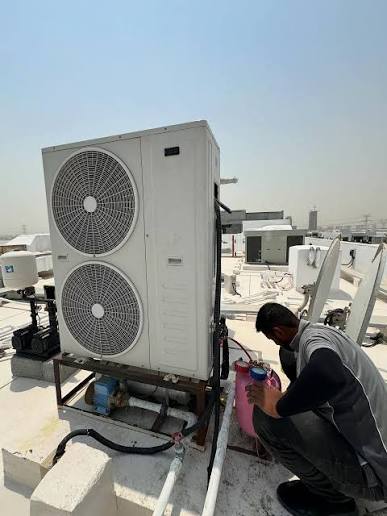
Ranches villas put their condensers on the roof, in full desert sun, at the edge of open sand. That combination is what kills compressors here, and almost all of it is preventable.
We are an independent repair company â not an authorized service center of any air conditioning brand. Brand names on this page are used only to identify the systems we repair, and all trademarks remain the property of their owners.

AC repair in Arabian Ranches is villa work: detached homes on ducted split systems, with condensers mounted on the roof or in side yards, distributing air through ductwork in a roof void. There is no district cooling here, so refrigerant, condensers and ductwork are all in play.
Three local conditions shape almost every fault we attend. The first is position: a rooftop condenser has excellent airflow but takes full radiant load from above and from the roof surface beneath it, so it operates hotter than a shaded ground-level unit ever would.
The second is sand. Ranches sits at the desert edge with open plots nearby, and fine wind-blown sand packs into a condenser fin surface far more aggressively than city dust. A coil can go from clean to significantly restricted in a single dusty season.
The third is the roof void. Ductwork and insulation live in a space that gets extremely hot in summer. Any gap in insulation, sagging flexible duct or separated joint means cooling produced at the plant never reaches the room it was meant for.
Put those together and you get the Ranches pattern: systems that seem fine in spring, then lose the upstairs rooms first, then start tripping out in the afternoon â and eventually take a compressor with them if nobody addresses the coil.
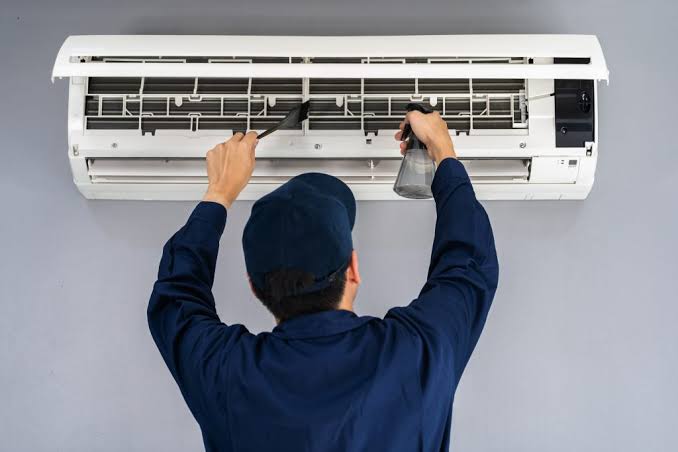
Six faults cover the great majority of Ranches villa call-outs, and the first two are responsible for most of the expensive ones.
Fine desert sand felted into the fin face so air cannot pass. Head pressure and current climb, and the compressor works in conditions it was never designed for.
Full sun above and hot roof surface below. The unit runs closer to its ceiling all summer, so any other fault shows up sooner and harder.
Roof heat gain plus duct losses in a 50 degree void. Usually insulation and airflow rather than capacity.
A stuck zone damper, a failed zone thermostat, or balancing that has drifted since handover. Traceable, and not a refrigerant fault.
Cooling fading across weeks. Flare joints, service valves and roof-void line-set sections are the usual locations.
A corroded or overflowing tray in the void discharges onto an upstairs ceiling. Cheap to fix, unpleasant to discover late.

Of everything on this page, this is the part worth acting on. At 45 degrees and above, a Dubai condenser is already operating near the limit of what it was designed to do. It has very little margin left.
Take that margin away with a coil that air cannot pass through and the consequences follow in order: condensing temperature rises, head pressure rises, compressor current rises, and the compressor is now running hot and hard for hours a day through a five-month summer. Sometimes protection intervenes and the system trips. Sometimes it simply endures â and fails two summers earlier than it should have.
A compressor is the single largest line item in split-system repair. Cleaning a condenser is one of the smallest. On a Ranches rooftop unit, that is not a maintenance upsell, it is straightforward economics.
How we do it matters too. Sand is brushed out along the fins rather than across them, cleaner is applied and rinsed from the inside outward so the dirt leaves the way it came in, and rinse pressure stays low because high pressure folds fins over and permanently reduces airflow. Bent fins get straightened, and we verify head pressure and current after the clean rather than assuming it worked.
The most common misdiagnosis on a zoned villa system, and the reasoning that avoids it.
An undercharged system loses capacity everywhere at once. If three rooms are fine and one is not, the refrigerant circuit is doing its job.
A zone damper stuck part-closed, or an actuator that has lost drive, starves one branch while the rest of the villa is unaffected.
A failed sensor, or a thermostat whose wiring link was disturbed, means that zone never calls for cooling properly.
Sagging or crushed flexible duct, a joint that has separated, or insulation that has slipped â all deliver warm, weak air to that one room.
A return grille blocked by furniture or stored items limits the whole loop for that zone, however well the supply performs.
Only once the zone has been cleared do refrigerant and compressor measurements become the next reasonable step.
Villa access is straightforward. Working safely at height in summer is the real constraint.
Which Ranches sub-community, how many zones, and whether one room or the whole villa is affected. That separates airflow from system faults before we set off.
No lift booking, no contractor registration. A community gate pass is occasionally needed. We schedule roof work sensibly rather than in peak afternoon heat.
Condenser fin condition, clearance, airflow, temperature split across the coil, then duct and damper condition in the void where relevant.
Head pressure and condensing temperature, compressor current against rated figure, capacitor value, and superheat with subcooling read together.
Fault, fix and cost agreed up front. Where a clean will restore the system, we say so instead of quoting a part.
Parts and labour carry a 90-day warranty. If the same fault returns inside that window, so do we.
Back to the main service page, or straight to the job your villa system needs.
Seeing a code on the display? Find out what it means before you call. AC Error Codes Explained →
Our full AC service â split, window, ducted and chilled-water systems across all four emirates.
The afternoon trip on a rooftop system, and why trip timing identifies the cause.
What the repair involves, and why the cause must be found or the replacement dies too.
Why a villa system needing gas every year has a leak worth finding.
More often than the manufacturer schedule suggests, and the reason is location rather than the equipment. Manufacturer intervals are written for temperate climates with relatively clean air. A Ranches rooftop unit sits at the edge of open desert, takes full radiant sun, and collects fine sand that packs into the fin surface far faster than urban dust would. Through the May to September peak the coil is the difference between a system that copes and one that trips out. We would rather tell you that plainly than sell you the compressor a clean would have saved.
Two things usually combine. First, heat gain: upper floors take roof load and afternoon sun, so they simply need more cooling than the ground floor at the same time of day. Second, delivery: the ductwork feeding upstairs often runs through a roof void that can exceed 50 degrees, and any gap in duct insulation, any sagging flexible section or any leaking joint means the air arrives warmer and weaker than it left. It is usually an airflow and insulation problem rather than a capacity problem.
On a zoned ducted villa system, a single failed zone points to the zone rather than the plant. The usual suspects are a zone damper that has stuck or lost its actuator, a zone thermostat that has failed or lost its wiring link, a duct branch that has come apart in the void, or balancing that has drifted since handover. All are traceable. What it almost never means is low refrigerant, because a refrigerant problem weakens the whole system rather than one zone.
All of them, across Ranches I, II and III â including Al Reem, Saheel, Alvorada, Mirador, Palmera, Savannah and Terra Nova, and the newer Ranches II and III villa clusters. Give us the sub-community name and, if you know it, how many zones the villa runs. Ranches villa types differ in system layout and in how many condensers they carry, so that detail helps us arrive properly equipped.
For a normal repair, no. Villa access is direct and there is no lift booking or contractor registration, which makes Ranches work considerably simpler than tower work. Community approval generally becomes relevant only if the condenser is being relocated or anything changes the exterior appearance of the villa, and that approval is the owner's to obtain. The genuine practical constraint on our side is working safely on a villa roof in summer heat, which is why we schedule roof work thoughtfully rather than at two in the afternoon in August.
No, and it is worth pushing back on firmly. A sealed refrigerant circuit does not consume refrigerant. If a villa system needs topping up annually, it has a leak, and on a ducted villa install the likely locations are flare joints at the condenser, service valves, or a section of line set running through the roof void. Finding and repairing that leak costs less over two seasons than repeated top-ups, and it stops the slow damage that running undercharged does to a compressor.
Tell us the sub-community and how many zones your villa runs. We arrive with roof access kit and the parts a Ranches system actually needs.
Which Ranches sub-community, how many zones, and whether one room or the whole villa is affected. That separates an airflow fault from a system fault immediately.
+971 50 988 6591
Daily, 8:00 AM â 6:00 PM
+971 50 988 6591
Send a photo of the rooftop unit and the thermostat