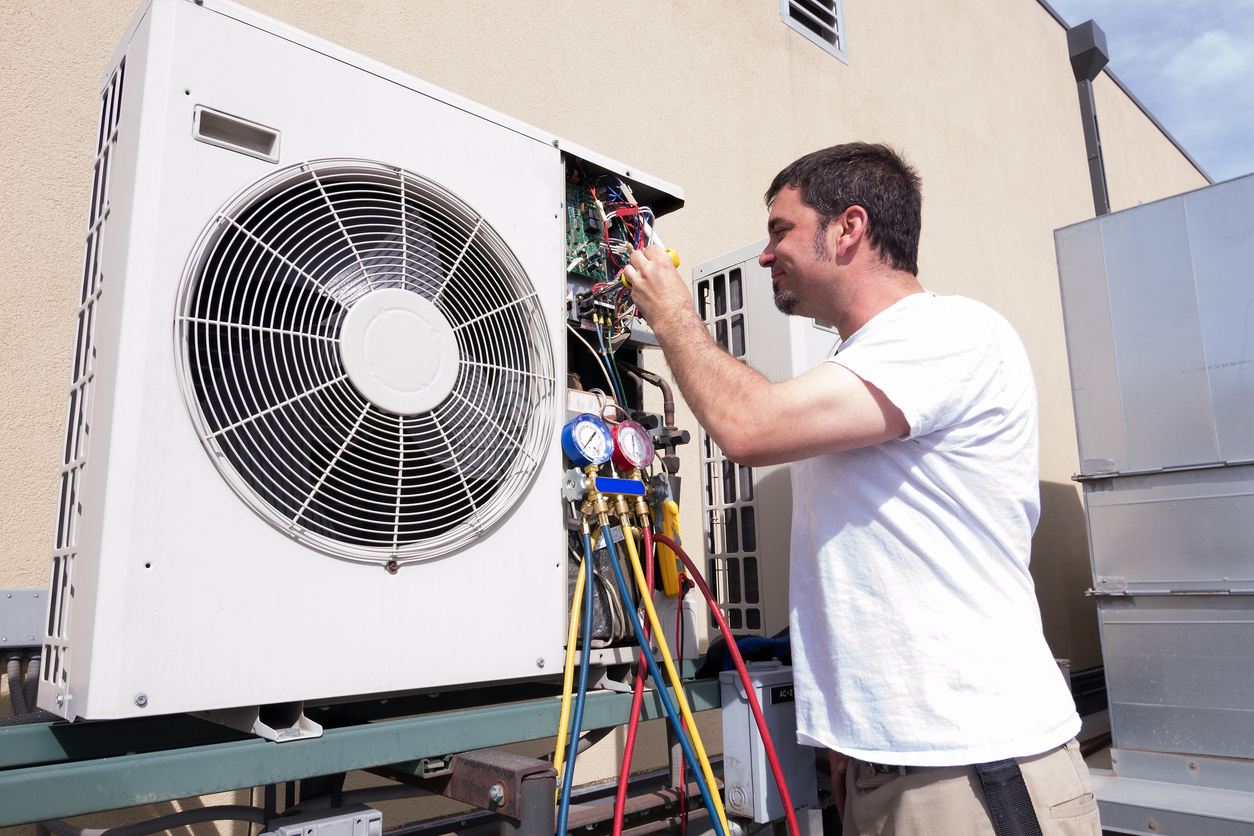
A sealed air conditioning system does not use up refrigerant. If yours needs gas every season, it has a leak â and topping it up without fixing that leak is money you will spend again.
We are an independent repair company â not an authorized service center of any air conditioning brand. Brand names on this page are used only to identify the systems we repair, and all trademarks remain the property of their owners.

AC gas filling in Dubai is sold as routine maintenance by a large part of the market. It is not maintenance, and understanding why will save you money for years.
Refrigerant circulates inside a closed loop. It changes state constantly â evaporating to absorb heat indoors, condensing to reject it outdoors â but none of it is used up in the process. A correctly installed system with no leaks holds its original charge for its whole working life. Refrigerant is not a consumable like engine oil.
So the logic is simple and unavoidable. If your air conditioner needs gas, gas has escaped. There is a leak. It might be a slow weep at a flare nut, a pinhole in a coil hairpin, or a joint that has vibrated loose over years, but it exists.
Which means a top-up without leak repair is a countdown, not a cure. The unit cools well for a while, the refrigerant escapes again, and the following summer you pay for the same visit. We have met plenty of systems on their fourth or fifth top-up whose leak had never once been searched for.
That is the whole basis of how we approach this job: establish whether the charge is actually low, find out where it went, and then decide what is genuinely worth doing.
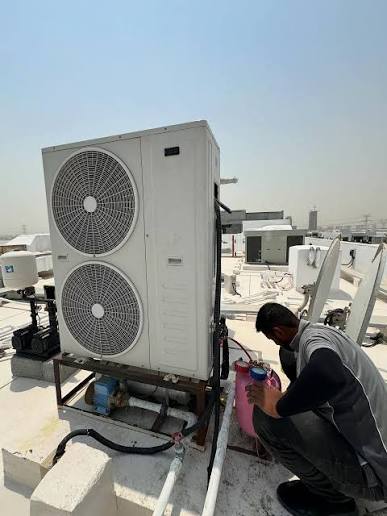
Gauge pressure alone cannot diagnose a charge. Read as a pair, superheat and subcooling separate three faults that look identical from the outside.
Genuine undercharge. There is not enough refrigerant in the system, which means it leaked out and the leak needs finding before anything is added.
A restriction in the liquid line â commonly a blocked filter drier or a faulty expansion device. Nothing has leaked. Adding gas here makes the problem worse.
A fouled condenser that cannot reject heat. Feels exactly like low gas to the occupant, needs a clean rather than refrigerant.
The reference method is to weigh in the factory charge from the data plate, then fine-tune on superheat or subcooling depending on the metering device fitted.
R22, R410A or R32 â the plate says which. They run at different pressures and are not interchangeable, and R32 carries extra handling requirements.
Ambient, return and supply temperatures, pressures and final charge weight recorded. Without that record, next year nobody can tell whether it leaked again.

Done properly, refrigerant work is a sequence, and skipping steps is what produces repeat visits. This is the order.
Confirm the fault is charge. Not airflow, not a fan, not a fouled coil, not a stuck valve. Refrigerant is the last thing to suspect, not the first.
Identify the refrigerant from the data plate. R22, R410A and R32 behave differently and are never mixed.
Recover, never vent. Existing refrigerant is recovered into a cylinder. Releasing it to atmosphere is both an environmental offence and a sign of a contractor to avoid.
Pressure test with dry nitrogen and hold it, watching for decay. This is what actually proves whether the system is tight, and it is the step most often skipped.
Repair the leak â re-flare or re-braze the joint, or replace the affected section â and fit a new filter drier, purging with nitrogen while brazing.
Evacuate to a deep vacuum and hold it with the pump isolated. That proves the system is both dry and leak-free. Moisture left inside a circuit does long-term damage.
Weigh in the nameplate charge, then verify superheat and subcooling and check compressor current against its rated figure.
There are two legitimate paths, and we will tell you which one your system justifies rather than defaulting to whichever is quicker to sell.
We do not publish fixed prices for refrigerant work, because the honest cost depends on the refrigerant type, the charge weight and what the leak turns out to be. You get a firm quotation after diagnosis and before any work begins.
Two situations where the right answer is to decline the job rather than take the booking.
If your building is served by Empower, Emicool or Tabreed, there is no refrigerant and no compressor in your apartment at all. You have a fan coil unit fed with chilled water. Gas filling is not applicable, and anyone offering it has misread the system.
Existing charge is recovered into a cylinder, never released. Venting is an environmental offence and we will not do it regardless of what it would save in time.
If the diagnosis says airflow, a fouled condenser or a restriction, we will tell you that and decline to add refrigerant, even if gas is what you called about.
If a system has been topped up before, the leak gets found. Repeating a top-up on a known leaker is not a service we are willing to sell.
We do not publish homeowner refrigerant procedures. Handling is regulated, R32 is mildly flammable, and charging by feel damages compressors.
Where the sums do not favour repair â an obsolescent refrigerant, a coil leak, tired ancillaries â we say so plainly and you can decide with the full picture.
Back to the main service page, or straight to the symptom that brought you here.
Showing a code rather than an obvious fault? Start here. Decode Your Error Code →
Our full AC service â split, window, ducted and chilled-water systems across all four emirates.
The ranked cause list that puts refrigerant fifth, not first. Start here if cooling has faded.
If nothing runs at all, refrigerant is not your problem. This is the page you want.
Water rather than gas â the four causes and how we tell them apart.
What a Daikin U0 code should and should not lead to, and O General diagnosis.
Refrigerant work applies to villa and ducted systems, not district-cooled apartments.
Never, as a matter of routine. This is the most important thing on this page. A refrigerant circuit is sealed, and refrigerant is not consumed the way fuel or oil is consumed. A correctly installed, leak-free system will hold the same charge for its entire working life. So if a unit needs gas, refrigerant has physically escaped through a leak. Any company selling annual gas top-ups as maintenance is selling you a symptom, and the leak is still there.
It means the leak was never found. That is not bad luck, it is the predictable outcome of adding refrigerant without leak detection, and it is very common in this market. The second visit is the point to change approach: pressure test the system with dry nitrogen, hold it, and locate the leak properly. Repairing an accessible flare joint or valve is often inexpensive. If the leak is in a buried line set or a coil hairpin, that is a bigger decision, and we would rather have that conversation honestly than sell you a third top-up.
By reading superheat and subcooling together, not by looking at gauge pressure. High superheat with low subcooling indicates genuine undercharge. High superheat with high subcooling indicates a restriction in the liquid line â a blocked filter drier or a faulty expansion device â where no refrigerant has been lost at all and adding gas would make things worse. The reference method for setting a charge is weighing in the factory charge from the data plate, then fine-tuning on superheat or subcooling depending on the metering device.
It matters a great deal, and it is printed on the data plate. Older systems, broadly pre-2010, often use R22, which is being phased out under the Montreal Protocol and is becoming progressively harder and more expensive to obtain. Systems from roughly 2010 to 2020 typically use R410A. Newer inverter units increasingly use R32. They are not interchangeable, they run at different pressures, and R32 is mildly flammable so it carries additional handling requirements. Anyone who does not check the plate before charging should not be charging your system.
That depends on the leak and the unit, and it deserves a straight answer rather than a sales pitch. If the leak is at an accessible joint and the machine is otherwise sound, repair and recharge can be perfectly sensible. If the leak is in a coil or a buried pipe, or the compressor and condenser are also near the end of their life, then spending significant money on an obsolescent refrigerant is usually poor value, and replacement is the honest recommendation. We will lay out both options with the reasoning and let you decide.
No, and we would strongly advise against it. Refrigerant handling in the UAE is regulated, distributors are expected to verify onward sale to qualified technicians, and venting refrigerant to atmosphere is an environmental offence. Beyond the legal position, charging by feel rather than by weight and measurement is how systems get overcharged, which damages compressors, and R32 systems add a flammability consideration. There is also no way to establish whether you have a leak or a restriction without proper instruments.
We diagnose the charge properly, find the leak if there is one, and tell you the honest options before any work. Every repair carries a 90-day warranty.
The model from the rating plate, and whether this unit has been gassed before. If it has, that changes the conversation entirely.
+971 50 988 6591
Daily, 8:00 AM â 6:00 PM
+971 50 988 6591
Send a photo of the rating plate on the outdoor unit