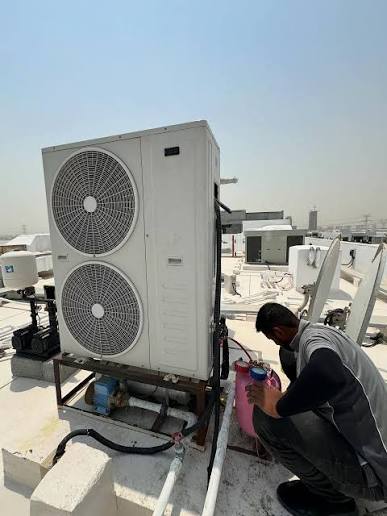
JVC is genuinely split down the middle. Newer towers run district cooling; the low-rise buildings, townhouses and villas are marketed chiller-free and run their own split systems. The faults are completely different.
We are an independent repair company â not an authorized service center of any air conditioning brand, and not affiliated with or appointed by Empower or any district cooling provider. Brand and utility names appear here only to describe the systems we service.

AC repair in JVC begins with a question that changes everything: is your home chiller-free, or is it on district cooling? Both exist here in quantity, often within a few hundred metres of each other.
The newer towers are served by Empower district cooling, so each apartment has a fan coil unit fed with chilled water. No refrigerant, no compressor, no outdoor unit of your own. The fault set is valves, drains, filters, coils and blowers.
The low-rise buildings, townhouses and villas are largely marketed as chiller-free, meaning each home runs its own refrigerant system with its own condenser outside. That is attractive on the monthly bills, and it puts condenser condition and refrigerant integrity squarely in the owner's hands.
And in JVC the chiller-free side has a distinctive problem that follows directly from how the community is built. Plots are efficient, so outdoor units end up in small rear yards, narrow side passages and light wells. That crowding is the single biggest cause of summer failure here, and it is why so many JVC systems work perfectly in April and give up in July.
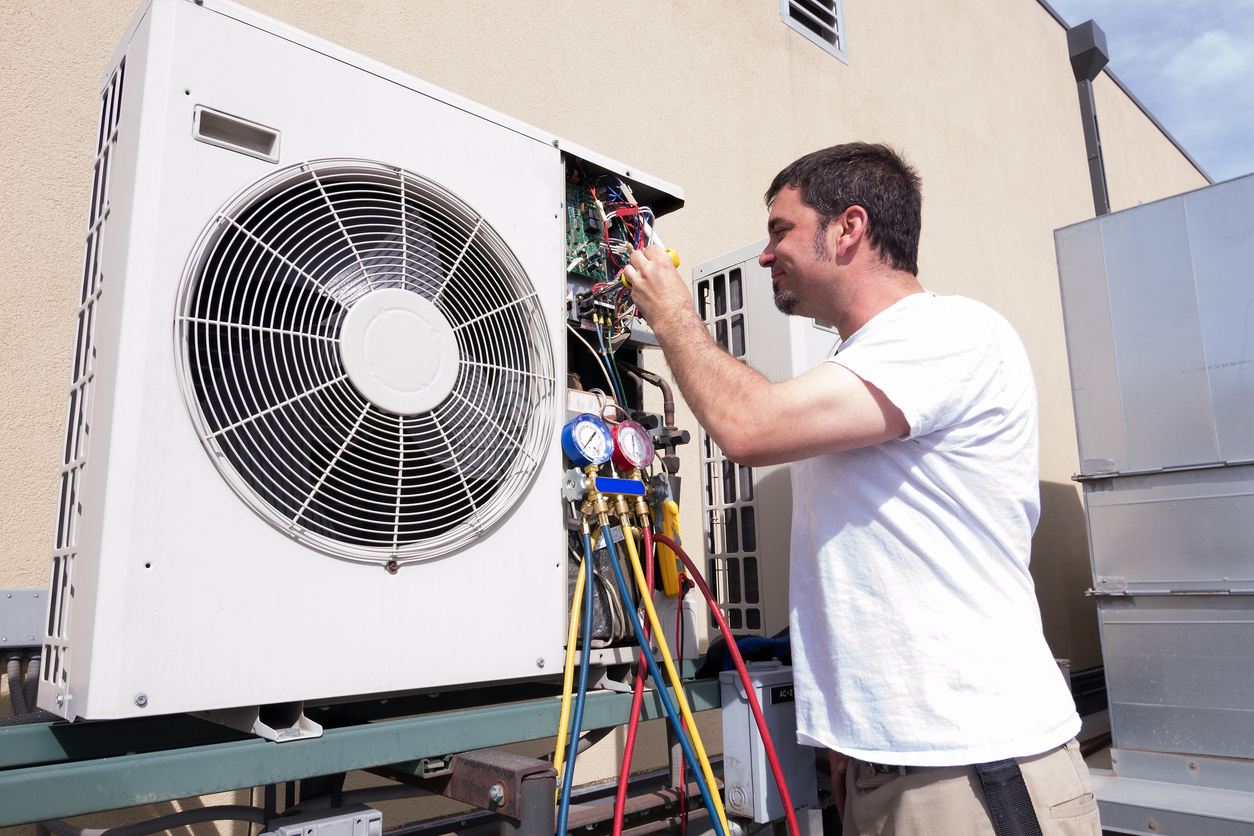
Four faults from the chiller-free side, two from the towers. Which set applies depends only on your building type.
A condenser boxed into a light well or narrow yard re-breathes its own discharge. Fine in spring, trips out in July. The defining JVC fault.
Dust packed into the fins on top of poor clearance. Head pressure climbs, current rises, capacity collapses at peak ambient.
Long returns loaded with lint, sagging flex duct in a hot roof void, and dampers left unbalanced after handover. One room stays warm.
Cooling fading over weeks. A sealed circuit does not consume refrigerant, so a system needing gas has a leak to find.
Blocked condensate line backs the pan up into the ceiling void. The stain usually appears away from the unit.
Fan runs, air moves, nothing is cold. The chilled-water valve actuator has stuck and no cold water reaches the coil.

If you take one thing from this page, take this: a system that cools well early and fails in the afternoon heat almost never needs refrigerant. It needs to be able to reject heat.
An air conditioner works by moving heat from inside your home to the air outside. The condenser does that job, and it needs a supply of relatively cool air and somewhere for the hot air to go. Put it in a confined light well or a narrow side passage and the discharge air has nowhere to travel, so it circles back into the intake. The unit is then trying to reject heat into air it has already heated.
In mild weather there is enough margin to absorb that inefficiency. As ambient rises through the forties, the margin disappears. Head pressure and condensing temperature climb, compressor current rises with them, and eventually a high-pressure switch or the breaker intervenes. From inside, it looks exactly like the system "losing its gas in the heat".
So we measure head pressure and current, check the air path around the unit, and clean the coil properly. If the installed position is the fundamental problem, we say so â because in that case a clean buys you one season and clearance buys you years.
The route splits at step one, depending on which JVC you live in.
Tower, low-rise, townhouse or villa, plus the district number. This decides whether we bring refrigerant gauges or valve and drain tooling.
Townhouses and villas are direct, sometimes with a community gate pass. Towers need contractor registration and a service-lift slot through building management.
Air path and clearance around the condenser, coil condition, head pressure and condensing temperature, compressor current, capacitor value, then superheat and subcooling together.
Filter and coil condition, temperature difference across the coil, valve actuator stroke, strainer, drain pan and line, thermostat signal.
Fault, fix and cost agreed before anything is dismantled. If clearance rather than a component is the real problem, we tell you that plainly.
Parts and labour carry a 90-day warranty. If the same fault returns inside that window, so do we.
The chiller-free side is entirely ours. The tower side has an ownership boundary worth knowing.
We are not affiliated with, appointed by, or acting for Empower or any district cooling provider. Utility names appear only to describe how a building is cooled.
Back to the main service page, or straight to the job your system needs.
Seeing a code on the display? Find out what it means before you call. AC Error Codes Explained →
Our full AC service â split, window, ducted and chilled-water systems across all four emirates.
The afternoon trip explained â why trip timing tells you the cause.
Where crowded, overheating condensers eventually lead â and why the cause must be fixed too.
For chiller-free homes: why a system needing gas every season has a leak.
Same-day cover across the surrounding communities.
It means your home has its own refrigerant-based air conditioning rather than being connected to a district cooling network, so you pay no separate chilled-water charges. Practically, it means there is a condenser outside that belongs to you, a refrigerant circuit, and full responsibility for maintaining it. Chiller-free is genuinely attractive on the bills, but it does mean condenser cleaning and refrigerant integrity are your problem rather than a utility. Most of the AC complaints we attend in the chiller-free parts of JVC trace back to that outdoor unit.
That timing pattern is close to diagnostic, and in JVC it usually points at the outdoor unit having nowhere to breathe. Condensers here are frequently squeezed into small rear yards, side passages and light wells with very little clearance. The unit discharges hot air, that air cannot escape, and it gets drawn straight back in. In the cool of the morning the system copes; once ambient climbs past the mid forties there is no margin left, head pressure and current rise, and protection cuts it out. The fix is usually clearance and a proper condenser clean rather than any part.
Very unlikely. Refrigerant undercharge weakens the whole system, not one room. A single warm room on a ducted townhouse system points to airflow: a damper closed or badly balanced, a flexible duct crushed or sagging in the roof void, a duct joint that has come apart and is dumping cold air into the ceiling, or a return path blocked by furniture or storage. Those are traceable, and the fix costs a great deal less than a refrigerant job.
All of it â the tower stock, the low-rise chiller-free buildings, and the townhouses and villas, across the JVC districts. Please give us the district number and your building type when you book. JVC addresses are notoriously similar from one district to the next, and knowing whether you are in a tower or a townhouse changes what we load into the van before we set off.
The same standards, but genuinely different work. In a district-cooled tower we are servicing a fan coil unit: filters, coil, blower, drain pan and the chilled-water control valve, with no refrigerant involved at all. In a chiller-free home we are servicing a refrigerant system: condenser, compressor, capacitor, fans, charge integrity and ductwork. Diagnosing one with the assumptions of the other is the single most common mistake we are called in to correct here.
More than most JVC installations have. The principle is straightforward: the condenser must be able to draw cool air in and discharge hot air away without that hot air returning. In practice that means keeping the coil faces clear, not boxing the unit in on multiple sides, not stacking storage against it, and not fitting covers that stay on while it runs. We will tell you honestly if the installed position is the root cause, because in that case cleaning alone will only buy you a season.
That one detail decides whether we arrive with refrigerant gauges or a valve actuator. Same-day slots, price agreed before any work.
Tower, low-rise building, townhouse or villa, plus the JVC district number. That tells us which of the two systems you have.
+971 50 988 6591
Daily, 8:00 AM â 6:00 PM
+971 50 988 6591
Send a photo of the outdoor unit or ceiling grille