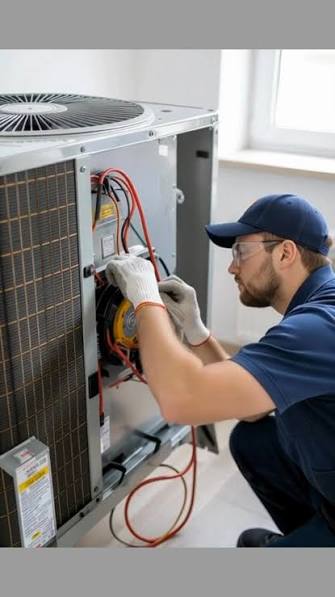
SKM is made here in the UAE and specified for this climate, which is why so much of it sits in Dubai homes and offices. Almost nobody covers these units properly. We do.
We are an independent repair company â we are not affiliated with, endorsed by, or an authorized service provider of SKM Air Conditioning. The brand name is used here only to identify the machines we repair, and all trademarks remain the property of their owners.

SKM AC repair in Dubai gets very little serious coverage, which is odd given how much of this equipment is installed across the country. So this page exists to do the job properly.
SKM Air Conditioning is a UAE manufacturer based in Sharjah. That matters practically rather than patriotically. Equipment designed in this region for this region starts from different assumptions than a product engineered for a temperate market and then sold here â SKM ducted mini-splits are rated to operate at ambient temperatures up to around 52 degrees, which is a specification written for the conditions the machine will actually meet.
It also means the supply chain is local. Parts and technical support exist within the country rather than requiring import, which generally keeps repair turnaround shorter and costs more predictable than for brands with a thin local presence.
The range we encounter most is ducted mini-splits in top-discharge and side-discharge forms, serving apartments, houses, offices and small commercial premises, alongside larger commercial ducted equipment. Refrigerant across the installed base is predominantly R410A.
And because these are ducted systems, the diagnosis lives as much in the ductwork as in the plant â which is where the rest of this page goes.
The honest position, plus the reason it costs you almost nothing on this particular brand.
Public technical documentation for SKM is thinner than for the large international manufacturers, and we could not verify a code-to-fault mapping to the standard we apply across every brand page on this site. Publishing an unverified table would risk sending you to buy a component that was never at fault â the exact failure this policy exists to prevent.
We apply the same rule to brands many times SKM's size. Consistency is the point.
On ducted systems, the faults that actually generate call-outs are overwhelmingly airflow and condensate problems â a sagging duct, degraded insulation, a stuck damper, a blocked drain, a fouled coil.
None of those would be reported by a fault code in the first place. A code names an electrical or refrigeration subsystem; it cannot tell you a flexible duct has drooped in your roof void.
So the diagnosis that serves you here is a physical inspection of the distribution path plus measurements â which is what we do regardless of whether a table exists.
Four of these six are distribution faults rather than equipment faults, which is typical of ducted systems.
Damper position, crushed or sagging duct, a separated joint, or a blocked return. Never a refrigerant fault on its own.
Filters, blower wheel and losses across the whole network. Measured at the grilles rather than assumed at the plant.
Duct insulation degraded in a hot roof void. The cooling is produced correctly and lost in transit.
Drain tray corrosion, a blocked line, or a run that has lost its fall. Common on any ducted system of age.
Condenser fouling first, then airflow, then charge measured properly. The high-ambient rating needs a clean coil to deliver.
Supply and isolator, capacitor value, contactor and control signal, in that order.

The single most common mistake on a ducted system is diagnosing it at the plant and stopping there. The plant can be in perfect health while the house is uncomfortable.
Here is why. The equipment produces cooled air at one point and your rooms are supplied through a network that runs, in most Dubai properties, through a roof void that becomes extremely hot in summer. Everything that happens in between affects what actually arrives.
Insulation that has hardened and cracked lets that heat into the airstream, so air leaves the unit cold and arrives lukewarm. A flexible section that has sagged under its own weight or been crushed restricts flow to whatever sits at the end of it. A joint that has worked loose discharges conditioned air into the void rather than into the house. Dampers drift out of balance over years and nobody resets them.
Measure at the unit and everything reads correctly. Measure at the grille in the affected room and the problem is immediately obvious.
So our ducted diagnosis includes the void: duct condition and insulation, flexible run integrity, joint security, damper positions and return air paths, plus airflow and temperature split taken at the grilles that matter rather than only at the plant. On an SKM system that is where the answer usually is.
Ducted mini-split, commercial ducted or split, plus the model from the plate. That determines the parts and the approach.
If the unit is still within its warranty period we will point you to that rather than taking payment.
Duct condition, insulation, flexible runs, joints, dampers and return paths â not just the plant readings.
Airflow and temperature split in the rooms that matter, plus condenser condition, capacitor value and current against nameplate.
Drain tray, line fall and trap. On ducted systems this is where the expensive water damage starts.
Fault, fix and cost agreed before anything is dismantled, with a 90-day warranty on parts and labour.
âšī¸ Independent third-party repair notice: we are not an authorized service center, dealer or affiliate of SKM Air Conditioning. We have no endorsement from them and no authorization to carry out warranty work on their behalf. If your unit is still within its warranty period, contact the retailer or the brand's own support channel first.
Back to the main service page, compare with another brand, or read about the symptom.
Not sure the code you are seeing is on our list? Compare it across every brand. All Brand Error Codes →
Our full AC service â split, window, ducted and chilled-water systems across all four emirates.
The other UAE-associated brand here, and the O General confusion worth clearing up.
The other major ducted platform in UAE villas, also diagnosed by model series and symptom.
Duct losses, sagging flex and blocked returns â the core ducted fault set.
What lets a high-ambient rating actually deliver at 45 degrees and above.
Ducted systems are concentrated in the villa and light-commercial districts.
SKM Air Conditioning is a UAE manufacturer based in Sharjah, and it matters in two practical ways. First, the equipment was designed with this climate in mind rather than adapted to it â SKM ducted mini-splits are rated to operate at ambient temperatures up to around 52 degrees, which is a genuinely relevant specification here. Second, being locally manufactured means parts and technical support exist within the country rather than requiring import, which usually keeps repair turnaround short.
No, and we would rather explain why than give you a list. Public technical documentation for this brand is thinner than for the large international manufacturers, and we could not verify a code-to-fault mapping to the standard we apply across this site. Publishing one anyway would risk pointing you at a component that is not your problem. It matters less than you might expect on these systems, though, because the faults we actually attend on SKM ducted units are overwhelmingly airflow and condensate issues that no code would report in the first place.
The distribution side rather than the plant. On a ducted system the air has to travel through a network of ducts, dampers and grilles, and that network degrades independently of the equipment â insulation hardening in a hot roof void, flexible sections sagging or crushed, joints separating, dampers drifting out of balance. Alongside that, condensate handling matters: drain trays, drain lines and their fall. Add coil and filter fouling from Dubai dust, and you have most of what we attend.
Almost certainly not. A refrigerant or compressor problem weakens the whole system rather than one room, so a single underperforming space points to the branch serving it. The usual causes are a damper stuck or badly balanced, a flexible duct crushed or drooping in the roof void, a duct joint that has come apart and is discharging into the ceiling, or a return path blocked by furniture or storage. All are traceable, and all cost considerably less to put right than anything involving the refrigerant circuit.
It is genuinely relevant, with one important caveat. Equipment specified to operate at high ambient temperatures has more margin at the point in the day when a Dubai system is under most strain, and that shows in reliability through the summer peak. The caveat is that any rating assumes the machine can reject heat as designed. A condenser coil blinded by dust and sand removes that margin entirely, and at that point the specification on the plate is irrelevant. Cleaning the outdoor coil properly is what lets the rating do its job.
Generally more straightforward than for brands relying on import, which is one of the practical advantages of a locally manufactured product. Common service components â capacitors, contactors, fan motors, sensors and thermostats â cover most repairs and are usually obtainable without a long wait. Where availability is worth confirming before you commit is model-specific boards and proprietary assemblies, and we will establish that at quotation stage rather than starting a job and stalling.
On these systems the fault is usually airflow or condensate rather than the plant. We check the whole distribution path, not just the unit.
The model from the rating plate and whether it is a ducted mini-split, a commercial ducted unit or a split. That shapes the visit.
+971 50 988 6591
Daily, 8:00 AM â 6:00 PM
+971 50 988 6591
Send a photo of the rating plate and the unit