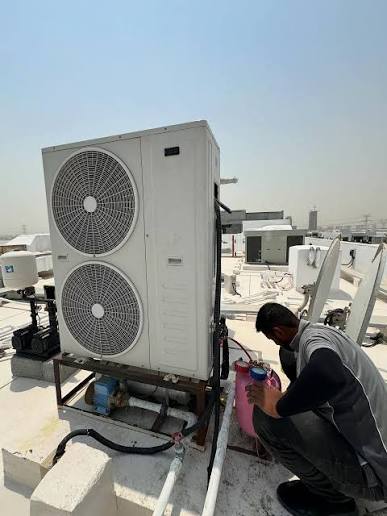
At 45 degrees your condenser is already near its limit. Pack the fins with sand and it goes past that limit every afternoon â which is the most common route to a dead compressor in this city.
We are an independent repair company â not an authorized service center of any air conditioning brand. Brand names on this page are used only to identify the systems we service, and all trademarks remain the property of their owners.

AC condenser coil cleaning in Dubai is not routine maintenance in the way it might be elsewhere. Here it is the intervention that decides whether your compressor reaches its expected life.
The reason is temperature. An air conditioner rejects heat outdoors by making its condenser hotter than the surrounding air. When the surrounding air is 22 degrees that is easy. When it is 45, the system is already working close to the limit of what it can do â the gap it has to work with is small.
Now pack the fin surface with fine dust and sand. Air can no longer pass through, so the coil cannot shed heat. Condensing temperature climbs, head pressure climbs with it, and the compressor draws more current to push against that pressure.
The result is visible in the afternoon: capacity collapses, or the unit trips on protection, or the breaker goes. And the result you cannot see is worse â the compressor has been running hot and hard, hour after hour, through a five-month summer.
That is why we treat this as the highest-leverage preventive job on any refrigerant system in this city, and why we measure head pressure and current rather than just making the coil look tidy.
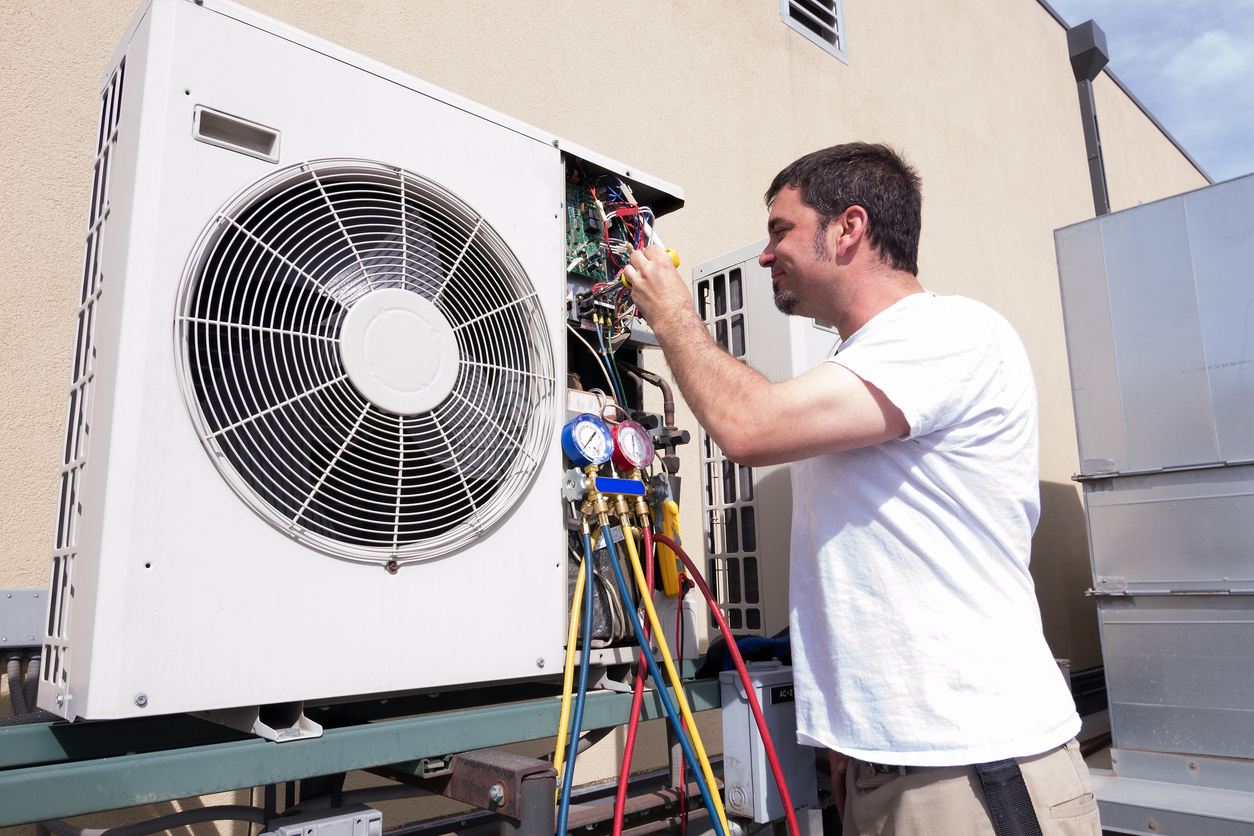
Direction and pressure matter more than product. Doing this wrong makes the unit perform worse than before.
Power off and locked at the isolator. There is live electrical equipment in that enclosure and water is about to be introduced.
Loose sand brushed out along the direction of the fins, never across them. Brushing across is how fins get bent flat.
Cleaner applied, then rinsed from the inside outward so debris leaves the way it came in. Rinsing inward drives dirt deeper.
Enough to carry dirt away, never enough to fold aluminium fins. A folded fin pack is permanent airflow loss.
Bent fins combed straight where possible, and debris cleared from around the unit so discharge air can actually escape.
Head pressure, condensing temperature and compressor current checked after the clean. Numbers, not impressions.

A fouled condenser has a distinctive signature, and it is worth knowing because it separates this fault from the ones it is commonly confused with.
The classic picture is high head pressure and high condensing temperature with a normal refrigerant charge, usually alongside raised compressor current and, in bad cases, high-pressure lockouts or breaker trips in peak heat. The charge is fine. The system simply cannot get rid of the heat.
Compare that with genuine undercharge, which shows as high superheat with low subcooling, or a liquid-line restriction, which shows as high superheat with high subcooling. Three faults, three signatures, one identical complaint from the customer â which is exactly why measurement rather than assumption decides it.
It is also why we take readings after cleaning as well as before. If head pressure and current come down and the temperature split recovers, the coil genuinely was the problem and the job is done. If they do not move, the coil was not the whole story, and we continue diagnosing rather than declaring the clean a success and leaving you where you started.
Fouling rate and cleaning benefit both depend heavily on position. These are the patterns we see across Dubai.
Excellent airflow, but full radiant load and wind-blown sand. They foul fast and, being out of sight, nobody notices until performance collapses.
The unit re-breathes its own hot discharge. Cleaning helps, but clearance is the real fix and we will say so rather than sell repeat cleans.
Airborne dust loads coils in a fraction of the usual time. Shorter intervals genuinely make sense here.
Less sand, more salt. Here rinsing deposits away before they establish protects the metal itself, not just the airflow.
Restricted airflow plus accumulated household dust. Worth checking that nothing has been stored against the unit.
A clean coil going into May is worth considerably more than a clean coil in December. Timing is part of the value.
Cleaning is genuinely valuable and it is not a cure-all. Both halves of that are worth stating.
Where the measurements after cleaning say the fault lies elsewhere, we tell you that rather than booking you in for the same clean again next summer.
Back to the main service page, or to the faults a blocked condenser causes.
Showing a code rather than an obvious fault? Start here. Decode Your Error Code →
Our full AC service â split, window, ducted and chilled-water systems across all four emirates.
The indoor half of the job â evaporator chemical wash including the blower wheel.
What a neglected condenser eventually costs you, and why the cause must be fixed too.
The afternoon trip explained â the signature symptom of a coil that cannot reject heat.
The ranked cause list, with condenser fouling near the top and refrigerant near the bottom.
Rooftop and desert-edge units foul fastest and are least often inspected.
Your condenser has one job: reject the heat your system collected indoors into the outside air. To do that, air must pass freely through its fin surface. When fine dust and sand pack into those fins they form a mat that air cannot get through, so heat has nowhere to go. Condensing temperature rises, head pressure rises with it, the compressor works harder and draws more current, and cooling capacity falls. In mild weather there is enough margin to hide it. At 45 degrees there is none, which is why the symptom appears in the afternoon.
Because the damage a blocked coil does is cumulative and lands on the most expensive part of the system. Every hour the compressor spends working against elevated head pressure and drawing raised current is an hour of running outside the conditions it was designed for. Across a five-month Dubai summer that adds up to real mechanical wear. A compressor is the single largest line item in split-system repair, and cleaning a condenser costs a small fraction of one. Spending the small amount to protect the large one is simply arithmetic.
That pattern points at heat rejection more strongly than almost any other symptom, and a fouled condenser is the usual cause. In the cooler part of the day the system has enough margin to cope even with a partly blocked coil. As ambient climbs past the mid forties, the outdoor air is already hot before it even reaches the coil, the margin disappears, pressure and current rise past the trip threshold, and either a pressure switch or the breaker intervenes. It is one of the most diagnostic things you can tell us when booking.
We would not recommend it, for two reasons that both cost money. Rinsing from the outside pushes dirt further into the fin pack rather than out of it, so it looks cleaner while performing worse â the correct direction is from the inside outward, so debris leaves the way it entered. And ordinary hose or pressure-washer force folds the thin aluminium fins over, which permanently reduces airflow. There is also live electrical equipment in the outdoor enclosure. A proper clean uses appropriate cleaner, controlled low pressure and the correct direction.
More often than manufacturer schedules suggest, because those were written for temperate climates with cleaner air. What matters more than a fixed interval is where your unit sits. Villa rooftop units at the desert edge, units near open plots or construction, and units in dusty inland communities foul considerably faster than a sheltered coastal unit. Coastal units have their own issue in salt rather than sand. As a practical guide, going into the May to September peak with a clean coil is worth far more than cleaning it in December.
It will help, but we will tell you honestly if location is the underlying problem. A condenser boxed into a narrow light well or a confined side yard re-breathes its own hot discharge air, and no amount of cleaning changes that. In those cases a clean buys you a season and improved clearance buys you years. Where we find that, you get a plain assessment of what would actually help rather than an invitation to book the same clean again next summer.
We measure head pressure and current before and after, so you can see what the clean actually achieved. Price agreed before any work.
Roof, side yard, balcony or light well, and how many units. Access and working height determine how we plan the visit.
+971 50 988 6591
Daily, 8:00 AM â 6:00 PM
+971 50 988 6591
Send a photo of the outdoor unit and its surroundings