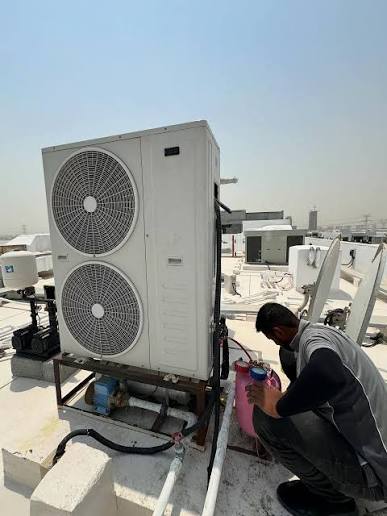
Al Qusais equipment does not fail from age alone. It fails from duty cycle — systems running continuously in high-occupancy homes, breathing industrial-area dust, in light wells that recycle their own hot air.
We are an independent repair company — not an authorized service center of any air conditioning brand. Brand names on this page are used only to identify the systems we repair, and all trademarks remain the property of their owners.

AC repair in Al Qusais is shaped less by how old the equipment is than by how hard it works. Understanding that changes which faults you expect and which parts you check first.
Wear on an air conditioner tracks running hours rather than calendar years. A system serving a high-occupancy home runs far more hours per day than one in a lightly used apartment, so it accumulates bearing revolutions, capacitor heat exposure and compressor operating hours at a much faster rate. Across a five-month Dubai summer, a near-continuous duty cycle compresses several years of ordinary wear into one season.
Two local conditions compound it. The area sits alongside substantial light-industrial activity, so airborne particulate loading is higher than in a purely residential district, and coils and filters foul faster. And a great deal of the outdoor equipment sits in enclosed light wells and shared shafts where discharge air cannot escape properly and gets re-drawn into the intake.
Add a stock of 15-to-25-year-old wall splits and legacy ducted systems in the older villas and compounds, and you have a district where the failure pattern is genuinely distinct: not neglected equipment, but equipment doing more work in worse conditions than it was specified for.
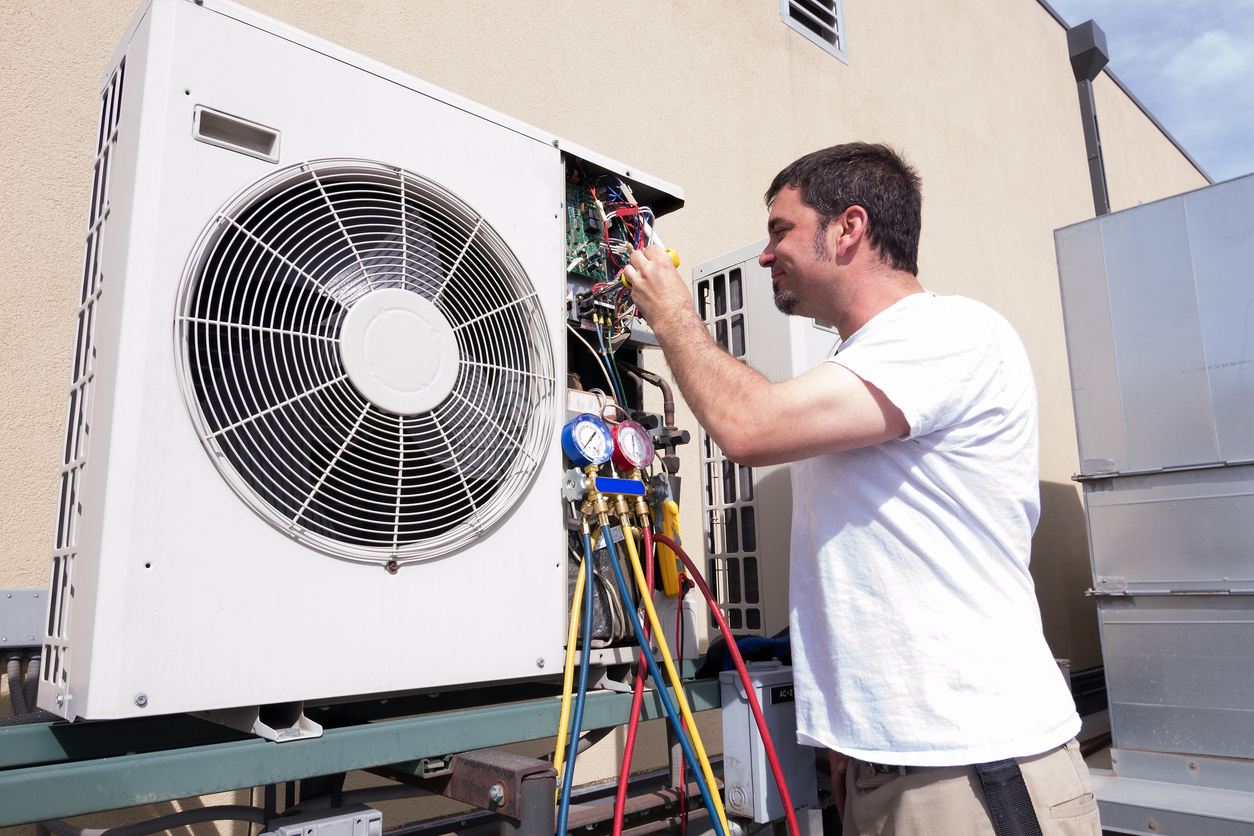
These fail in a fairly predictable order on a heavily used system, which is why we check them in this sequence.
First to go under heat and continuous cycling. The highest-frequency consumable on a hard-working system, and the cheapest to replace.
Wear tracks revolutions, and these turn constantly. Grinding or squealing that rises with fan speed is the signature.
Light wells and shared shafts where discharge air cannot escape. The unit re-breathes its own heat and loses capacity on hot afternoons.
Industrial-area particulate plus long running hours. Coils need attention on a noticeably shorter cycle than elsewhere.
Legacy ducted systems topped up repeatedly rather than repaired. The compressor pays for every month it runs undercharged.
The endpoint when the above are left unaddressed. Almost always the consequence of something else, not a random failure.

This is the underlying fault we find most often in Al Qusais, and it is worth explaining because cleaning alone will not fix it.
An air conditioner rejects heat by making its condenser hotter than the surrounding air and blowing that heat away. The arrangement depends entirely on the discharged hot air actually leaving.
Put the unit in an enclosed light well, a narrow shaft or a boxed-in service area, and the hot air has nowhere to travel. It circulates within the space and gets drawn straight back into the intake. The unit is now trying to reject heat into air it has already warmed — and the hotter that air gets, the worse the situation becomes.
The symptoms follow inevitably. Capacity falls in the afternoon. Head pressure and compressor current climb. Protection devices operate and the unit short cycles, or the breaker trips. And every hour spent in that condition shortens the compressor's life.
So when we diagnose here, we assess the air path around the outdoor unit as seriously as the unit itself. Cleaning the coil in a badly ventilated position buys you a season. Improving clearance, removing stored items, and where possible changing how air enters and leaves that space buys you years. If the position is the problem, we will say so rather than booking you in for the same clean next summer.
Residential, villa and light-commercial premises all get the same standards, with scheduling adjusted to suit.
Apartment, villa or commercial, and roughly how many hours a day it runs. Duty cycle genuinely changes which components we expect to have worn.
Landlord or building caretaker coordination in much of the stock, and roof or light-well access negotiated per building. Commercial premises scheduled around trading hours.
Clearance around the outdoor unit, whether discharge air can escape, and coil condition. In this district that is where the underlying fault usually sits.
Capacitor value against rating, motor current and bearing condition, compressor current against nameplate, then superheat with subcooling where refrigerant is involved.
Fault, fix and cost agreed before anything is dismantled — including the honest position where the installed location is the real problem.
Parts and labour carry a 90-day warranty. If the same fault returns inside that window, so do we.
Where equipment runs near-continuously, a few things make a disproportionate difference.
You get the reasoning and both options. We would rather tell you a machine is near the end than sell you repairs that postpone the same decision.
Back to the main service page, or straight to the repair a hard-working system needs.
Seeing a code on the display? Find out what it means before you call. AC Error Codes Explained →
Our full AC service — split, window, ducted and chilled-water systems across all four emirates.
Shorter intervals genuinely matter here. The job that protects the compressor.
Bearings wear by revolutions, and these turn constantly. What replacement involves.
The light-well pattern in detail — protection operating because heat cannot escape.
Why annual top-ups on a legacy ducted system are costing you a compressor.
Usually duty cycle rather than the equipment being worse. A system serving a high-occupancy home runs far more hours per day than one in a lightly occupied apartment, and wear tracks running hours rather than calendar age. Bearings accumulate revolutions, capacitors accumulate heat exposure, and compressors accumulate operating hours. A unit running close to continuously through a five-month summer does several years of ordinary wear in one season. It is not that the machine is poor; it is being asked to do considerably more work.
Considerably, and it is one of the most common underlying faults we find here. A condenser needs to draw cooler air in and discharge hot air away. In an enclosed light well the discharge air has nowhere to go, so it circulates and gets drawn back into the intake. The unit is then trying to reject heat into air it has already heated. Cooling falls, head pressure and current rise, and on hot afternoons protection cuts in. Cleaning helps; improving the airflow path helps far more and lasts far longer.
Yes, and it shows up on the coils rather than in the air you notice. Al Qusais sits alongside substantial light-industrial activity, and the airborne particulate load is higher than in a purely residential district. That dust packs into condenser fins and loads indoor filters faster than manufacturer schedules assume. Combine heavier dust loading with longer running hours and you get coils that need attention on a noticeably shorter cycle than the same equipment would elsewhere in Dubai.
That deserves a proper answer rather than another refill. A sealed system does not consume refrigerant, so annual top-ups mean a leak nobody has repaired, and running undercharged for months damages the compressor. The questions that decide the outcome are whether the leak is accessible, what refrigerant the system uses — older systems may use one that is being phased out, which changes the economics — and what condition the rest of the equipment is in after years of heavy duty. We will set out repair and replacement with the reasoning rather than defaulting to whichever is easier to sell.
All of it — Al Qusais 1, 2 and 3, the industrial areas, the streets around Damascus Street and Al Qusais and Stadium Metro stations, and out towards Al Twar and the Al Nahda border. Tell us the property type and building when you book. The residential, villa and light-commercial stock here run quite different systems, and knowing which you have determines what we bring.
Yes. A good deal of what we do in Al Qusais is small commercial — shops, offices, workshops and similar premises — and the equipment is often the same split and ducted systems found in homes, simply working harder. What differs is scheduling, because we can usually work around trading hours, and access arrangements where a landlord or building owner is involved. Tell us at booking and we will plan around your opening times rather than yours around ours.
Continuous duty wears specific parts in a predictable order. We check those first, and the price is agreed before any work.
Apartment, villa or commercial premises, and roughly how many hours a day the system runs. Duty cycle genuinely changes what we expect to find.
+971 50 988 6591
Daily, 8:00 AM – 6:00 PM
+971 50 988 6591
Send a photo of the outdoor unit and its surroundings