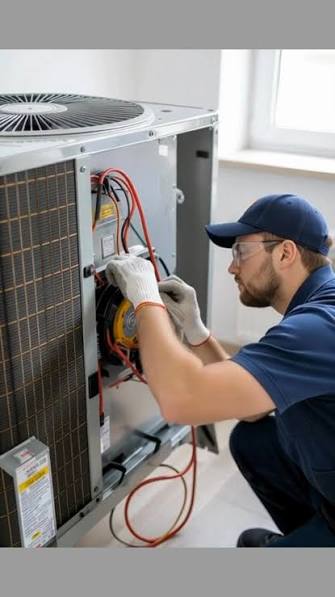
A motor that hums without turning is usually not a dead motor. Before anything is replaced, the capacitor gets measured — because it costs a fraction as much and produces identical symptoms.
We are an independent repair company — not an authorized service center of any air conditioning brand. Brand names on this page are used only to identify the systems we repair, and all trademarks remain the property of their owners.

AC fan motor replacement in Dubai should almost never be the first conclusion, because the symptom that prompts it is produced far more often by a component costing a fraction as much.
A single-phase motor cannot start on its own. It needs a capacitor to shift the phase of part of its winding current and create the rotating field that produces starting torque. When that capacitor's capacitance has drifted well below its rated value, the motor gets full power, produces no useful starting torque, and sits humming while drawing heavy current.
That is indistinguishable — by ear, by sight, by touch — from a mechanically seized motor. Which is why "your fan motor has failed" is quoted so often when the actual fault is a capacitor.
The test takes two minutes with a meter. Accepted tolerance is roughly six percent of the rated microfarad value, so a 45 microfarad capacitor should read somewhere around 42 to 48. Below that it is failing. There is also a homeowner-level clue: if the fan starts running once nudged, it has running torque but no starting torque, and that is a capacitor rather than a motor.
When a motor genuinely has failed, this page covers what replacing it properly involves.
Each distinguishes a genuine motor failure from something cheaper that mimics it.
Measured against rating, roughly six percent tolerance. The single most common reason a healthy motor will not start.
Running torque present, starting torque absent. Close to conclusive evidence for the capacitor rather than the motor.
Bearing failure, and on these motors bearings are not field-serviceable. This one genuinely does mean replacement.
Turned by hand with power off. Roughness, grinding or excessive movement confirms bearing wear before anything is dismantled.
With power off and capacitor disconnected. An open winding is a failed motor; a plausible reading is not.
Clamp-meter reading compared with the rated figure. High current on a motor that runs points at bearings or a wrong capacitor.

Air conditioning systems have two fan motors doing quite different jobs, and knowing which has failed tells you what else to expect.
The indoor blower drives a drum-shaped wheel that pushes room air across the cold coil. When it stops, airflow disappears — and because the coil is still being cooled, its temperature drops below freezing and ice forms. So a failed blower presents as poor cooling, then as an iced coil, then as water everywhere when the ice thaws. It is very frequently diagnosed as a refrigerant problem, which is expensive and wrong.
The outdoor fan draws air across the condenser so the system can reject heat. When it stops, heat has nowhere to go: condensing temperature and head pressure climb rapidly, and the system either loses capacity or trips out on protection within minutes. In peak Dubai heat that happens fast, and every minute of it stresses the compressor.
Both are ordinary repairs. What matters is recognising the chain, because in each case the visible symptom is one step removed from the actual fault. Ice on a coil sends people to refrigerant. Pressure trips send people to compressors. Checking the fans first avoids both wrong turns.
Matching the specification matters more than the swap itself, and mismatches cause problems that surface weeks later.
Power off and locked, and the capacitor safely discharged before anything is touched. Capacitors hold a dangerous charge after the supply is removed.
Blower motors commonly have multiple speed windings. Reconnecting to the wrong tap gives you the wrong airflow and an unexplained performance complaint.
Rotation direction, power rating, speed, frame size, shaft dimensions and voltage. An approximate substitute causes problems that appear later.
Keeping an old capacitor of the wrong value to save a little money shortens the life of the new motor considerably. It is a false economy.
Cleaned and balanced. A blower wheel caked with grime undoes much of the benefit, and an unbalanced blade causes vibration and noise.
Current against nameplate, airflow and temperature split re-measured, and on outdoor fans the head pressure confirmed back to normal.
Where a motor genuinely needs replacing, and where the fault is somewhere else entirely.
Rewinding is offered locally and we do not recommend it for small AC fan motors — the cost approaches a new motor of known specification and known remaining life.
Back to the main service page, or to the cheaper cause that mimics this one.
Showing a code rather than an obvious fault? Start here. Decode Your Error Code →
Our full AC service — split, window, ducted and chilled-water systems across all four emirates.
The part that gets misdiagnosed as a motor. Measured, not guessed.
Grinding means bearings, humming means capacitor. The full noise decoder.
Usually not, and this is the most important thing on the page. A single-phase motor needs a capacitor to develop starting torque. When that capacitor has drifted below its rated value, the motor receives full power but cannot begin turning — so it sits there humming and drawing heavy current. That is identical, to anyone without a meter, to a seized motor. The capacitor costs a small fraction of a motor, so it gets measured first. If you can nudge the fan and it then runs, that is close to conclusive.
On the small motors used in domestic air conditioning, no — and we would rather say that plainly than imply otherwise. Grinding or squealing means the bearings have failed, and on these motors the bearings are not field-serviceable. There is no practical way to restore them, and a motor running on failed bearings deteriorates further every hour and can seize. Replacement is the honest answer. The good news is that fan motors are considerably cheaper than compressors, and it is an ordinary repair rather than a major one.
They do different jobs and fail somewhat differently. The indoor blower drives a drum-shaped wheel that pushes air across the cold coil and into your rooms, so when it fails you lose airflow and the coil can ice up. The outdoor fan draws air across the condenser so the system can reject heat, so when it fails the system loses its ability to shed heat and trips out on pressure. Both are replaceable, and both require matching the correct specification rather than fitting an approximate substitute.
It needs to match on several counts, and getting this wrong causes problems that appear later rather than immediately. Rotation direction has to be right, or the fan moves air the wrong way. Power rating, speed and frame size all have to suit. The shaft has to fit the existing wheel or blade. And the capacitor has to be matched to the motor — fitting a motor while keeping an old capacitor of the wrong value is a common shortcut that shortens the life of the new motor considerably.
Directly, and it is a useful chain to recognise. The indoor coil runs cold by design and stays above freezing because a steady flow of warm room air passes over it. Stop the blower and that flow disappears, so the coil temperature falls below zero and ice forms quickly. The system then appears to have a refrigerant problem — and it is very often diagnosed as one — when the actual fault is a stopped blower or the capacitor that drives it. Checking the blower before condemning the charge saves a great deal of money.
Rewinding is offered locally and we would not recommend it for small AC fan motors. The economics do not work in your favour: by the time a motor has been removed, rewound and refitted, the cost approaches a new motor of known specification and known remaining life, while the rewound unit carries neither. For larger commercial motors the calculation can differ, but on the domestic and light-commercial fan motors in most Dubai systems, replacement with a correctly matched motor is the durable and usually cheaper answer.
The capacitor is checked first because it produces the same symptom for a fraction of the cost. Price agreed before any work.
Indoor blower or outdoor fan, and whether it hums, grinds, turns slowly, or does nothing at all. Each points somewhere different.
+971 50 988 6591
Daily, 8:00 AM – 6:00 PM
+971 50 988 6591
Send a short video with sound if you can