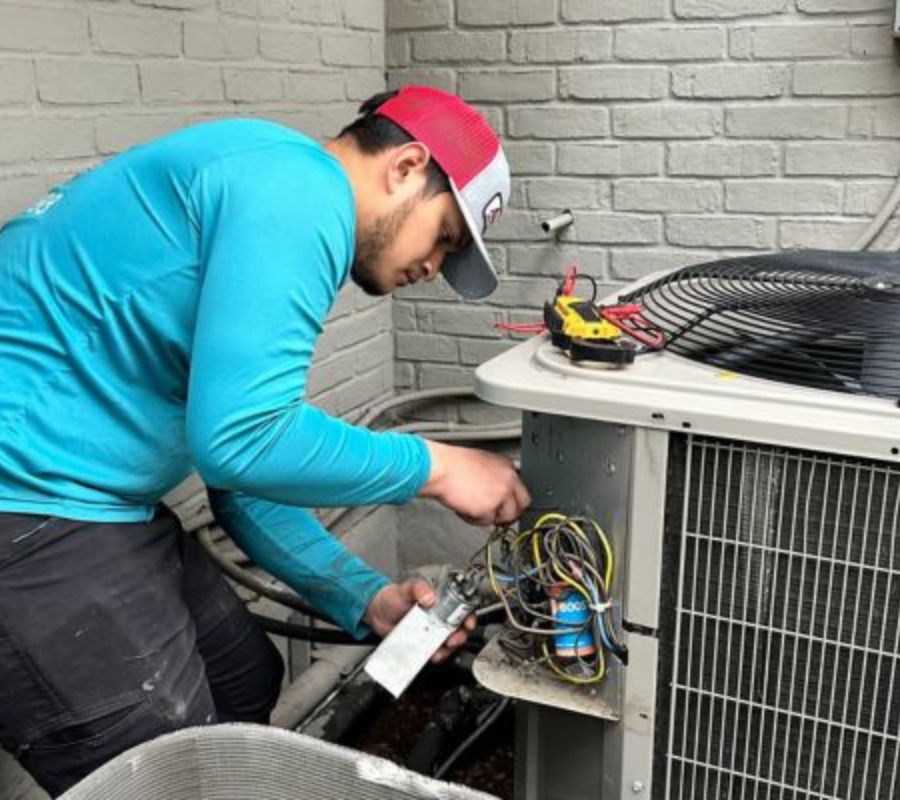
The capacitor is the cheapest meaningful repair on an air conditioner, and the part most often blamed for a compressor failure that never happened. It takes a meter and two minutes to know for certain.
We are an independent repair company â not an authorized service center of any air conditioning brand. Brand names on this page are used only to identify the systems we repair, and all trademarks remain the property of their owners.

AC capacitor replacement is the least glamorous job in air conditioning and one of the most commercially important, because of a single awkward fact: a failing capacitor produces exactly the same symptoms as a failed compressor.
A capacitor's job is to give a single-phase motor the phase shift it needs to develop starting torque. Without that, the motor gets power but cannot begin to turn. It hums. It draws heavy current. It may trip the breaker. To anyone standing next to it without a meter, that is indistinguishable from a seized motor or a dead compressor â and those are the two most expensive parts on the machine.
The difference between those diagnoses is a measurement that takes about two minutes. Read the capacitance on the microfarad range, compare it to the value printed on the body, and you know. Accepted tolerance is roughly six percent, so a 45 microfarad unit should read somewhere between about 42 and 48. Below that it is failing.
We put this on its own page because "your compressor has gone" is one of the most expensive sentences a Dubai homeowner can hear, and a meaningful proportion of the time the actual fault is a component that costs very little. If you have been quoted a compressor, this is the check to insist on first.
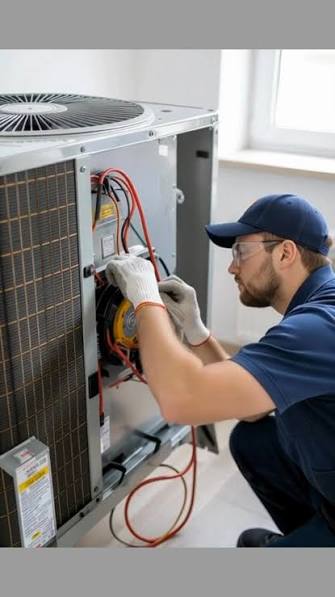
Any of these is worth a two-minute measurement before anything expensive is discussed.
The outdoor unit buzzes but the fan or compressor never turns. The single most characteristic capacitor symptom there is.
A fan that begins turning once helped along has enough running torque but no starting torque. That is a capacitor, not a motor.
Breaker goes a second or two in, as the compressor engages. High starting current from a capacitor that can no longer do its job.
A swollen top or any oil residue means replacement regardless of the meter reading. The seal has already failed.
A blower or fan turning but noticeably weak. Quiet, easy to miss, and a real cause of low airflow.
Sometimes starts, sometimes does not â often worse on the hottest afternoons as the enclosure temperature peaks.

Capacitors have a design ambient temperature, and a Dubai outdoor unit does not respect it. The component sits inside a metal electrical enclosure, on a roof or in a plant space, with the sun on it and the unit's own heat around it, for five months a year.
Electrolytic degradation accelerates with temperature. So capacitance drifts downward faster here than the same part would in a temperate market, which is why capacitors are the highest-frequency consumable in air conditioning in this region. A unit needing its second capacitor within a few years is not a badly made unit; it is a normal outcome of this climate.
There is a compounding effect worth knowing about, because it links this page to the most expensive one. A fouled condenser raises the temperature of the entire outdoor unit, enclosure included. So a dirty coil shortens capacitor life at the same time as it raises compressor current. Two failures, one root cause â and cleaning the coil addresses both.
That is also why repeated capacitor failure is a signal rather than an inconvenience. If we are fitting your third capacitor, we will be checking motor current, the value that was fitted previously, and the temperature conditions in that enclosure, instead of simply taking payment for another part.
The contactor sits alongside the capacitor in the same enclosure and produces overlapping symptoms, so it gets checked in the same visit.
An electrically operated switch that connects mains power to the compressor when the control system calls for cooling. Every start and stop passes through its contacts.
Contact faces pit and burn from arcing over thousands of switching cycles, so they no longer pass full current. The coil can also fail, leaving nothing to pull the contacts together.
Coil continuity, whether correct control voltage is arriving at the coil, and whether the contacts genuinely pass power both energised and de-energised.
A contactor that buzzes or chatters usually has pitted contact faces or is receiving unstable control voltage. Both are worth finding rather than tolerating.
It is offered, and it does not work. Filing removes the plating from the contact faces, after which they oxidise quickly and the fault returns worse. Contactors get replaced.
A pitted contactor and a weak capacitor both present as a compressor that will not start. Checking both in one visit avoids a second call-out.
This is a genuinely cheap repair, and it is also the one with the most underestimated shock risk.
Parts fitted are OEM-standard compatible and matched to your unit's rated value. Every repair carries a 90-day warranty on parts and labour.
Back to the main service page, or to the faults a weak capacitor imitates.
Showing a code rather than an obvious fault? Start here. Decode Your Error Code →
Our full AC service â split, window, ducted and chilled-water systems across all four emirates.
The expensive diagnosis a weak capacitor imitates. Read this before agreeing to one.
Dead unit, or power but no start? The ordered check sequence, with the capacitor in its proper place.
A start-up trip is the capacitor's other signature. Trip timing tells you which fault you have.
A weak capacitor leaves a blower turning slowly rather than stopping â a quiet airflow killer.
No. Capacitors are always replaced, never repaired, and we would rather say that plainly than dress it up. There is nothing serviceable inside one â it is a sealed component that stores and releases electrical energy, and when its capacitance degrades or its casing swells, its working life is over. The good news is that this is genuinely the cheapest meaningful repair on an air conditioning system, so the honest answer here is also the inexpensive one. People search for "capacitor repair", and the correct service is replacement.
By measuring it, on the microfarad range, and comparing the reading against the value printed on the capacitor body. The accepted tolerance is around six percent, so a capacitor rated at 45 microfarads should read roughly 42 to 48. Anything meaningfully below that is failing even if the unit still limps along. There is also a visual test that overrides the meter entirely: any bulging of the top, any swelling of the casing, or any sign of oil weeping means replace it regardless of what it measures.
Heat, and it is the honest explanation rather than a quality complaint. A capacitor has a design ambient temperature it expects to work within. Mount one inside a metal electrical box on an outdoor unit, in a plant space or on a roof, through a Dubai summer, and it spends months operating well above that. Electrolytic degradation accelerates with temperature, so capacitance drifts downward faster than it would in a temperate climate. That is why capacitors are the highest-frequency consumable in air conditioning here, and why a five-year-old unit having its second capacitor is entirely normal.
That is the textbook capacitor symptom, yes. A single-phase motor needs a phase shift to develop starting torque, and the capacitor provides it. When capacitance has dropped too far, the motor receives power but cannot generate enough torque to begin rotating, so it sits there humming and drawing heavy current. Left like that it will eventually trip the breaker or overheat. It is also exactly what a seized motor or a failed compressor sounds like, which is why so many expensive parts get quoted for a cheap fault.
Repeated failure means something else is causing it, and fitting a third capacitor without investigating is not a repair. There are three usual explanations. The motor it serves may be drawing higher current than it should because its bearings are worn, which stresses the capacitor continuously. The wrong microfarad rating may have been fitted previously, so it is working outside its design point. Or the electrical enclosure is running exceptionally hot, sometimes because a fouled condenser has raised the whole unit temperature. We check motor current and enclosure conditions rather than just supplying another part.
Please do not. A capacitor stores electrical energy and holds a dangerous charge after the power has been switched off, so it must be safely discharged before it is even touched â that surprises people, and it is a genuine shock risk rather than a theoretical one. Beyond that, fitting the wrong microfarad value or the wrong voltage rating damages the motor it serves, and the terminal identification on a dual-run capacitor matters. In Dubai, electrical installation and modification work must also be carried out by appropriately approved contractors.
That is the classic capacitor symptom. We measure the value before fitting anything, and it is the cheapest real repair on an AC system.
Humming without starting, fan not spinning, or tripping on start-up? All three point at the capacitor, and all three are quick to confirm.
+971 50 988 6591
Daily, 8:00 AM â 6:00 PM
+971 50 988 6591
Send a photo of the outdoor unit and its rating plate