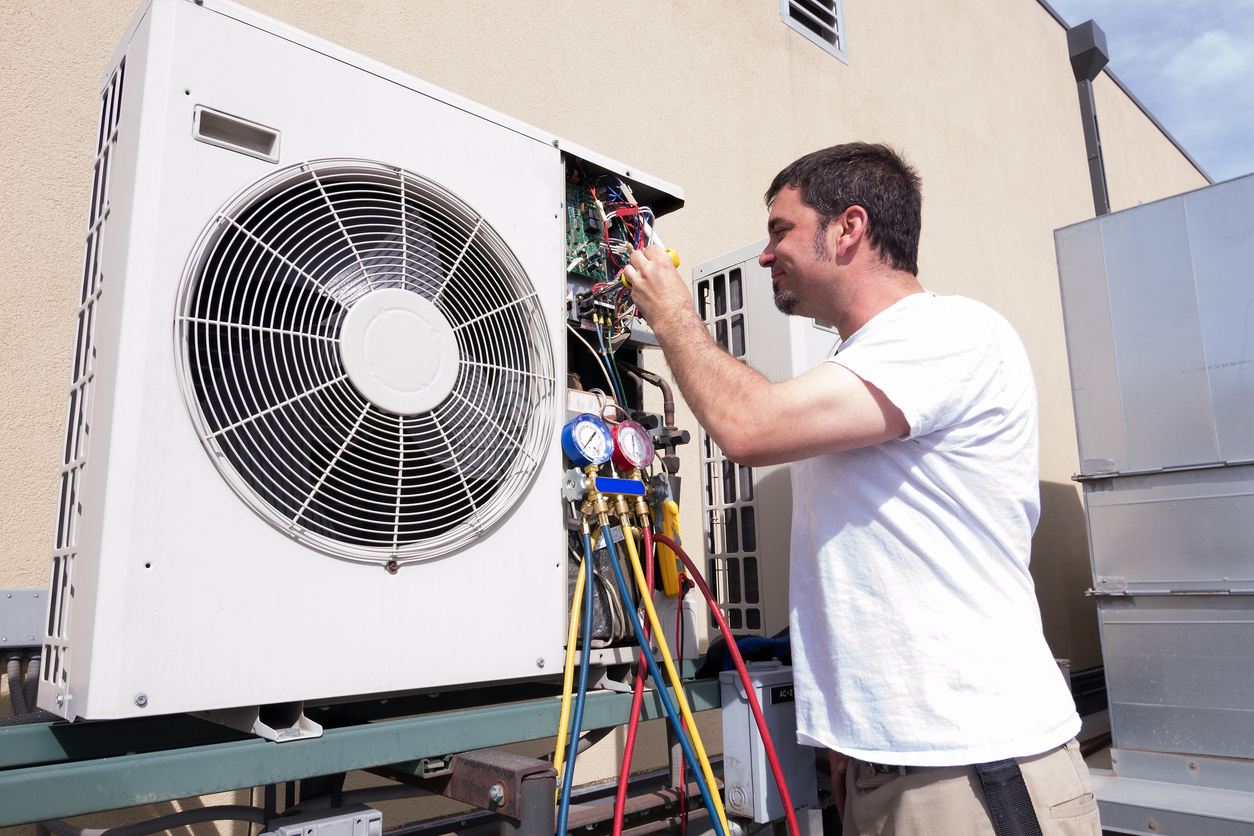
A unit that keeps switching itself off is usually not broken. It has detected a condition it was designed to shut down for. The fault is whatever created that condition, and it is upstream.
We are an independent repair company — not an authorized service center of any air conditioning brand. Brand names on this page are used only to identify the systems we repair, and all trademarks remain the property of their owners.

When an AC keeps switching itself off, the instinctive conclusion is that the unit is failing. Usually the opposite is true: it is doing precisely what it was designed to do.
Air conditioners carry protection devices that monitor conditions and shut the system down when one goes outside safe limits. High pressure. Freeze conditions. A full condensate pan. Sensor readings out of range. Each exists to prevent expensive damage, and each will stop the machine rather than let it run into harm.
So a short-cycling unit is generally reporting that a monitored condition has gone wrong — and the shutdown is the report, not the fault. The actual fault is whatever created that condition, and it is upstream.
This distinction has a practical consequence. Resetting the unit, or replacing the protection device that keeps operating, addresses nothing. The condition is still there, so the shutdown recurs — and in the meantime every restart puts the compressor through another high-load start.
Which is why our diagnosis here has two steps rather than one: identify which protection operated, then find what triggered it.
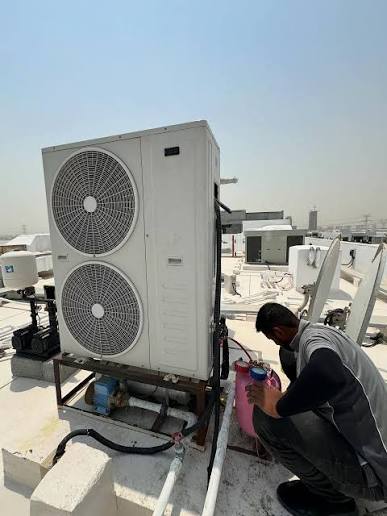
Roughly in the order we find them in Dubai. The first is by far the most common here.
A fouled condenser cannot shed heat at peak ambient. Pressure climbs, protection operates, it cools slightly and restarts. The afternoon-only pattern.
Restricted airflow drops the coil below freezing, so the system shuts down to prevent icing. Filters and blower condition come first.
A full drain pan trips a safety switch to prevent an overflow. The unit is fine; the drain is blocked.
A thermistor reading incorrectly makes the system believe a condition exists that does not, or satisfy far too early.
In direct supply airflow, in a corridor, or orphaned into a small space by a fit-out. It satisfies on a temperature that is not the room.
Cools to setpoint too fast to run a proper cycle. Cold but clammy air, and no component replacement will fix it.

If your system runs happily in the morning and starts cutting out from early afternoon, that pattern alone narrows the diagnosis substantially.
Your condenser rejects heat into outdoor air. It does that by running hotter than the surrounding air, so the hotter that air becomes, the harder the job gets. At 45 degrees the working margin is already slim.
Now add a coil with dust and sand packed into its fins. Airflow through it collapses, so the refrigerant cannot condense at the temperature it should, and head pressure climbs. In the cool of morning there is still enough margin to cope. By mid-afternoon there is none, pressure passes the protection threshold, and the system shuts down.
It then sits, pressure falls as things cool, and it restarts — only to repeat. That is textbook short cycling driven by heat rejection, and it usually resolves with proper condenser cleaning rather than any component.
There is a warning attached. Every one of those cycles is a high-load compressor start, and between them the compressor has been running at elevated pressure and current. A system left short cycling through a Dubai summer is being consumed. The protection is buying you time to act, not solving the problem.
These details narrow the diagnosis before we arrive, so they are worth noting.
Points hard at heat rejection — a fouled condenser or restricted airflow around the outdoor unit. The most common case in Dubai.
More likely a sensor, thermostat placement or sizing issue than a pressure problem, since ambient is not the deciding factor.
Classic oversizing or very short cycles. Cooling happens; dehumidification needs sustained runtime and never gets it.
Different fault. A lockout that latches, or an electrical problem rather than a cycling protection device.
Also different — that is an electrical fault, and the trip timing tells its own story.
Check this. A float switch cutting the unit on a full pan is a drainage repair, not a refrigeration one.
Two steps, in that order. Skipping the second is why short cycling so often returns after a "repair".
Where the answer is sizing rather than a fault, we say so plainly. No part replacement can fix a unit that is simply too large for the space.
Back to the main service page, or straight to the underlying cause.
Showing a code rather than just a symptom? Start here. Decode Your Error Code →
Our full AC service — split, window, ducted and chilled-water systems across all four emirates.
The fix for the afternoon cut-out, and the job that protects the compressor.
Where freeze protection is the device operating, and why it is usually airflow.
If it trips the breaker rather than simply stopping, that is a different fault entirely.
A float switch cutting the unit on a full pan is a drainage repair. The full decision tree.
Where short cycling left unaddressed eventually leads, and why the cause must be fixed too.
It means the system is starting and stopping far more frequently than it should, running for a short period rather than completing a proper cooling cycle. A healthy air conditioner runs long enough to bring the space down to temperature and then rests. A short-cycling unit runs a few minutes, stops, and starts again shortly after. The distinction matters because it tells you the shutdown is being triggered by something other than the room reaching its setpoint — usually a protection device responding to a condition it was designed to prevent.
Yes, and that is the reason not to live with it. The heaviest electrical and mechanical load on a compressor occurs at start-up, so a system that starts many times an hour is accumulating far more of that stress than one running normal cycles. It also runs less efficiently, because a short run never reaches steady-state operation, and it dehumidifies poorly, which is noticeable in Dubai humidity. A unit that short cycles all summer is being worn out faster than one simply running for long periods.
That timing points strongly at heat rejection, and it is the most common cause we find here. As ambient temperature climbs past the mid forties, a condenser that is partly blocked by dust and sand can no longer shed heat properly. Head pressure rises, and eventually a high-pressure protection device operates and shuts the system down. Once it cools slightly the pressure falls and it restarts — then repeats. In the cooler morning there is enough margin to run normally, which is exactly why the pattern is time-of-day dependent.
It can be, and there are two versions worth distinguishing. A thermostat with a drifting or faulty sensor may read the room as satisfied when it is not, cutting the cycle short. Separately, a thermostat located in the wrong place — in direct airflow from a supply grille, in a corridor, or orphaned into a small space during a fit-out — will satisfy quickly on a temperature that does not represent the room you care about. The equipment is fine in both cases; the control input is wrong.
Yes, and it is worth knowing because no component replacement will fix it. A unit with substantially more capacity than the space needs cools the air to setpoint very quickly, satisfies the thermostat and shuts off before it has run long enough to do a proper job. The room feels cold but clammy, because dehumidification needs sustained runtime and never gets it. If diagnosis points to sizing rather than a fault, we will tell you that honestly rather than selling you parts that cannot address it.
No. Each restart puts the compressor through another high-load start into conditions that have not changed, so repeated resetting adds wear without addressing anything. If the unit is cutting out on protection, the sensible course is to stop using it and get the cause diagnosed, particularly during peak summer when the underlying condition is most severe. If it cuts out and will not restart at all, or trips the breaker rather than simply stopping, leave it off and tell us — that is a different fault.
Resetting it treats nothing. We identify which protection operated and what triggered it, with the price agreed before any work.
How many minutes before it cuts out, whether it restarts by itself, and whether it only happens in the afternoon heat.
+971 50 988 6591
Daily, 8:00 AM – 6:00 PM
+971 50 988 6591
Send a photo of the unit and any code showing