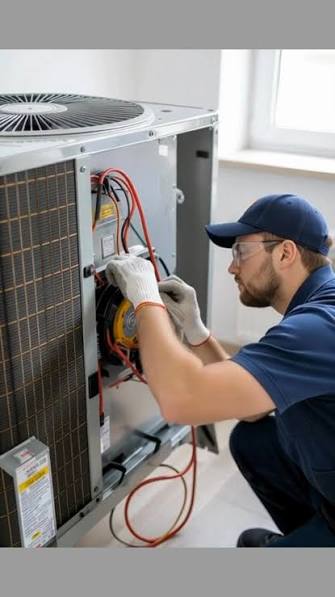
Grinding, humming, rattling and banging are four different faults, not one complaint. Describing the sound accurately gets you a much faster and cheaper diagnosis than saying the AC is noisy.
We are an independent repair company â not an authorized service center of any air conditioning brand. Brand names on this page are used only to identify the systems we repair, and all trademarks remain the property of their owners.

When an AC is making noise, the description you give is doing more diagnostic work than you might think. Grinding, humming, rattling and banging point to four separate mechanisms, with four different repairs and four very different costs.
Grinding or squealing is mechanical wear â a bearing that has lost lubrication and is running rough. It tends to rise and fall with fan speed, and it gets worse with use.
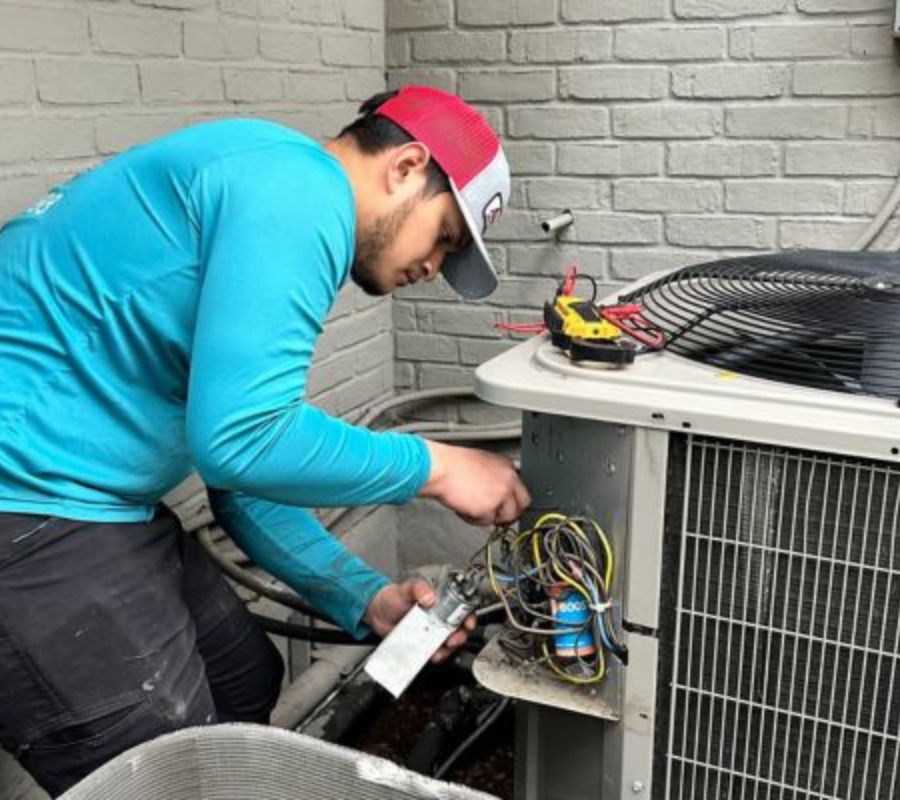
A steady hum with nothing turning is electrical, not mechanical. The motor has power but cannot start, and the usual cause is a weak capacitor â one of the cheapest parts on the machine.
Rattling is vibration: a loose panel, a fixing that has worked free, or debris inside the outdoor casing. Frequently the least expensive of the four.
Banging or knocking in the ceiling, in a chilled-water building, is water hammer from a control valve closing too abruptly â a hydraulic effect rather than a fan or motor problem at all.
So the most useful thing you can do before booking is listen properly. What kind of sound, indoors or outdoors, and when â on start-up, continuously, or as the unit cycles. A short video with sound is even better, and we are happy to receive one.
Find the description closest to what you are hearing. The likely cause and its urgency follow from it.
Failed motor bearing. Rises and falls with fan speed. Not field-serviceable on these motors, so the motor is replaced. Do not keep running it.
Motor powered but unable to start. Almost always a weak capacitor. Cheap to fix, and routinely misdiagnosed as a failed compressor.
Loose panel, a fixing vibrated free, or debris inside the outdoor casing. Often intermittent because it depends on fan speed.
Water hammer in a chilled-water building. The control valve is closing too fast, hunting or worn. More pronounced on higher floors.
Airflow forced through a restriction â a choked filter, a crushed duct, or grilles blocked or partly closed after a fit-out.
Hardened mounting rubbers or loose brackets transmitting normal vibration into the building structure instead of absorbing it.

Of all the sounds on this page, the steady hum is the one worth understanding in detail, because it is the one that costs people the most money unnecessarily.
A single-phase motor cannot start on its own. It needs a capacitor to shift the phase of part of its winding current and create the rotating field that produces starting torque. When that capacitor's capacitance has drifted well below its rated value, the motor receives full power, produces no useful torque, and sits there humming while drawing heavy current.
To anyone standing beside it, that is indistinguishable from a mechanically seized motor or a failed compressor. And a compressor is among the most expensive components on the machine, so the difference between those two diagnoses is very large indeed.
Telling them apart takes a meter and about two minutes. Accepted tolerance on a capacitor is roughly six percent, so a 45 microfarad part should read somewhere around 42 to 48. Below that it is failing. Bulging or oil weeping means replace it regardless of the reading.
There is one more trap worth knowing. A compressor with a tripped internal thermal overload reads as open circuit and mimics total failure perfectly â then recovers once it cools. Any honest diagnosis lets a hot compressor cool and re-tests before condemning it.
Not every noise is an emergency, and not every noise can wait. Here is the honest ranking.
Any electrical or burning smell alongside a noise means switch off at the breaker and do not restart until it has been inspected. This is the one genuine stop-now case.
A motor drawing locked-rotor current heats very quickly. Leaving it humming for hours risks turning a cheap capacitor job into a motor or compressor job.
A failing bearing deteriorates every hour it runs, and a seizure can damage more than the motor itself. Book promptly rather than living with it.
Not dangerous, but the repeated shock loading gradually damages the valve and pipe joints. It is cheaper to correct early.
Ordinarily fine to run while you arrange a visit, though worth checking nothing is loose enough to fall into the fan.
Not urgent, and often resolved substantially by a proper clean, balance and service rather than by replacing parts.
Some of these sounds only occur on one of Dubai's two cooling technologies, which itself narrows the diagnosis.
There is no compressor and no refrigerant in a district-cooled apartment, so compressor and refrigerant noises simply do not apply there.
Back to the main service page, or straight to the repair your sound points to.
Showing a code rather than just a symptom? Start here. Decode Your Error Code →
Our full AC service â split, window, ducted and chilled-water systems across all four emirates.
The fix for a hum with no rotation, and the cheapest meaningful AC repair there is.
What a hum gets misdiagnosed as. Read this before agreeing to one.
Whistling and rushing air mean a restriction. This is where that leads.
For chilled-water apartments, where valve noise and valve faults live.
Water hammer is a high-rise signature, most pronounced on upper floors.
Grinding or squealing almost always means a bearing has failed in a fan or blower motor. The bearing has lost its lubrication and the shaft is now running rough, which is why the noise typically rises and falls with fan speed. On the small motors used in domestic air conditioning these bearings are not field-serviceable, so the honest answer is that the motor is replaced rather than repaired. It is worth acting on promptly, because a seizing motor draws rising current and can take other components with it.
It sounds alarming and it is usually one of the cheapest faults on the machine. A steady hum with no rotation means the motor is receiving power but cannot develop enough torque to start, and the most common reason by far is a run capacitor that has drifted below its rated value. That is a small, inexpensive part. The same symptom is regularly reported to homeowners as a failed compressor, which is one of the most expensive repairs there is, so the capacitor gets measured before anything else is discussed.
In a chilled-water building that is water hammer. Your fan coil unit is fed through a motorised control valve, and when that valve closes quickly the moving column of water stops abruptly and sends a shock through the pipework. It is more pronounced on higher floors where the pressure difference across the valve is greater. The valve or actuator is usually closing too fast, hunting, or worn. It is worth fixing, because the same shock loading gradually damages the valve and the joints around it.
Rattling is usually the most benign category and often the cheapest to resolve. The common causes are a loose service panel or grille on the outdoor unit, fixings that have vibrated free, or debris sitting inside the outdoor casing where leaves, packaging or small objects have found their way in. Because it is vibration-related, it frequently appears only at certain fan speeds or during start-up, which is exactly why it can be maddeningly intermittent. It is worth reporting even if it comes and goes.
It depends which noise. Rattling is usually safe to run briefly while you arrange a visit. Grinding is not â a failing bearing is deteriorating every hour it runs, and a motor that seizes can damage more than itself. A steady hum with no rotation should be switched off promptly, because a motor drawing locked-rotor current is heating rapidly. And any burning or electrical smell alongside noise means switch it off at the breaker immediately and do not restart it until it has been inspected.
It is common, but it is not something you have to accept. Gradual noise increase usually reflects accumulated wear and dirt rather than a single fault: bearings slowly drying out, a blower wheel unbalanced by a coating of grime, mounting rubbers hardening and transmitting more vibration into the structure, and fan blades collecting deposits that upset their balance. Several of those are addressed by a proper clean and service rather than parts, and a system that has never been deep cleaned often becomes noticeably quieter afterwards.
Grinding, humming, rattling or banging â and whether it comes from indoors or outdoors. Two details, and we arrive with the right parts.
What kind of noise, whether it is indoors or outdoors, and when it happens â on start-up, all the time, or when the unit cycles.
+971 50 988 6591
Daily, 8:00 AM â 6:00 PM
+971 50 988 6591
Send a short video with sound if you can