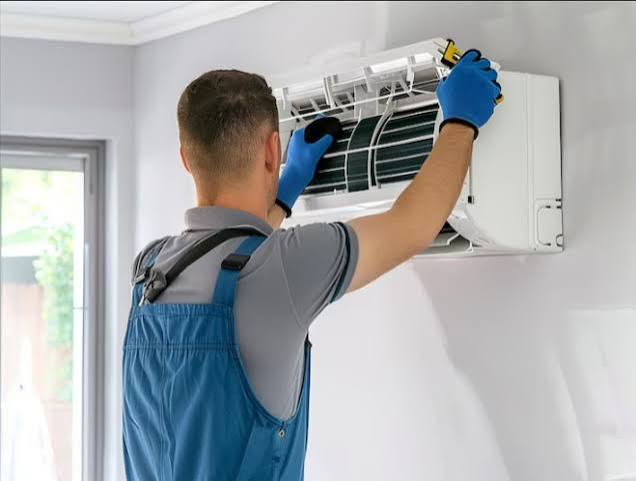
Downtown towers are tall, and height changes the problem. High differential pressure across control valves produces noise, hunting and wear you simply do not see in a low-rise building.
We are an independent repair company â not an authorized service center of any air conditioning brand, and not affiliated with or appointed by Tabreed, Emaar or any district cooling provider. Brand and utility names appear here only to describe the systems we service.

AC repair in Downtown Dubai is fan coil unit work, because these towers are served by district cooling â the Downtown scheme is majority-owned by Tabreed. Chilled water arrives from a central plant and a concealed unit in your ceiling passes room air across a water coil. There is no refrigerant and no compressor in your apartment.
What makes Downtown distinct from the other chilled-water districts is vertical scale. A supertall or high-rise building has to distribute water across a large pressure range, which means pressure zoning and balancing. The consequence at apartment level is that the small motorised valve feeding your coil may be working against a much higher differential pressure than the same valve in a six-storey building.
That produces a specific family of faults you rarely see elsewhere: valves that hunt rather than settle, valves that slam shut and send a bang through the pipework, accelerated wear on valve seats, and floor-to-floor variation where one apartment underperforms while the rest of the stack is fine.
Add concealed units above high-specification gypsum ceilings, often with minimal access provision, and you have the two things that define working here: a pressure-related fault set, and the most demanding access conditions in the city.
Six faults account for most of our Downtown call-outs. Note how many of them trace back to pressure rather than to the unit itself.
A bang in the ceiling as the control valve closes against high differential pressure. Irritating, and it slowly damages the valve and its joints.
The actuator cannot settle, so cooling surges and fades. Often read as a thermostat fault when the valve and its control are the real issue.
Neighbours are fine, you are warm. A partially passing valve, a blocking strainer or a fouled coil on your branch alone.
Blocked condensate line or a dried trap. Cheap to repair, expensive to make good in a high-specification ceiling.
Concealed units finished without adequate access. Reaching the unit means careful opening, which we flag before starting rather than mid-job.
Fine dust felts the coil face and loads the blower. Airflow falls quietly, and in a hotel-standard apartment the noise rises with it.

Most Downtown complaints â noise, surging cooling, an apartment that will not hold temperature â converge on one component: the two-way chilled-water valve and the actuator sitting on top of it.
The sequence matters. First, is the thermostat actually sending a signal? Second, is the actuator physically stroking through its full travel, or is it stalling part-way? Third, is the valve and its strainer passing water freely, or is there silt restricting it? Those three checks separate a dead thermostat from a failed actuator from a blocked strainer â three different repairs at three very different costs.
On the noise side, a valve that slams rather than closing progressively is what creates water hammer. Sometimes that is a worn actuator; sometimes it is a control setting that makes the valve act as an on-off device when it should modulate. Either way, replacing the thermostat â the common first guess â changes nothing.
This is also why we ask which floor you are on. High-floor apartments in a tall stack sit at a different point in the pressure regime than low-floor ones, and that context genuinely informs the diagnosis before we arrive.
Access here takes longer than the repair. We would rather set that expectation than pretend otherwise.
Noise, poor cooling, or water. Plus the floor, because height is genuinely diagnostic in a tall stack.
Contractor registration through community management, a booked service-lift slot, concierge coordination, and in some towers restricted working hours. We arrange it and tell you the realistic timeline.
If the concealed unit has no adequate access provision, we tell you what opening is needed and what making good involves â before any ceiling is touched.
Thermostat signal, actuator stroke, valve and strainer flow, coil and filter condition, temperature difference across the coil, drain pan and line.
Fault, fix and cost agreed up front. If the problem is a building riser or plant matter, we say so plainly and you owe nothing for a repair we did not make.
Parts and labour carry a 90-day warranty. If the same fault returns inside that window, so do we.
District cooling has a firm ownership boundary. Knowing where it sits saves everyone a wasted appointment.
We are not affiliated with, appointed by, or acting for Tabreed, Emaar or any district cooling provider. Those names appear only to describe how the district is cooled.
Back to the main service page, or straight to the symptom your system is showing.
Seeing a code on the display? Find out what it means before you call. AC Error Codes Explained →
Our full AC service â split, window, ducted and chilled-water systems across all four emirates.
Ceiling stains above concealed units â the four causes and how we tell them apart.
The ranked cause list, and what "not cooling" means on a chilled-water system.
Weak air from the grilles, and the loaded blower wheel almost nobody cleans.
Same-day cover across the neighbouring tower districts.
That is water hammer, and it is far more common on high floors than low ones. Your fan coil unit is fed by a chilled-water branch controlled by a motorised valve. In a tall tower the pressure difference across that valve can be considerable, so when it closes quickly the moving column of water stops abruptly and the shock travels through the pipework as a bang. The valve or its actuator is usually either closing too fast, hunting between open and shut, or worn. It is fixable, and it is worth fixing because the same shock loading wears the valve and the joints.
In a supertall building, pressure and flow are not identical on every floor, and the balancing that compensates for that can drift or be disturbed. A valve that is partially passing, a strainer starting to block, or a coil that has fouled will show up as one apartment underperforming while the rest of the stack is unaffected. It is diagnosed at your unit: valve stroke, strainer condition, coil cleanliness and the temperature difference across the coil, measured rather than assumed.
Honestly, Downtown has the strictest access regime we work under anywhere in Dubai. Expect contractor registration through community management, a booked service-lift slot, concierge coordination, and in some buildings restricted working hours. A further practical issue is that concealed ceiling units were sometimes finished without adequate access panels, so reaching the unit can require careful opening and making good. We tell you before we start if that applies, rather than discovering it mid-job.
All of the residential stock, including the Burj Khalifa district and the Opera District, the Boulevard buildings, Old Town and Souk Al Bahar, South Ridge, Burj Views, Standpoint and the Address residences. Give us the building name and the floor when you book. Downtown has clusters of similarly named towers and the loading and service entrances differ considerably between them.
It deserves quick attention, because the finishes here make the consequences expensive rather than because the fault is unusual. The cause is almost always the condensate drain: the pan under the concealed unit has filled because the line is blocked or the trap has dried, and the overflow soaks into the gypsum. In an apartment with designer ceilings and concealed lighting, the repair itself is modest while the making-good is not. Switch the unit off at the thermostat and call.
No, and we will tell you that before taking a booking. The district cooling provider owns and maintains the central plant up to the energy transfer station, and the building owns the pumps, risers and heat exchangers beyond it. We work on the fan coil unit inside your apartment. If cooling has failed across multiple apartments or the whole tower, the fault is upstream of anything we can lawfully or practically touch, and community management is who you need.
Tell us the building and the floor. We know the access process here and we arrive knowing what high-rise pressure does to a control valve.
Building name, floor number, and whether you have noise, poor cooling or water. High floors and low floors in the same tower behave differently.
+971 50 988 6591
Daily, 8:00 AM â 6:00 PM
+971 50 988 6591
Send a photo of the thermostat and the ceiling grille