Musty, sour, chemical or burning are four different smells with four different causes, and one of them means switch the unit off immediately. Describing it accurately matters more than you would think.
We are an independent repair company — not an authorized service center of any air conditioning brand. Brand names on this page are used only to identify the systems we service, and all trademarks remain the property of their owners.

When an AC smells bad, the source is almost always a surface that is meant to be wet and has stayed wet long enough for something to grow on it.
Cooling air means condensing moisture out of it. That is not a side effect, it is how dehumidification works — the coil runs below the dew point and water forms on it, collects in a pan beneath, and drains away. In Dubai humidity the volume of water involved is considerable.
Dust that gets past the filters settles on those wet surfaces. Damp plus organic material is all biofilm needs to establish, and once it does it colonises the coil face, the drain pan and the inside of the drain line. Every time the fan starts, air passes across that growth on its way into your room.
Which is why the smell is usually strongest in the first minutes after start-up, and why it recurs no matter how often you change the filters. The filters are not where it lives.
It is also why a spray cannot solve it. Deodorising the airflow masks the smell for a day. The growth is still there, still on the coil, still being blown into the room the moment the fragrance fades.
Find the closest description. One of these means stop using the unit immediately.
The classic. Biofilm on the coil, in the pan and along the drain line. Strongest on start-up. Unpleasant, not dangerous, and fully fixable.
Not the coil. A dried-out drain trap letting waste odour travel back up the condensate line. Restoring the trap is the fix.
Switch off at the breaker. Can indicate overheating windings, a failing capacitor or scorched wiring. Do not restart until inspected.
Worth investigating properly rather than ignoring. Could be residue from a previous aggressive clean, or something requiring closer inspection.
Occasionally something has entered an outdoor unit or duct run. Unpleasant but straightforward once located and removed.
After a long idle period, settled dust burning off surfaces. Usually clears within minutes. If it does not, it is one of the above.

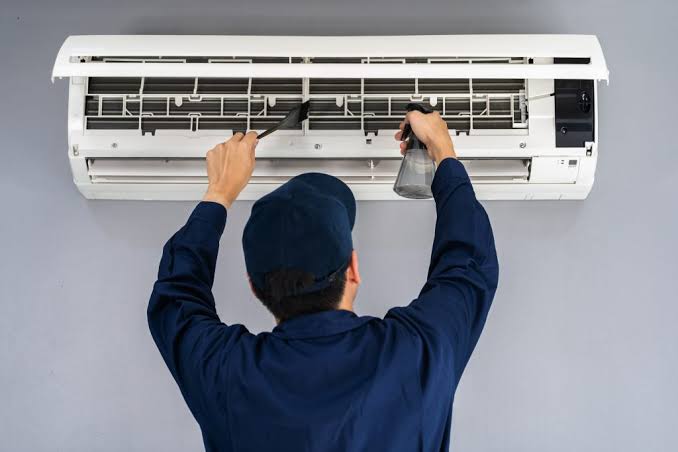
Treating an odour properly means going where the growth is, and that means opening the indoor unit rather than spraying into a grille.
The coil face gets a chemical wash with an appropriate non-corrosive cleaner, allowed to dwell and rinsed at low pressure. High pressure folds the fins and permanently reduces airflow, which makes the underlying conditions worse rather than better.
The blower wheel is cleaned blade by blade. This is the step most often skipped, and on a smelly system it matters twice over — the wheel holds its own damp coating of grime, and a caked wheel reduces airflow, which keeps the coil wetter for longer.
The drain pan is cleaned and sanitised. This is where standing water sits and where growth is usually heaviest.
The drain line is flushed so water actually leaves rather than lingering in the pipe, and the fall and trap are checked, because a line that holds water will simply re-colonise.
Do all four and the thing producing the smell is gone rather than covered. Do only the first and you have treated the visible surface while leaving the wettest parts untouched — which is why some cleans fix a smell for a few weeks and no longer.
A clean removes what is there. These are the conditions that decide how quickly it returns.
Standing water in the pan between cycles is the single biggest factor. If the line has poor fall or no working trap, growth returns quickly whatever you clean.
Filters do not stop biofilm, but they reduce the organic material reaching the wet coil. In this climate they load faster than most schedules assume.
A restricted system keeps the coil colder and wetter for longer. Cleaning the blower wheel is part of the odour fix, not an optional extra.
Running the fan briefly after the cooling cycle helps dry the coil. Some systems do this automatically; on others it is a habit worth adopting.
An unused unit lets the drain trap dry out, which is how sewer odour finds its way back up the line. Worth knowing before a long absence.
Going into the humid months with clean, free-draining surfaces is far more effective than reacting once the smell has established.
The mechanism is the same on both Dubai cooling technologies, because both have a wet indoor coil.
Nothing about an odour diagnosis involves refrigerant on either system type, so this should never lead to a gas quotation.
Back to the main service page, or straight to the service that removes the source.
Showing a code rather than just a symptom? Start here. Decode Your Error Code →
Our full AC service — split, window, ducted and chilled-water systems across all four emirates.
The deep clean that removes the growth — coil, blower wheel, drain pan and line.
A pan that will not drain is both an odour source and a leak risk. The full decision tree.
Restricted airflow keeps the coil wetter for longer, which is why the two problems travel together.
If a burning smell was followed by the unit stopping, start here after switching off at the breaker.
Chilled-water units suffer the same wet-surface growth, with heavy condensate volumes.
Because biological growth has established on damp surfaces inside the indoor unit, and the first rush of air carries it into the room. Your cooling coil is wet by design — condensing moisture out of the air is how it dehumidifies — and in Dubai humidity those surfaces stay damp for long periods. Dust that gets past the filters settles on them, and damp plus organic material is all that biofilm needs. The smell is strongest on start-up because the growth has been sitting undisturbed and the initial airflow lifts it.
It masks it for a day or two and changes nothing. The growth producing the odour is on the coil face, in the drain pan and along the drain line, not in the ductwork where the spray lands. Deodorising treats the air rather than the source, so as soon as the fragrance dissipates the smell returns unchanged. Some aerosol products can also leave a residue on the coil that traps more dust. The durable fix is removing the growth: wash the coil, clean the blower wheel, clean and sanitise the pan, and flush the line.
No, and please treat it differently. A burning, hot-plastic or electrical smell means switch the unit off at the breaker and do not restart it until it has been inspected. That smell can indicate overheating windings, a failing capacitor, scorched wiring or a component running far hotter than it should. Unlike a musty smell, which is unpleasant but not dangerous, this one warrants stopping immediately. Call us and describe exactly what you smelt and when.
Three local conditions combine against you. Humidity is high for much of the year, so indoor coils produce large volumes of condensate and surfaces stay damp. Ambient dust loads are heavy, which means plenty of organic material settling on those damp surfaces. And systems run long hours across a five-month summer, so there is little opportunity for anything to dry out fully. Add a drain line sitting warm in a ceiling void and you have close to ideal conditions for biofilm.
It can be, and it is worth distinguishing because the fix is different. If the condensate drain connects into a waste system and the trap has dried out — which happens when a unit sits unused for a period — sewer odour can travel back up the drain line and out through the indoor unit. That smells sour or sewage-like rather than musty and damp. The fix is restoring the trap and its water seal rather than cleaning the coil, so telling us which of the two smells you have genuinely changes the visit.
We are a repair company rather than a health authority, so we will stay in our lane and say what we can stand behind. What we can tell you is mechanical: biological growth on a wet coil and in a drain pan is being blown into your living space, and a system in that condition is also usually suffering restricted airflow and reduced cooling because the same surfaces are fouled. Removing it improves the machine measurably. For anything about health effects, ask a medical professional rather than a technician.
We remove what is producing the smell rather than masking it — coil, blower wheel, drain pan and line. Price agreed before any work.
Musty and damp, sour, chemical, or burning? And is it worst on start-up or constant? Those answers point in genuinely different directions.
+971 50 988 6591
Daily, 8:00 AM – 6:00 PM
+971 50 988 6591
Tell us the smell type and when it is strongest