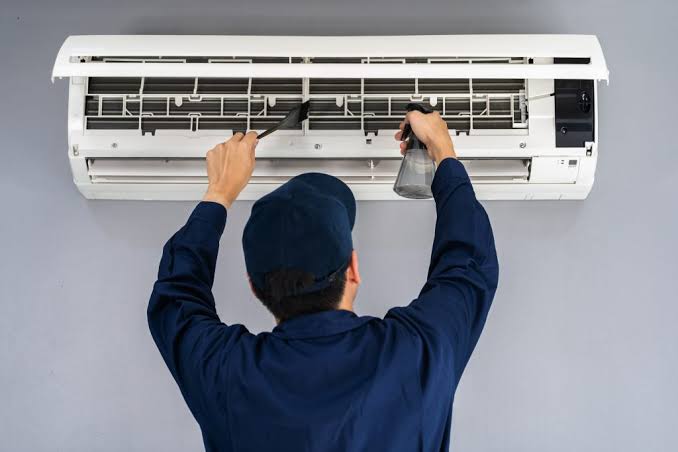
Most indoor units that drip do not need a new pan. They need the line cleared properly and the fall corrected. We tell you which one you are looking at before quoting either.
We are an independent repair company โ not an authorized service center of any air conditioning brand. Brand names on this page are used only to identify the systems we repair, and all trademarks remain the property of their owners.

AC drain pan replacement in Dubai is quoted far more often than it is actually needed, and the reason is that a blocked line and a failed pan produce exactly the same thing in your living room: water where it should not be.
They are not the same job. Clearing a condensate line means drawing the blockage out, flushing the run and treating it so it does not immediately regrow. It is a service visit. Replacing the pan means getting to the tray that sits directly under the cooling coil, and on most indoor units the coil has to come out to do that. It is a strip-down.
The price difference is substantial, which is why we diagnose the condensate path first and quote afterwards. In the large majority of dripping units we attend, the pan is entirely sound and the line is the problem.
We would rather tell you that and do the smaller job. A company that quotes a pan replacement for every leak is not diagnosing, it is guessing in its own favour.
Where the pan genuinely has failed โ corroded through, cracked, or distorted so it no longer falls toward the outlet โ we will say so and explain what the replacement involves before you commit.
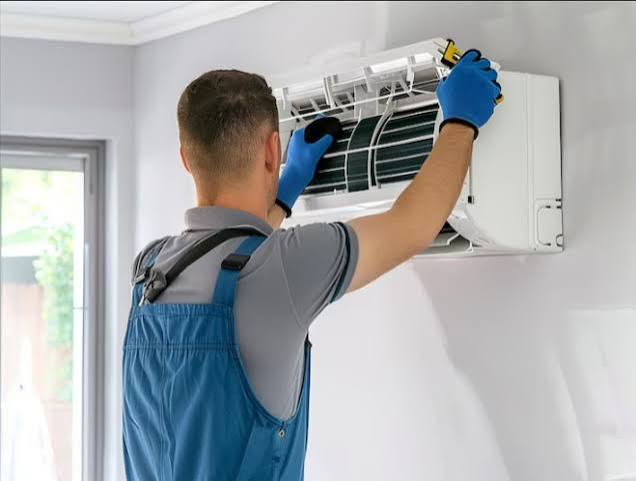
Each one separates a blocked line, a design fault, and a genuinely failed pan.
Water poured into the pan should run away steadily. If it backs up, the line is blocked and the pan is probably fine.
The whole run checked for level sections, sags between clips and unnecessary bends. This is what makes blockages come back.
Cleared and dried before judging. Corrosion and cracks are invisible while a pan is holding standing water.
Lifted by hand to confirm it interrupts the circuit. A unit stopping on its own is often this device working correctly.
Dripping at the wall penetration is usually failed pipe insulation sweating, which is not a drain fault in any way.
Where a condensate pump is fitted, the reservoir, float and discharge are checked separately from the gravity run.

Condensate volume follows humidity rather than running hours, and that single fact explains most of what goes wrong with drains in this city.
Air conditioning cools air below its dew point. Moisture condenses onto the coil, runs down into the pan and leaves through the drain. On a humid coastal day a domestic indoor unit can shed a genuinely surprising quantity of water, which is why people notice heavy dripping from the outdoor end of the pipe and assume something is wrong when the system is behaving exactly as designed.
That volume matters because everything the air carries with it โ dust, fibres, the fine sand that gets everywhere here โ ends up in the pan. Combine that with water sitting at ambient temperature in a dark pipe and you have ideal conditions for biofilm, the soft slime that closes condensate lines. It grows faster in warm humid conditions than it does in temperate climates.
So drains here need clearing more often than the manufacturer literature written for cooler markets suggests. That is normal maintenance rather than a fault. What is not normal is a line that blocks again within a few months, and that almost always points at inadequate fall rather than at how dirty your air is.
Clearing from the wrong end drives the blockage further in, and skipping the treatment step means it returns.
Power off, and the area below the unit covered. A blocked line releases the water it has been holding as soon as it clears.
A wet vacuum applied at the discharge pulls the blockage out of the pipe. Pushing from the pan end compacts it deeper into the run.
The line is flushed through to confirm it flows freely along its entire length, not just at the section that was reachable.
The pan is cleaned out and treated to slow biofilm regrowth. A cleared pipe feeding a fouled pan blocks again quickly.
The run is checked for level sections and sagging between clips. Where the fall is inadequate we say so, because cleaning alone will not hold.
The system is run so real condensate is produced, and the discharge is watched. The float switch is confirmed to reset and hold.
Where a replacement is the honest answer, and where it would simply be an expensive way to fix a cheaper fault.
We quote the diagnosis outcome, not the worst case. If the pan is sound you will be charged for the work the unit actually needed.
Back to the main service page, or to the symptom that brought you here.
Showing a code rather than an obvious fault? Start here. Decode Your Error Code →
Our full AC service โ split, window, ducted and chilled-water systems across all four emirates.
The symptom page, with the full decision tree for locating where water is escaping.
Pan and drain cleaning form part of a proper evaporator service.
In chilled-water towers the same pan sits under a fan coil unit instead.
A thawing iced coil overwhelms a pan and is often mistaken for a drain fault.
No, and this is the single most important distinction on this page because the two are priced very differently. Clearing a blocked condensate line means removing the biofilm and debris that stop water draining, then flushing and treating the line. Replacing the pan means removing the tray that sits under the coil, and on most indoor units that means dismantling the unit and pulling the coil out to reach it. One is a routine service visit. The other is a substantial strip-down. Well over four out of five units that drip need the first, not the second, so we diagnose before quoting rather than after.
Because the underlying fault is usually not the blockage itself. A condensate line drains entirely by gravity, so it needs a continuous fall along its whole length. If a section runs level, sags between clips, or has been routed with too many bends, water sits in that section between cycles. Standing water grows biofilm quickly in this climate, and the biofilm closes the pipe again. Cleaning removes the symptom and the slope recreates it. When we find inadequate fall or a sagging run, we say so plainly, because otherwise you are buying the same cleaning visit twice a year forever.
In most cases a safety device did exactly what it was designed to do. Many indoor units have a float switch in the pan that interrupts the cooling circuit when the water level rises. If the drain blocks, the level climbs, the float lifts and the unit stops before water overflows into your ceiling. So the shutdown is not the fault, it is the protection working. The actual fault is the blocked drain underneath it. Worth knowing: a unit that stops and restarts on its own after a while is often doing this repeatedly rather than having an electrical problem.
Sometimes, and we will tell you honestly which situation you are in. A hairline crack in an accessible plastic pan can occasionally be sealed and hold well. Corrosion in a metal pan generally cannot, because where you can see one perforation the surrounding metal is usually thin as well, and a patch simply moves the leak a few centimetres. A pan that has cracked because it was distorted during a previous installation will crack again in the same place. When a repair is a genuine option we offer it, because it saves you a strip-down.
Because condensate volume tracks humidity, not just running hours, and coastal Dubai humidity is high for much of the year. Air conditioning cools air below its dew point, so moisture condenses out onto the coil and runs into the pan. The more humid the incoming air, the more water is produced, which is why units here can produce a surprising quantity on a humid day even when the temperature setting has not changed. It also explains why drains block faster here than in dry climates: more water, more nutrients carried with it, and warm conditions that suit biofilm growth.
A condensate pump is used where the drain cannot fall naturally to a suitable outlet, which is common in apartments where the indoor unit sits below the drainage point. It collects water in a small reservoir and pumps it up and away. Because it is an active device rather than plain gravity, it introduces its own failure modes: the reservoir fouls, the float sticks, or the pump fails and the reservoir overflows. If your unit has one, it needs cleaning as part of routine service. If your unit drains by gravity, adding one is not usually an improvement.
We diagnose the condensate path before quoting, because a line clear and a pan replacement are very different jobs at very different prices.
Dripping from the unit itself, staining on the ceiling below it, or water at the wall where the pipes leave โ each points somewhere different.
+971 50 988 6591
Daily, 8:00 AM โ 6:00 PM
+971 50 988 6591
A photo of where the water appears helps a lot