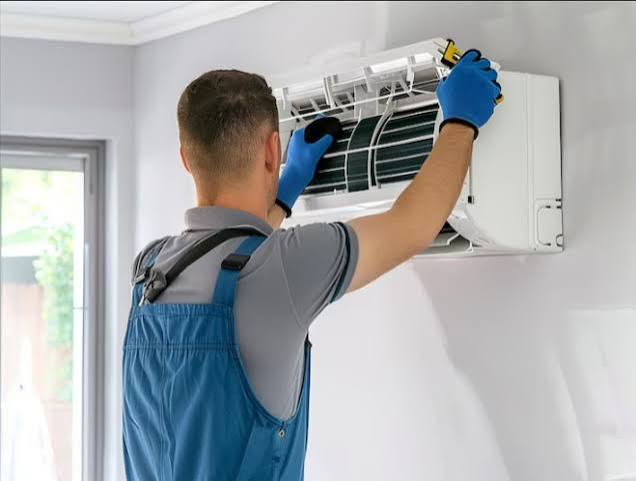
Gree units tell you something is wrong by putting a code on the indoor display. Reading that code correctly for your specific model, rather than against a generic list, is what separates a real diagnosis from a guess.
We are an independent repair company â we are not affiliated with, endorsed by, or an authorized service provider of Gree. The brand name is used here only to identify the machines we repair, and all trademarks remain the property of their owners.

Gree AC repair in Dubai has one practical advantage: most Gree splits show a code directly on the indoor unit display when a fault or protection condition occurs. You do not have to count blinking lamps or interpret a pattern. The unit puts a code in front of you.
That is genuinely useful, because a code narrows the search from the whole machine to one subsystem. What a code does not do is name the broken part. A protection code tells you the unit shut itself down to avoid damage; it does not tell you whether that was caused by a blocked coil, a supply voltage problem or a sensor reading incorrectly.
Gree is also one of the largest air conditioner manufacturers in the world, and it manufactures units sold under other brand names as well as its own. For an owner in Dubai that is quietly good news: parts commonality across the market is high, components are widely available here, and repairs tend to be straightforward to source rather than requiring a long wait for something obscure.
So the page below is organised the way we actually work on these units: read the code, then measure, then conclude â and be honest about which of those steps a generic online table can and cannot help with.
This is a deliberate editorial decision, and it is worth explaining rather than leaving as a gap.
Gree splits display a code on the indoor unit when a fault or protection condition occurs, and the scheme is structured rather than arbitrary â codes group by the kind of fault they describe, which is what makes them useful to a technician who has the correct reference for that model.
We can also tell you that the most valuable thing you can do is photograph the code together with the model number from the rating plate. With both, we can look the code up against the right reference before we arrive, and bring the parts that are actually likely to be needed.
We could not verify a complete code-to-fault table against Gree documentation for the UAE market specifically. The long Gree tables circulating online are largely copied between third-party sites and drawn from various regions and model years.
Publishing one as fact would risk pointing you at a component that is not your problem â and in air conditioning that means buying a part you did not need. So we hold to the same rule we apply to every brand on this site: publish what can be verified, explain what cannot, and diagnose your specific unit with measurements rather than assumptions.
A code tells us where to look. Measurements tell us what has failed.
With or without a code showing, this is the order a technician should work through.
Usually protection operating correctly. The question is the trigger: coil condition, supply voltage, or a sensor out of range.
On these units we check the outdoor coil and clearance before anything else, because protection-related complaints here usually trace back to heat rejection rather than to the refrigerant charge.
Capacitor value, contactor and control signal checked in order, long before the compressor is suspected.
Trip timing is the clue â instant, on compressor start, or after twenty minutes in the afternoon heat.
Blocked condensate drain, a full pan, or a dried trap. Nothing to do with refrigerant.
Obstruction first, then the motor and its capacitor, then the board output. Cheap causes before expensive ones.

Inverter air conditioners contain power electronics that are considerably less forgiving of poor supply quality than the fixed-speed machines they replaced. That is a trade-off for their efficiency, not a defect.
Where mains voltage sags under load, spikes, or fluctuates, an inverter system notices. The first symptom is usually protection operating â the unit shutting itself down rather than running in conditions that would damage it. Owners read that as unreliability. Over a longer period, persistent supply irregularity contributes to power-module and control-board damage, and those are among the more expensive parts on the machine.
This matters diagnostically because it is easy to miss. If a unit trips repeatedly, the coil is genuinely clean, airflow is good and the charge measures correctly, then continuing to replace components is not going to help. Supply quality belongs on the list.
What we do about it is check rather than speculate: incoming voltage under load, earthing quality, and the condition of terminals and connections in the outdoor enclosure, where a loose or corroded connection creates its own voltage drop and heat. Where the issue is genuinely in the building supply rather than the appliance, we will say so â that is a matter for a licensed electrical contractor, not an AC repair.
The code on the display plus the model number from the rating plate. That lets us look it up against the correct reference before we set off.
Where the unit remains inside its manufacturer cover period, using that route costs you nothing and we will point you to it.
For a protection code: coil condition, airflow, supply voltage under load, sensor resistance. The code says which system; the measurements say why.
Capacitor value against rating, current against nameplate, temperature split, and superheat with subcooling where refrigerant is involved.
Fault, fix and cost agreed before anything is dismantled. Parts commonality on Gree usually means good availability and sensible pricing.
Parts and labour carry a 90-day warranty. If the same fault returns inside that window, so do we.
âšī¸ Independent third-party repair notice: we are not an authorized service center, dealer or affiliate of Gree. We have no endorsement from them and no authorization to carry out warranty work on their behalf. If your unit is still within its manufacturer warranty period, contact the retailer or the brand's own support channel first.
Back to the main service page, compare with another brand, or read about the symptom.
Not sure the code you are seeing is on our list? Compare it across every brand. All Brand Error Codes →
Our full AC service â split, window, ducted and chilled-water systems across all four emirates.
The other large-volume manufacturer here, and why its codes must be looked up by model.
Trip timing as a diagnostic, including the supply-quality cases.
The cheapest meaningful AC repair, and the one that imitates a dead compressor.
The ranked cause list behind weak cooling, whatever the badge says.
No, deliberately, and we would rather explain the reasoning than hand you a list we cannot stand behind. Gree units do display codes on the indoor unit, and the scheme is organised in a way that is genuinely useful to a technician. What we could not do is verify a complete code-to-fault table against Gree documentation for the UAE market specifically. There are long Gree tables circulating online, copied between sites and drawn from different regions and model years. Publishing one as fact risks sending you to buy a part you do not need, so we read the code on your actual unit against the correct reference for that model and confirm it with measurements.
Not necessarily. A protection code usually means the unit has detected a condition it was designed to shut down for, and has protected itself rather than failed. That is the system working correctly. The real question is what triggered it. Common genuine causes are a condenser coil that cannot reject heat, a supply voltage problem, or a sensor reading out of range. Clearing the code without finding the trigger simply means it will happen again, usually on the next hot afternoon.
Yes, and it is worth taking seriously here. Inverter air conditioners contain sensitive power electronics, and they are less tolerant of voltage that sags, spikes or fluctuates than an old fixed-speed machine was. Persistent supply irregularity shows up first as protection trips, and over time as damage to the power module or control board. If your Gree trips repeatedly and the coil is clean and the airflow is good, supply quality genuinely belongs on the list of things to investigate rather than being dismissed.
Generally not, and there is an interesting reason why. Gree is one of the largest air conditioner manufacturers in the world and also manufactures units sold under other brand names. That means a good deal of parts commonality exists across the market, and components are widely available here. In practice, sourcing a capacitor, contactor, fan motor or sensor for a Gree split in Dubai is usually straightforward, which keeps repair costs sensible and turnaround short.
The range found in UAE homes and small commercial spaces â wall-mounted splits in both inverter and fixed-speed forms, ducted units, cassettes, and floor-standing models. Inverter and fixed-speed units behave very differently when they fail, so telling us which you have shapes the diagnosis before we arrive. Refrigerant also varies with age, with both R410A and R32 in circulation across the range.
If the unit is still within its manufacturer warranty, contact the retailer you bought it from or the brand support channel for your region first. A repair carried out by an independent company can affect that cover, and there is no sense paying for work you are entitled to have done. Our service is intended for units that are out of warranty, or where the owner has chosen to use an independent repairer. We will tell you plainly if we think the warranty is the better route.
The code plus the model number lets us look it up against the right reference for your unit before we arrive, rather than guessing from a generic table.
A photo of the code on the indoor display and the model number from the rating plate. Those two together are worth more than any description.
+971 50 988 6591
Daily, 8:00 AM â 6:00 PM
+971 50 988 6591
Send a photo of the display code and the rating plate